


Blog
Cock Rings and Erectile Dysfunction: What Product Pages Can Explain Without Promising Treatment

High-volume ED keywords can attract buyers, but aggressive health claims may misrepresent an ordinary consumer product and expose customers and retailers to unnecessary risk.
On this page 8 sections
Retailers may explain that constriction rings are used in some clinical vacuum-device systems, but they should not claim that an ordinary cock ring cures or treats erectile dysfunction without product-specific evidence and an appropriate regulatory basis. Persistent erection problems should be discussed with a healthcare professional.
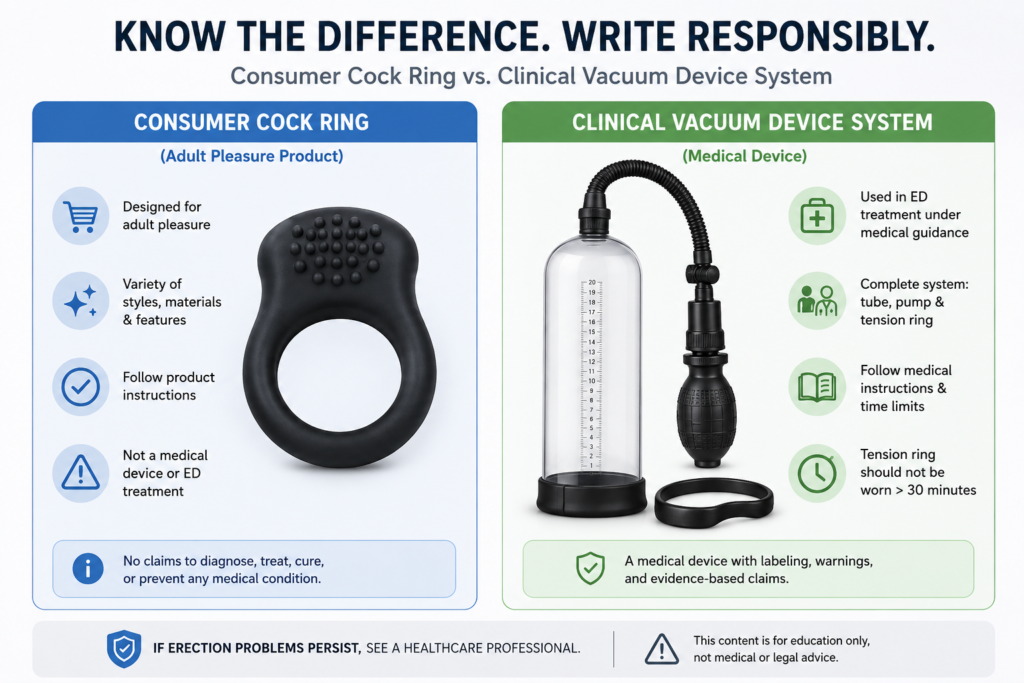
The important distinction is not simply the product’s shape. It is the product’s intended use, evidence, labeling, instructions, and regulatory position. This article provides general information for copy review, not medical or legal advice.
Why Should Sex-Toy Cock Rings and Medical Tension Rings Not Be Treated as Identical?
Similar-looking rings may appear in consumer and clinical settings, but visual similarity does not establish the same intended use or evidence.
A consumer cock ring is not automatically a medical ED device. A medical tension ring may be designed as one component of a vacuum erection system, with specific sizing, warnings, instructions, and clinical use. Retailers must classify the exact product before making any health-related statement.
The phrase cock ring for erectile dysfunction can hide several different product categories:
- An ordinary flexible ring marketed for adult pleasure
- A vibrating consumer ring
- A rigid or adjustable constriction product
- A replacement band intended for a specific vacuum erection device
- A complete vacuum erection system with a tube, pump, and tension ring
- A device recommended or prescribed by a healthcare professional
These products should not share the same copy simply because all include a ring.
The Mayo Clinic overview of penis pumps describes a vacuum erection device as a system containing a plastic tube, a manual or powered pump, and a tension ring placed at the base of the penis after an erection forms. MedlinePlus guidance on vacuum erectile devices describes the same basic system as a tube, pump, and constriction band, with the vacuum drawing blood into the penis and the band helping maintain the erection.
That system-level context matters. The ring is not described as independently diagnosing the cause of ED, creating an erection in every user, or curing the condition.
Before using terms such as ED ring, erection ring, or penile constriction ring, product-copy teams should confirm:
- What exact product is being sold?
- Is it a standalone consumer product or part of a complete device?
- What intended use appears in the supplier documentation?
- What claims are supported by product-specific evidence?
- What rules apply in each destination market?
- Do the box, manual, website, and advertising use consistent language?
If those questions cannot be answered, medical positioning should not be added merely to capture search traffic.
How Do Constriction Rings Appear in Clinical Vacuum-Device Guidance?
Clinical sources discuss tension rings within a defined process, not as interchangeable accessories that guarantee results for every person.
In vacuum erection device guidance, a pump creates a vacuum that draws blood into the penis, after which a tension ring is placed at the base to help retain blood. This may help maintain an erection, but Mayo Clinic states that a penis pump does not cure erectile dysfunction.
This is the evidence boundary copywriters often miss. An authoritative source may explain a mechanism in a complete medical context, but that does not prove that every ring sold online delivers the same result.
Mayo Clinic identifies penis pumps as one possible ED treatment and says the right treatment depends on the cause, severity, underlying conditions, and personal circumstances. ED care may also include oral medicines, counseling, injections, implants, lifestyle changes, or other approaches selected with a healthcare professional.
A retailer can accurately summarize the clinical context in educational content:
- Vacuum erection devices use negative pressure to draw blood into the penis.
- A tension ring may then help retain blood after the tube is removed.
- The ring is one component of the system.
- Outcomes vary, and correct technique matters.
- A vacuum device does not cure the underlying condition.
However, a retailer should not convert those points into statements such as:
- “Any cock ring treats ED.”
- “Guaranteed erection.”
- “Clinically proven ED cure.”
- “Works better than medication.”
- “Doctor-approved,” without documented support
- “Safe for everyone.”
- “Prevents future erectile dysfunction.”
Safety Context Cannot Be Separated From the Claim
Mayo Clinic says a tension ring used with a penis pump should not remain in place for more than 30 minutes because prolonged restriction may cause injury. MedlinePlus gives the same maximum for a vacuum erection device’s constriction band and warns that longer use may seriously bruise or damage the penis.
Possible issues associated with vacuum-device use include pain, bruising, numbness, coldness, color changes, small red spots caused by bleeding beneath the skin, and ejaculation changes. People taking blood-thinning medicine or living with some blood or bleeding disorders should speak with a healthcare professional before using a vacuum erection device.
These statements come from guidance about vacuum erection systems. Retailers should not present them as proof that an unrelated consumer ring has been medically evaluated. They can use authoritative guidance to support cautious general education while still reviewing warnings for the exact SKU.
Where Does Retail Language Cross Into a Treatment Claim?
A product description becomes a medical claim when it says or strongly implies that the product diagnoses, prevents, treats, mitigates, or cures a health condition. The FDA guidance for external penile rigidity devices addresses product design, intended use, warnings, labeling, sizing, removal, and instructions within its specific medical-device scope. An ordinary consumer ring should not borrow that positioning without an applicable product and regulatory basis.
Retail language crosses the boundary when it promises that a ring will treat ED, restore erectile function, replace professional care, or deliver guaranteed results. A mechanism statement may also become a treatment claim when the surrounding title, images, testimonials, or metadata connect it directly to a diagnosed condition.
The wording does not need to include the word “cure” to create a strong implication.
Lower-Risk Product Description
Depending on the verified SKU, copy may describe:
- Product dimensions
- Material listed in the approved specification
- Fixed, flexible, or adjustable construction
- Intended placement from the supplier instructions
- Closure and removal method
- Package contents
- Cleaning and storage directions
- Consumer-oriented design features
- Compatibility with a named system, only when verified
Claims Requiring Careful Evidence and Regulatory Review
The following phrases should not be added casually:
| Risky claim | Why it is a problem |
|---|---|
| “Treats erectile dysfunction” | States a therapeutic purpose |
| “Clinically proven ED ring” | Requires relevant product-specific clinical evidence |
| “Restores normal erections” | Promises a health outcome |
| “Alternative to Viagra” | Compares the product with prescription treatment |
| “Recommended by urologists” | Requires documented, representative support |
| “Improves penile blood flow” | Makes a physiological performance claim |
| “Guaranteed to maintain an erection” | Promises a result that varies by user and condition |
| “FDA approved” | Must never be used without exact, applicable documentation |
A disclaimer does not automatically repair an unsupported headline. Writing “not medical advice” below a claim such as “cures ED naturally” leaves the central promise intact.
Copywriters should review the whole presentation, including:
- Page title
- URL
- H1 and subheadings
- Product bullets
- Comparison tables
- Images and icons
- Customer testimonials
- FAQ answers
- Search snippets
- Marketplace attributes
- Paid advertisements
- Packaging and manuals
For more guidance on separating verified specifications from promotional wording, see our adult toy product description guide.
Why Can Keyword-Driven ED Copy Mislead Buyers?
For a broader explanation of how “cock ring,” “penis ring,” “erection ring,” and “tension ring” differ by search intent, see our penis ring naming guide. An SEO tool may recommend medical phrases without knowing whether the product has the evidence or status needed to support them.
Keyword volume does not establish claim accuracy. Using “cock ring for erectile dysfunction” as a search phrase may be appropriate in educational content, but placing it in a product name or sales promise can imply that an ordinary ring is an ED treatment.
The phrase invites a direct answer, so weak content often says, “Cock rings treat ED by trapping blood.” That advice fails for several reasons.
First, it collapses a complete vacuum erection system into one accessory. Clinical guidance explains that the vacuum creates the erection and the tension ring helps retain blood after the pump has been used.
Second, it ignores the causes of ED. Mayo Clinic explains that diagnosis may involve medical and sexual history, a physical examination, and tests for conditions such as heart disease, diabetes, low testosterone, or blood-flow problems. Treatment depends on the cause, severity, and underlying health conditions.
Third, it assumes all rings have the same fit and restriction. An ordinary flexible toy, a rigid ring, and a band engineered for a specific pump may differ in dimensions, release method, instructions, and intended use.
Fourth, it may delay appropriate care. Consistent erection problems should be evaluated because they may be associated with underlying health issues. A retailer should not tell a customer that buying a ring makes medical evaluation unnecessary.
A Better SEO Approach
Retailers can address the keyword without turning it into a product promise:
- Explain the difference between consumer and medical products.
- Describe how a tension ring appears in vacuum-device guidance.
- State that an ordinary ring is not automatically an ED treatment.
- Avoid diagnosing the reader.
- Encourage professional advice for persistent concerns.
- Link only to products whose descriptions match their verified intended use.
- Keep educational content separate from unsupported conversion claims.
This approach answers the search intent honestly. It may also attract better-qualified visitors who understand what the product does and does not claim to do.
What Are the Hidden Compliance, Trust, and Support Costs?
Aggressive copy may produce clicks, but the problems often appear later through complaints, refunds, platform reviews, and difficult health questions.
Unsupported cock ring medical claims can create regulatory scrutiny, marketplace restrictions, refunds, chargebacks, reputation damage, and unsafe customer expectations. They also force support teams to answer medical questions they are not qualified to diagnose or manage.
A customer who reads “ED treatment ring” may reasonably expect a therapeutic result. If the product is actually a standard consumer toy, the mismatch begins before the order is placed.
Refunds and Chargebacks
A buyer may say the product did not treat the condition promised on the page. The retailer then has difficulty defending the listing because the claim was broader than the product documentation.
Platform and Advertising Problems
Marketplaces, payment providers, and advertising platforms may apply special rules to medical or health claims. Product classification and claim requirements can vary by market, so businesses should obtain qualified regulatory or legal review where needed.
Reputational Damage
A wellness brand depends on trust. Unsupported claims can make accurate specifications look unreliable as well. Cautious wording is not weak marketing; it helps customers understand the product’s true scope.
Difficult Support Cases
Support staff may receive questions such as:
- “Will this cure my ED?”
- “Should I use this instead of my prescription?”
- “Is this safe with blood thinners?”
- “Why am I experiencing numbness?”
- “Which ring size will medically treat my condition?”
Customer-service teams should not diagnose, prescribe, recommend stopping medication, or decide whether a product is medically appropriate. Mayo Clinic and MedlinePlus advise people with certain blood conditions or those taking blood thinners to discuss vacuum-device use with a healthcare professional.
A suitable support response is: “We can explain the product’s verified dimensions, material, removal method, and instructions, but we cannot determine whether it is appropriate for treating a medical condition. Please ask a qualified healthcare professional about persistent ED, medicines, or personal health risks.”
A Responsible Evidence and Claims Framework for Product Pages
A repeatable review process helps teams avoid copying medical language from an unrelated product, competitor, or general health article.
Responsible copy begins by classifying the exact product, checking its intended use and evidence, separating mechanism education from treatment claims, citing authoritative medical sources, adding clear scope language, and directing persistent ED concerns to healthcare professionals.
1. Classify the Exact Product
Confirm whether the SKU is:
- A consumer pleasure product
- A standalone constriction ring
- A replacement component
- Part of a vacuum erection system
- A product with a documented medical intended use
Do not classify it based only on appearance.
2. Verify the Evidence
Collect the supplier specification, instructions, testing documents, labeling, and applicable market records. Evidence from another model does not automatically support the current SKU.
Authoritative health sources can establish general clinical context. They do not replace product-specific evidence.
3. Separate Mechanism From Outcome
“Designed to apply constriction” describes a physical feature. “Treats erectile dysfunction” states a medical purpose. Even mechanism wording should match the exact design and should not be used to imply guaranteed outcomes.
4. Review Every Claim Location
Use this checklist before publication:
- [ ] Product classification is documented.
- [ ] Intended use matches the supplier documentation.
- [ ] No cure, treatment, prevention, or guarantee is implied without a valid basis.
- [ ] Clinical evidence relates to the exact product.
- [ ] “FDA approved,” “medical-grade,” and similar terms are absent unless verified.
- [ ] Health sources are authoritative and current.
- [ ] Safety language matches the product scope.
- [ ] Persistent ED concerns are referred to healthcare professionals.
- [ ] Packaging, manual, product page, and advertising agree.
- [ ] Destination-market review has been completed where appropriate.
5. Prepare Support Teams
Give customer-service staff an approved response library. They may explain dimensions, fit range, care, package contents, and removal instructions, but they should escalate product defects and refer personal medical questions to qualified professionals.
6. Keep Consumer and Clinical Content Distinct
Our general cock ring guide covers category-level product information. ED-focused content should remain educational and should not convert every product link into a treatment recommendation.
At WMCustomDolls, we support retailers, distributors, and private label buyers with product selection, mixed orders, wholesale sourcing, and OEM or packaging coordination, depending on the product and project details. Business buyers can also review our wholesale and OEM guidance or contact our team to discuss claim-ready specification fields without implying unsupported medical outcomes.
FAQ
Can a Cock Ring Cure Erectile Dysfunction?
No cock ring should be promoted as curing ED without an appropriate evidence and regulatory basis. Mayo Clinic specifically states that a penis pump does not cure erectile dysfunction, although it may help create an erection firm enough for sex in some cases.[1] Persistent erection problems should be discussed with a healthcare professional.
Are All Cock Rings the Same as Medical Tension Rings?
No. A medical tension ring may be one component of a vacuum erection device that also includes a tube and pump. An ordinary consumer ring is not automatically equivalent merely because it has a similar shape.
What Should Retailers Say When Customers Ask About ED?
Retailers can explain verified product features and the general role of tension rings in clinical vacuum systems, but they should not diagnose the customer or recommend a product as treatment. Direct customers with persistent symptoms, medication questions, bleeding risks, pain, or numbness to a qualified healthcare professional.
Conclusion
Accurate ED copy begins with product scope, evidence, and restraint. Contact WMCustomDolls to discuss wholesale selection, mixed orders, packaging, or private label coordination.
Planning a Wholesale Order?
Share your product interests, estimated quantity and destination market with our team.
Request Wholesale Information