


Blog
Cock Ring Safety: What Buyers Should Know About Fit, Time, Removal, and Makeshift Alternatives

A ring that feels acceptable at first can become unsafe when tightness, swelling, lost sensation, or delayed removal goes unnoticed.
On this page 9 sections
Cock ring safety depends on controlled fit, limited wear time, intact sensation and circulation, and prompt removal. Remove the ring immediately for pain, numbness, coldness, marked swelling, unusual discoloration, or difficulty removing it. Never use a hair tie or another makeshift substitute.
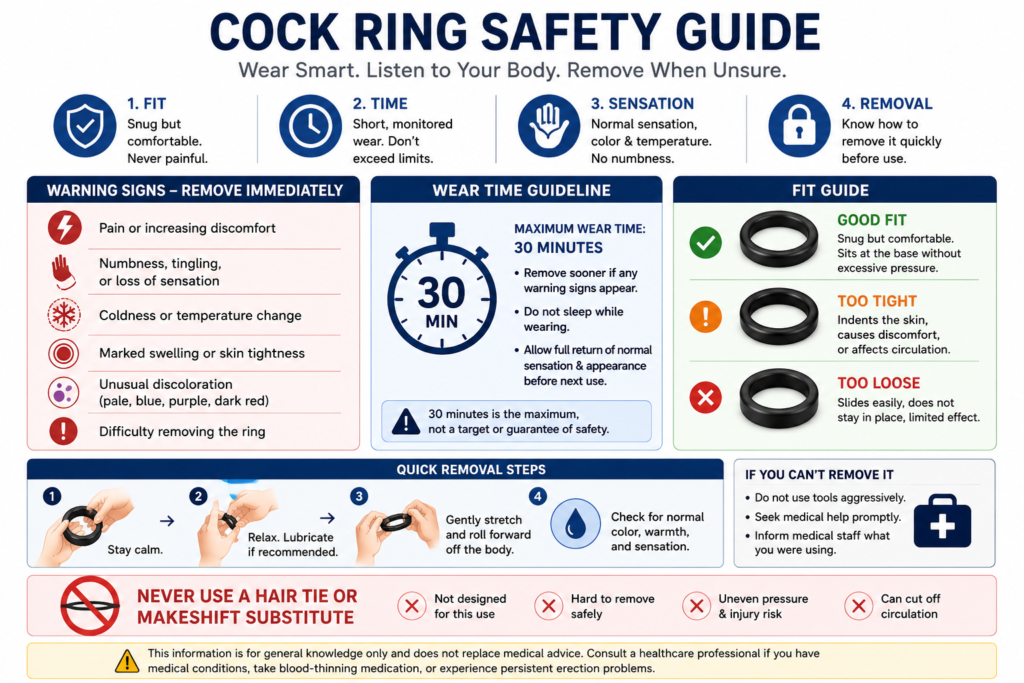
This article is for general education and does not replace personal medical advice. Product pages and packaging should give adults enough information to recognize problems early rather than relying on vague advice such as “snug but comfortable.”
Why Does Safety Depend on Fit, Time, Sensation, and Quick Removal?
A product can start with an acceptable fit but become increasingly restrictive as the body changes during use.
Safer use requires four controls: a non-painful fit, a short and monitored wear period, normal sensation without concerning color or temperature changes, and a reliable removal method. If any control is lost, the product should be removed rather than adjusted tighter or left in place.
The important issue is not the product category alone. It is whether the user retains control over tension, time, physical feedback, and removal.
A purpose-designed product should provide:
- Verified resting dimensions
- Clear material and flexibility information
- A stated placement method
- An obvious release or removal path
- A wear-time warning
- Stop-use signs
- Care and inspection instructions
- Guidance for a product that cannot be removed
Fit cannot be judged by appearance alone. A thick band may distribute pressure differently from a narrow one, while fixed, flexible, and adjustable designs can behave differently under tension. Retailers should describe the exact design instead of suggesting that one size or construction suits everyone.
“Snug but comfortable” is incomplete guidance because comfort is subjective and may change. It does not tell a first-time user how long to wear the product, what color or temperature changes matter, or what to do if swelling makes removal harder.
Sensation also matters. Pain is not the only warning. Numbness, tingling, increasing coldness, and reduced awareness can indicate that the product is too restrictive. Waiting for severe pain may delay action.
Quick removal is the final safeguard. Before use, an adult should understand how the ring comes off and confirm that any closure, tab, or adjustment mechanism works. A product that cannot be removed promptly is not an appropriate choice for experimentation.
What Does Authoritative Medical Guidance Say About Constriction-Ring Use?
Clinical guidance generally discusses constriction rings as part of vacuum erection devices, so ordinary pleasure products should not automatically be treated as medically equivalent.
Medical guidance for vacuum-device tension rings commonly sets a maximum wear time of 30 minutes, with earlier removal if pain, numbness, coldness, bruising, swelling, or concerning discoloration develops. This limit is a ceiling, not a target or a guarantee that every person or product is suitable.
Mayo Clinic describes a penis pump as a system using a tube and pump to draw blood into the penis, followed by a tension ring that helps maintain the erection. Its guidance says the ring should not remain in place for more than 30 minutes because longer use may cause injury.
That medical context is narrower than the general consumer market. An ordinary pleasure ring may not have been evaluated as part of a vacuum system, and its design may differ in dimensions, pressure, flexibility, or release method. Retailers should not borrow a clinical device’s claims, but the time and warning principles provide an important safety boundary.
A responsible cock ring wear time statement can say:
- Follow the exact product instructions.
- Never exceed 30 minutes.
- Remove it sooner if anything feels or looks concerning.
- Do not sleep while wearing it.
- Do not use it in situations where time and physical changes cannot be monitored.
- Allow normal sensation and appearance to return before considering any later use.
The 30-minute limit should never be interpreted as proof that continuous use for 30 minutes is appropriate for everyone. A ring that causes concerning symptoms after a few minutes should be removed at that point.
Medical history can also change risk. Clinical guidance for vacuum erection devices advises speaking with a healthcare professional when a person has a blood or bleeding disorder or takes blood-thinning medication, because these factors may increase bruising or bleeding concerns.
People with reduced sensation, circulation concerns, recent genital surgery, active injury, or other relevant health conditions should seek individual medical guidance before using a constriction product. Customer-service teams should not decide suitability on the customer’s behalf.
Persistent erection problems also deserve professional evaluation. Mayo Clinic notes that ongoing erectile dysfunction can relate to physical or psychological causes and may be associated with conditions such as heart disease, high blood pressure, diabetes, or certain medicines. The NHS similarly recommends seeing a GP or sexual health clinic if erection problems keep happening.
Why Can “Tighter Is Better” and All-Day Wear Advice Cause Harm?
A stronger feeling of pressure does not prove that a product is working better or that continued use is appropriate.
A tight ring can restrict circulation excessively and contribute to pain, bruising, numbness, swelling, coldness, discoloration, skin injury, or difficult removal. Extended or all-day wear removes the time control that makes prompt action possible and should not be recommended.
The phrase “tighter is better” creates a dangerous feedback loop. A user may interpret discomfort as expected, tighten an adjustable ring further, or ignore early numbness because a listing promised stronger results.
This is why tight cock ring risks should be explained through observable signs rather than general reassurance.
| Unsafe assumption | Why it fails | Better guidance |
|---|---|---|
| More pressure means better performance | Greater restriction may increase injury risk | Use only a non-painful fit that can be removed promptly |
| Numbness means the area is adapting | Lost sensation is a warning sign | Remove the product immediately |
| Darker color is always normal | Significant or worsening discoloration may indicate a problem | Remove and monitor recovery |
| Thirty minutes is a required session | It is a maximum in medical tension-ring guidance | Remove sooner for any concern |
| An adjustable ring can always be loosened later | Swelling or mechanism failure may complicate removal | Test the release and avoid overtightening |
| Sleeping in a ring saves time | Sleep prevents active monitoring | Never wear a constriction ring while asleep |
Fit may also change after placement. As swelling increases, a ring that initially seemed manageable can become harder to move. Continuing because “it was fine five minutes ago” ignores that changing fit.
A safe product description should never use phrases such as “wear as long as you like,” “all-night performance,” or “the tighter, the better.” It should not imply that numbness, major discoloration, or pain is a normal stage of use.
The user should also remain able to check time and symptoms. Alcohol or other substances may reduce judgment or awareness, making it easier to overlook warning signs. Retail content does not need to moralize, but it should not normalize use when monitoring is impaired.
Why Do Hair Ties and Improvised Rings Create Uncontrolled Risk?
A household elastic may appear similar to a flexible ring, but it is not designed, sized, labeled, or tested for genital constriction.
Using a hair tie as a cock ring creates unknown pressure, a narrow contact area, unpredictable stretching, and no designed removal system. Hair ties, rubber bands, cords, cable ties, metal hardware, and other improvised objects should not be used as penis rings.
The problem with a hair tie as cock ring advice is loss of control.
A purpose-designed product can provide an inner diameter, band width, material description, and removal method. A hair tie typically provides none of those. Its elastic may be worn, uneven, or covered by a narrow seam or metal join. Its pressure can become concentrated in a small area.
Improvised objects can fail in several ways:
- The tension is unknown.
- The band may be too narrow.
- The object may roll, twist, or tighten.
- Hair or skin may become trapped.
- Swelling may make the object difficult to reach.
- A knot or connector may not release under tension.
- The material may tear, snap, or irritate the skin.
- Cutting it away may be difficult without risking injury.
Rubber bands and hair ties may also encourage doubling or repeated wrapping. That makes the final tension even less predictable. Cable ties and rigid hardware create a more obvious hazard because they can tighten without an easy release or become trapped as swelling develops.
The low purchase cost of an improvised item does not make it a low-risk alternative. It simply transfers the cost from product design into uncertainty and possible emergency removal.
Purpose-designed does not mean automatically suitable or risk-free. Buyers should still check dimensions, flexibility, condition, instructions, and removal. However, rejecting makeshift substitutes removes several avoidable variables at once.
Our broader cock ring types, materials, and safety guide provides category-level background. This article focuses more narrowly on time, tightness, warning signs, and control.
Which Warning Signs Mean the Product Should Be Removed?
Waiting for severe pain is not a reliable safety strategy because circulation or nerve-related changes may begin with subtler symptoms.
Remove the ring immediately if there is pain, numbness, tingling, unusual coldness, marked or increasing swelling, significant discoloration, skin injury, or loss of normal sensation. Seek urgent medical help if removal is difficult or symptoms are severe or do not improve promptly after removal.
A practical warning-sign table can help consumers and support teams respond consistently:
| Sign | Immediate response |
|---|---|
| Pain or rapidly increasing discomfort | Stop and remove the product |
| Numbness or reduced sensation | Remove immediately |
| Tingling or unusual coldness | Remove immediately |
| Marked or worsening swelling | Remove immediately |
| Blue, purple, very dark, or otherwise concerning color change | Remove immediately |
| Broken skin, bleeding, or pinching | Stop use and assess the injury |
| Ring will not release or come off | Seek urgent medical assistance |
| Symptoms continue after removal | Contact a healthcare professional promptly |
Mayo Clinic lists pain or bruising, numbness, coldness, bluish or purple coloration, and small red spots caused by bleeding beneath the skin among possible effects associated with penis-pump use. These clinical observations reinforce why packaging should tell users what to watch for rather than offering only a vague comfort statement.
If a ring cannot be removed, the user should not keep waiting for swelling to settle while the product remains restrictive. Urgent medical care may be needed. Avoid using sharp or powered tools near the body in an attempt to cut off a rigid product; medical professionals may need appropriate equipment and techniques.
Medical advice is also appropriate when pain, bruising, numbness, swelling, skin injury, or discoloration persists after removal. The same applies if there are repeated problems during use.
This article cannot determine whether a symptom is serious for a specific person. When there is doubt, it is safer to stop use and seek qualified medical guidance.
Repeated erection problems should not be managed only by increasing ring tightness. Ongoing ED can have several causes, and treatment depends on the cause, severity, and underlying health conditions. A retailer can provide product information, but diagnosis belongs to healthcare professionals.
How Should Retailers Present Safety Information Without Giving Medical Advice?
A small “use responsibly” line does not give buyers enough information to prevent foreseeable misuse or help support teams handle urgent questions.
Retailers should provide verified sizing, a maximum wear-time warning, stop-use signs, a clear removal method, health-related precautions, and escalation guidance. Product copy should educate without diagnosing, prescribing, promising treatment, or claiming that a product is completely safe.
Poor safety content has costs beyond one incomplete listing. It may contribute to injury, emergency-care situations, refunds, platform complaints, reputational damage, and legal exposure. Support teams may then be asked to make medical decisions they are not trained to make.
Packaging and Instruction Checklist
Before approving a cock-ring product or private label package, confirm:
- [ ] Resting inner dimensions are verified.
- [ ] Band width and relevant thickness are listed.
- [ ] Flexible, fixed, or adjustable construction is clear.
- [ ] Intended placement matches the exact design.
- [ ] The removal method is illustrated.
- [ ] Any closure or release has been checked on the approved sample.
- [ ] The instructions say never to exceed 30 minutes.
- [ ] Earlier removal for pain or concerning changes is emphasized.
- [ ] The package warns against sleeping while wearing the product.
- [ ] Hair ties and makeshift substitutes are rejected.
- [ ] Health precautions are written without diagnosing users.
- [ ] Urgent-care guidance covers a ring that cannot be removed.
- [ ] Cleaning, drying, inspection, and storage directions are included.
- [ ] Claims match the supplier documents and destination-market review.
Medical guidance has long emphasized that users should receive information about significant risks and know what to do and whom to contact if complications occur. That principle is useful for consumer packaging even when the product is not marketed as a medical device.
Customer-Service Escalation
Support staff can explain verified product facts:
- Dimensions
- Material wording
- Flexibility
- Placement
- Adjustment method
- Removal method
- Package contents
- Manufacturer instructions
They should not tell a customer that pain or numbness is normal. They should not diagnose circulation problems, determine whether a medicine is compatible with the product, or advise someone to delay urgent care.
A suitable escalation framework is:
- Concerning symptom during use: Tell the customer to stop and remove the ring immediately.
- Product cannot be removed: Advise urgent medical assistance.
- Severe or persistent symptoms: Refer the customer promptly to a healthcare professional.
- Question about a medical condition or medicine: Explain that support cannot assess personal medical suitability.
- Repeated erection concerns: Recommend professional evaluation rather than tighter or longer ring use.
Product-Copy Review
Retailers should remove unsupported phrases such as:
- “100% safe”
- “Safe for everyone”
- “Wear all night”
- “No time limit”
- “The tighter, the better”
- “Guaranteed erection”
- “Treats circulation problems”
- “Medical-grade,” unless properly documented
- “Doctor approved,” unless the claim has a valid basis
Our adult toy product description guidance can help copy teams separate verified specifications from unsupported promotional language.
WMCustomDolls supports retailers, distributors, and private label buyers with product selection, mixed wholesale orders, packaging coordination, and OEM or private label projects, depending on the selected model and order details. Our team helps buyers coordinate product selection, customization, production, and shipping communication.
Business buyers can contact our team to discuss current product options, sample checks, instruction fields, packaging, and responsible claim review.
FAQ
How Long Can a Cock Ring Be Worn?
Do not exceed 30 minutes, and treat that as a maximum rather than a recommended target. Remove the ring sooner if there is pain, numbness, tingling, coldness, marked swelling, discoloration, or any other concern. Follow the exact product instructions and never sleep while wearing one.
Is It Safe to Use a Hair Tie Instead of a Cock Ring?
No. A hair tie has unknown tension, a narrow pressure area, no verified size, and no purpose-designed release method. Use only an intact, appropriately sized product designed for this purpose, and confirm that it can be removed promptly.
When Should Someone Stop Using a Cock Ring and Seek Medical Help?
Stop immediately for pain, numbness, coldness, significant color change, increasing swelling, skin injury, or reduced sensation. Seek urgent help if the ring cannot be removed, and contact a healthcare professional if concerning symptoms persist after removal.
Should Someone Ask a Doctor Before Using a Constriction Ring?
Professional advice is sensible for people with bleeding or clotting disorders, reduced sensation, circulation concerns, relevant genital conditions, recent surgery, or blood-thinning medication. Support teams and retailers cannot assess an individual customer’s medical suitability.
Sources
- Mayo Clinic: Penis pump
- Mayo Clinic: Erectile dysfunction — Symptoms and causes
- MedlinePlus: Vacuum erectile devices for erection problems
- NHS: Erectile dysfunction
Conclusion
Safer penis ring use requires controlled fit, short wear, active monitoring, and quick removal. Contact WMCustomDolls for responsible wholesale selection, packaging, or private label support.
Planning a Wholesale Order?
Share your product interests, estimated quantity and destination market with our team.
Request Wholesale Information