


Blog
Single and Dual Cock Rings: What Changes When a Design Adds a Second Loop

Two products may look closely related, but an added loop changes fit, tension, placement, removal, measurement, and the instructions a buyer needs.
On this page 8 sections
A dual cock ring is a two-loop fit system, not simply a single ring with an extra feature. Each opening needs verified dimensions, a stated purpose, documented stretch behavior, and a clear removal path. Buyers should compare both loops and the connector instead of relying on one overall measurement.
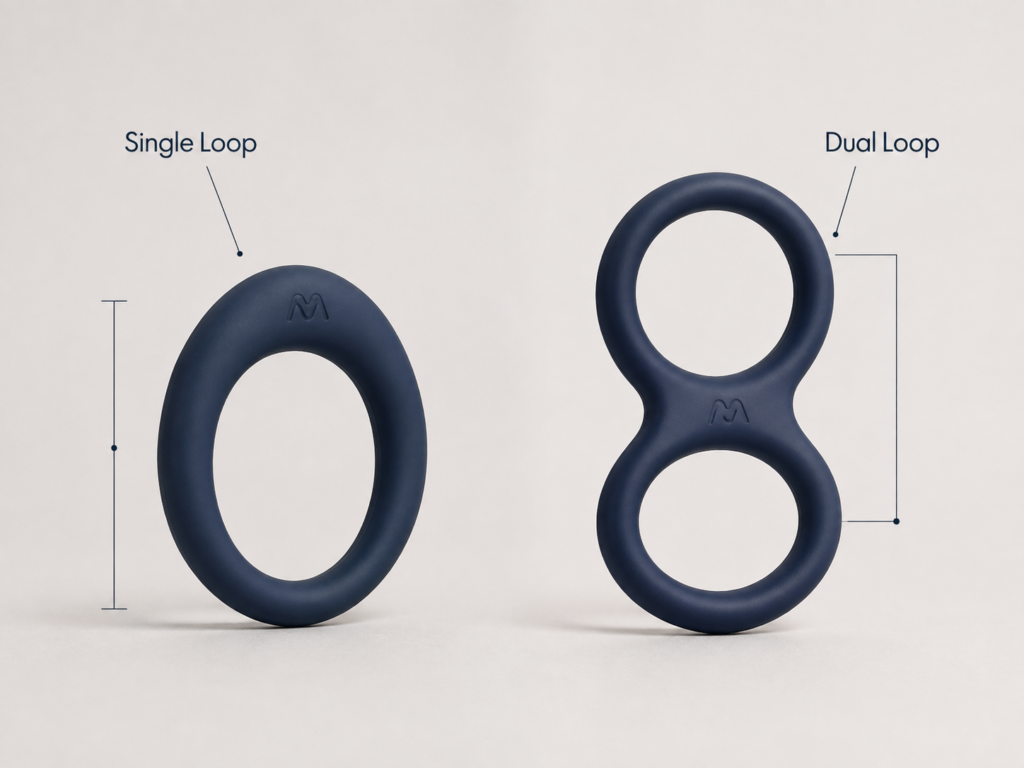
This distinction matters to consumers choosing a product and to retailers writing accurate listings. Loop count should be treated as a major design specification rather than a minor style filter.
Why Does Loop Count Change the Entire Fit System?
An extra loop creates another contact area, another fit decision, and another part that may affect how the complete product stretches or moves.
A single design applies tension through one opening, while a dual design divides its structure across two connected openings. The diameter, band width, connector, material flexibility, edge profile, and removal method of each section determine how the complete product fits.
A single measurement cannot fully describe most dual designs. An overall width may help with packaging or product photography, but it does not tell a customer the usable size of either opening.
For a double cock ring, the product specification should distinguish among:
- Primary-loop inner diameter
- Secondary-loop inner diameter
- Outer dimensions of each loop
- Band width and thickness
- Center-to-center distance between openings
- Connector width, thickness, and flexibility
- Unstretched measurement condition
- Supplier-documented stretch limits
- Material specification
- Edge profile and visible seams
- Designed placement for each opening
- Intended removal path
A connector is not just empty space between two circles. A short, thick connector can make the loops act like one rigid unit. A longer or more flexible section may let the openings move more independently. Neither arrangement is universally preferable, so the product page should describe the actual construction without promising universal comfort.
This is where many listings fail. They publish an overall length and width because those fields are already used for other products. The shopper sees a size but cannot tell whether it describes the larger loop, smaller loop, outside edge, or full structure.
For consumers, this creates incorrect expectations. For support teams, it creates questions that should have been answered before purchase. For retailers, it may contribute to avoidable returns when the product does not match the customer’s interpretation of “one size” or “dual fit.”
Single-Loop Designs: Why Are Sizing and Placement Simpler?
Even a basic ring needs accurate measurements, but one opening usually creates fewer variables for buyers to interpret.
A single cock ring is generally designed to sit around the base of the penis unless its product instructions state otherwise. Its listing should identify the inner opening, band dimensions, flexibility, measurement condition, and removal method rather than using only an overall product size.
This simpler structure makes a single cock ring easier to describe on a retail page. The buyer primarily needs to understand one opening and one designed placement.
A useful single-loop specification usually includes:
| Specification | What the listing should clarify |
|---|---|
| Inner diameter | The usable opening measured from the inside edges |
| Inner circumference | Optional, but helpful when clearly calculated or measured |
| Band width | The width of the material contacting the body |
| Band thickness | The depth or cross-section of the band |
| Measurement condition | Resting and unstretched, if applicable |
| Construction | Fixed, flexible, or adjustable |
| Release method | Stretch removal, closure, tab, snap, or another verified method |
| Material | Exact supplier-approved wording |
| Product orientation | Whether the design has a front, top, motor, or raised feature |
A single ring should not automatically be described as universal or beginner-friendly. Its suitability depends on dimensions, flexibility, edge design, removal, and the individual buyer. A simple shape can still be unsuitable if it is too tight or difficult to remove.
General cock ring placement information usually describes a single ring around the base of the penis. Consumer health guidance also notes that a properly fitting product should not cause pain and should be removed immediately if it causes discomfort or unusual coldness. This is general education, not medical advice, and buyers should follow the instructions for the exact product.
Retailers can make the design easier to compare by showing two images: a front-facing measurement diagram and a side profile. The front view explains the opening. The side view shows band thickness, raised features, closures, or a removable motor.
The listing title should also separate placement from marketing language. “Single-loop flexible ring with XX mm inner diameter” is more informative than “advanced comfort ring.” Verified measurements help customers decide; unsupported adjectives do not.
Dual-Loop Designs: Why Do Separate Dimensions and Tension Matter?
A dual product may be sold under one size name even though its two openings perform different jobs and have different measurements.
The Sexual Medicine Society of North America’s overview of penile constriction rings describes penoscrotal designs as two connected rings that encircle the base of the penis and the scrotum. For product listings, each loop should therefore have its own dimensions, stated placement role, and removal instructions.
A design described as a cock ring around penis and testicles may refer to more than one architecture. Some products use two clearly separated openings. Others use a larger surrounding band, a figure-eight layout, or a connected design in which the loops have different shapes.
That variation makes product-specific information essential.
Give Each Loop a Name
Product developers should choose consistent labels before creating the listing or manual. Possible terms include:
- Primary loop and secondary loop
- Penile loop and scrotal loop
- Loop A and Loop B
- Upper opening and lower opening
Anatomical labels may be clearer when the designed placement has been verified. Neutral labels such as Loop A and Loop B can work if a diagram explains them.
The same terminology should appear on the box, manual, size graphic, online listing, customer-service script, and sample approval form. Calling one opening the “secondary loop” on the box and the “support loop” online creates unnecessary confusion.
Record Both Sets of Dimensions
A dual-ring size table might use this structure:
| Field | Loop A | Loop B |
|---|---|---|
| Resting inner diameter | Verified value | Verified value |
| Outer diameter | Verified value | Verified value |
| Band width | Verified value | Verified value |
| Band thickness | Verified value | Verified value |
| Shape | Round, oval, or product-specific | Round, oval, or product-specific |
| Placement role | Verified intended placement | Verified intended placement |
The table is a template only. It does not contain specifications for a particular WMCustomDolls product.
Explain the Connector
The connector can change tension across the entire penis and scrotum ring. A listing should identify whether it is flexible, reinforced, hinged, molded as one piece, or connected through separate hardware.
The package should also show how the product naturally rests. A photograph can distort flexible products, so a labeled line drawing is often useful. If the two loops should not be twisted, reversed, or separated, the instructions should state that clearly.
Why Do Removal and Edge Design Need More Attention?
A product can have suitable loop measurements yet remain difficult to manage if the connector, edges, or release path are poorly explained.
Dual-ring instructions should show how each loop is released and in what order, based on the exact design. They should also identify closures, tabs, flexible edges, and connector restrictions. If pain, numbness, unusual coldness, or significant discoloration occurs, the product should be removed promptly.
Removal should be considered during product selection, not added as a short sentence after the packaging is finished.
For a single flexible ring, the removal path may be visually obvious. For a dual design, the user must understand how the two openings interact. Pulling on the wrong section could increase tension on the other loop or place unnecessary stress on the connector.
Instructions should answer:
- Does each loop stretch independently?
- Which loop is designed to be released first?
- Is there a tab, closure, snap, slider, or magnetic section?
- Can either loop be opened without stretching it?
- Should the connector be pulled or avoided?
- Is lubricant recommended for removal?
- What should the user do if prompt removal is not possible?
Packaging should never suggest using tools near the body as a normal removal method. If a constrictive product cannot be removed, urgent medical assistance may be necessary. Hard products that become trapped can cause serious injury, and medical attention should not be delayed.
Inspect the Edge Profile
A product diagram should show more than the openings. Buyers and product teams should also inspect:
- Rounded or squared edges
- Mold seams
- Flashing or rough areas
- Changes in band thickness
- Narrow points beside the connector
- Openings around a motor or attachment
- Hardware that could pinch skin
- Areas that become sharper when stretched
These checks do not establish medical safety or universal comfort. They help determine whether the submitted sample matches the approved design and whether its instructions need special warnings.
Within its specific medical-device scope, the FDA guidance for external penile rigidity devices recommends a simple and quick manual release method and advises limiting constriction-ring use to no longer than 30 minutes. Consumer-product packaging should still be reviewed for the exact design and destination market rather than copying medical-device wording without context.The exact package language should still be reviewed for the product and destination market.
How Can Generic Placement Advice Fail?
A short instruction such as “place at the base” may work for one product but leave the orientation and purpose of a two-loop design unclear.
Generic placement advice fails when it treats single and dual rings as interchangeable. A dual product needs a labeled diagram showing the intended role of both loops, product orientation, connector position, and removal sequence. Instructions should never assume that one placement works for every architecture.
A single-loop instruction often describes placing the ring around the base of the penis. A dual design commonly uses one loop around the penis and another around the scrotum, but the exact setup depends on the product’s shape and instructions.
That distinction should appear before purchase, not only on a small insert inside the box.
Why “Use as Shown” Is Not Enough
Customers may view the product page on a small screen, receive the item without its original online context, or discard the outer box. The manual must remain understandable on its own.
A useful diagram should identify:
- Loop A
- Loop B
- Intended placement of each loop
- Product front and back
- Connector position
- Motor or raised feature, if present
- Opening or adjustment method
- Removal order
The diagram can be non-explicit. A clean product outline with labels and a separate simplified placement graphic is often sufficient.
Different Designs May Suit Different Experience Levels
A flexible single loop with an obvious removal path may be easier to understand than a connected dual system. That does not make every single ring suitable for every beginner, and it does not mean dual products are inherently unsafe.
It means the product page should explain complexity honestly.
Useful retail filters may include:
- Single loop or dual loop
- Fixed, flexible, or adjustable
- Resting inner diameter
- Secondary-loop diameter
- Stretch level, when supported by verified data
- Closure or removal feature
- Vibrating or non-vibrating
- Experience level, only when the criteria are defined
- Material
- Product-specific instructions available
Our broader cock ring types, materials, and safety guide covers general category information. This comparison focuses on why a second loop requires different measurements and instructions.
A Specification Checklist for Dual-Ring Product Pages and Samples
An attractive photograph can hide missing measurements, reversed orientation, an unclear connector, or a removal process that was never tested against the manual.
Approve a dual cock ring by identifying each loop, recording its unstretched dimensions, inspecting the connector and edges, confirming stretch and removal, writing design-specific placement instructions, and checking the final packaging against the approved production sample.
A controlled specification sheet can keep purchasing, product copy, packaging, and support information consistent.
Product Configuration
- Record the exact model and SKU.
- Identify the purpose of Loop A and Loop B.
- State whether the product is one-piece or assembled.
- Identify fixed, flexible, adjustable, or powered sections.
- Record material wording from the approved supplier specification.
- Note all color and size variants.
Measurements
- Measure the resting inner diameter of each loop.
- Record non-round openings using width and height.
- Add outer dimensions where useful.
- Record band width and thickness for both loops.
- Measure connector length, width, and thickness.
- State whether every dimension is unstretched.
- Avoid copying values from a visually similar model.
Sample Checks
- Compare both openings with the specification.
- Inspect seams, edges, closures, and connector points.
- Check whether loops recover consistently after approved handling.
- Confirm the intended orientation.
- Review how each loop is removed.
- Verify that product photos show the correct version.
- Record the approved sample and revision date.
These checks do not justify unsupported durability or safety claims. They help the buyer identify differences between the sample, specification, and artwork.
Product Page and Packaging
The page should include:
- A labeled two-loop size diagram
- A clear product name
- Loop-specific measurements
- Placement description
- Material and flexibility information
- Removal method
- Cleaning and storage directions
- Exact package contents
- Relevant warnings
- Support contact path
Retail product-copy teams can use our adult toy product description guide to keep dimensions and feature wording consistent across channels.
Customer-Service Guidance
Support teams should not guess at fit or provide one script for every ring. Give them the approved diagram, dimensions, manual, and common clarification points.
A useful internal support sheet should answer:
- Which opening is Loop A?
- Which opening is Loop B?
- Where is each loop designed to sit?
- What is the removal order?
- Is either opening adjustable?
- Which dimensions are unstretched?
- What is included in the package?
- When should the customer stop use?
- What should happen if the product cannot be removed?
For health questions, support teams should avoid diagnosis. They should direct customers to stop use when concerning symptoms occur and seek qualified medical assistance when appropriate.
B2B and Private Label Review
WMCustomDolls supports brands, retailers, wholesalers, and distributors with flexible sourcing, mixed orders, packaging solutions, OEM or private label coordination, and order follow-up, depending on the selected product and project details.
For a private label dual-ring project, approve:
- Logo and product name
- Loop terminology
- Measurement diagram
- Material wording
- Placement illustration
- Warning panel
- Removal instructions
- Barcode and SKU
- Package contents
- Required languages
- Inner-pack quantity
- Master-carton label
- Manual and artwork version
WMCustomDolls lists cock rings within a broader adult toy catalog that includes anal toys, bullet vibrators, dildos, egg vibrators, suction toys, and other vibrators. Business buyers can review our cock rings wholesale category and ask our team about current mixed-order or private label options.
FAQ
Where Is a Single Cock Ring Designed to Sit?
A standard single ring is generally designed to sit around the base of the penis, but placement can differ for specialized products.Check the exact product diagram and instructions rather than applying generic advice to adjustable, powered, or multi-loop designs.
How Is a Dual Cock Ring Different From a Standard Ring?
A dual ring has two connected openings with separate placement roles. It also introduces another set of dimensions, a connector, more complex tension distribution, and a multi-step removal path that should be documented for the exact model.
What Dimensions Should Retailers List for a Dual-Ring Design?
Retailers should list the resting inner dimensions, outer dimensions, band width, and band thickness of each loop. They should also document the connector, opening shape, measurement condition, material, stretch information, and overall dimensions without using the overall size as a substitute for loop-specific data.
Conclusion
A dual cock ring needs two-loop specifications, not one overall measurement. Contact WMCustomDolls to discuss product selection, samples, mixed orders, packaging, or private label coordination.
Planning a Wholesale Order?
Share your product interests, estimated quantity and destination market with our team.
Request Wholesale Information