


Blog
Cock Ring and Butt Plug Combos: What Buyers Should Check Before Choosing a Combined Design

A cock ring butt plug combination must be evaluated as one connected system, not as two familiar toys placed together. A suitable plug and a suitable ring can still form a poor product when the connector pulls, twists, restricts removal, or creates difficult-to-clean spaces.
On this page 8 sections
Buyers should check the plug’s base and dimensions first, the ring’s fit and removal second, and then assess connector length, flexibility, movement, seams, cleaning, and instructions. A combined design is only convenient when both components fit at the same time and the connection does not create new problems.
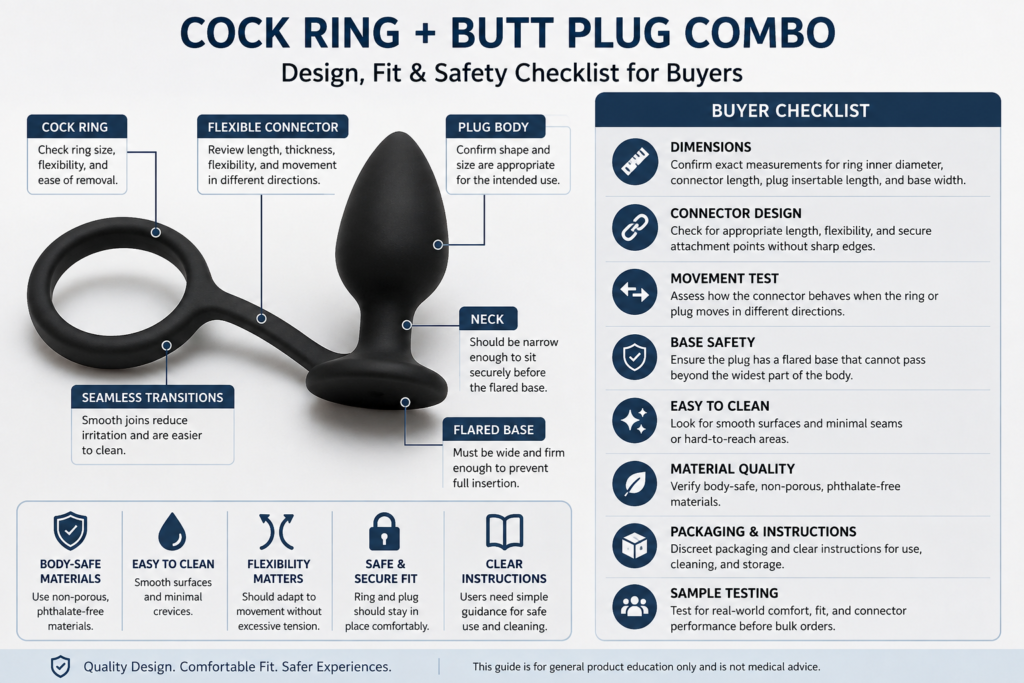
This article provides general product education, not medical advice. For broader information about each component, see our guides to cock ring types, materials, and safety and anal toy types and materials.
Why Must a Combined Product Be Evaluated as One System?
A “two-in-one” label can make a combo sound more convenient than separate products, but it says little about how the connected design behaves.
A cock ring and butt plug combo works as a system because movement at one component can transfer through the connector to the other. The connector may change ring tension, plug alignment, removal access, and cleaning, even when each component appears suitable on its own.
Buyers often evaluate the visible ends first. They check whether the plug has a flared base and whether the ring feels flexible. Those are necessary checks, but they do not answer the system-level question: what happens when both parts are positioned and the user moves?
The connector creates a mechanical relationship between two areas of the product. Depending on its geometry, it may:
- Pull the ring toward the plug
- Shift the plug base away from its intended position
- Rotate one component when the other moves
- Place continuous tension on the ring
- Fold or bunch against the body
- Limit access to the ring’s release or removal point
- Collect residue around seams or narrow junctions
This is why a soft material does not automatically mean a forgiving design. Softness is only one property. Connector length, cross-section, stretch, recovery, attachment angle, and complete product weight also affect behavior.
A useful review begins with the connected product laid out in its intended orientation. Buyers should identify the ring, connector, plug body, neck, and flared base. Product photographs should show these parts clearly from more than one angle. If the intended orientation cannot be understood from the listing or packaging, users may position the product incorrectly.
The right question is not simply, “Are both components acceptable?” It is, “Do both components remain understandable, removable, and manageable after they are connected?”
How Do Connector Length, Flexibility, and Movement Affect Fit?
The connector is easy to overlook because it is neither the ring nor the plug. Yet it often determines whether the complete design stays aligned.
A connector should provide enough reach for the intended arrangement without creating excessive slack or continuous pulling. Buyers should compare its resting length, width, thickness, flexibility, attachment points, and behavior when the two components move in different directions.
A very short connector may keep the product compact, but it can also transfer movement directly between components. If the plug shifts, the ring may be pulled. If the ring changes position, the plug base may rotate or tilt.
A longer connector may provide more movement tolerance. However, extra length can fold, twist, or create a loose section that is harder to position and clean. Longer is not automatically better.
Flexibility also needs context. A thin, highly elastic connector may stretch easily but offer limited positional support. A thicker or reinforced connector may hold its shape more clearly, but it can transmit more force. Buyers should avoid assuming that the softest version will fit every body or movement pattern.
Connector Details Worth Verifying
| Connector Detail | Why It Matters | What to Request |
|---|---|---|
| Resting length | Influences the distance between the ring and plug | Exact measurement between attachment points |
| Width and thickness | Affect flexibility, twisting, and cleaning | Dimensions at the narrowest and widest points |
| Material construction | May affect stretch and recovery | Verified material description for the connector |
| Attachment angle | Influences the intended orientation | Clear front, side, and underside images |
| Integrated or assembled design | Determines whether seams or joins are present | Construction details and close-up sample photos |
| Detachable or fixed | Changes setup, cleaning, storage, and part management | Instructions covering attachment and removal |
Movement should be reviewed gently and without treating a visual inspection as a guarantee of real-world fit. With a sample, a buyer can hold the plug base stationary and move the ring through a limited range to observe where the connector bends. The same check can be repeated while holding the ring still.
Look for sharp folding points, narrow joins, unexpected rotation, or a connector that obstructs access to either component. Product developers should also compare the sample with approved drawings or specifications. If the production sample has a different connector length or angle, the complete fit interaction may change even though the ring and plug dimensions remain the same.
Why Must the Plug Base and Ring Tension Be Reviewed Separately?
A connector does not remove the individual requirements of either component. The plug and ring must each remain suitable for their intended role.
The plug requires a clearly defined neck and a base designed to remain outside the body, while the ring needs documented internal dimensions and a prompt, understandable removal method. Connecting them does not compensate for an unclear base, unsuitable sizing, or difficult removal.
Start With the Plug
The first check is the base. It should be clearly wider than the insertable section and easy to identify in product images. Buyers should not treat the connector itself as a substitute for a purpose-designed base unless verified product information explicitly explains that construction.
Review these dimensions separately:
- Total plug length
- Insertable length
- Maximum plug diameter
- Neck diameter
- Base width and length
- Base thickness
- Distance from the plug base to the ring
- Complete product weight
Size labels such as “small,” “medium,” or “beginner” are not enough because they are not standardized. Exact dimensions provide more useful information.
Then Review the Ring
For the ring, verify:
- Unstretched internal diameter
- Band width and thickness
- Stretch or adjustment method
- Whether the ring is fixed, flexible, or adjustable
- Release or removal method
- Whether the connector blocks removal access
A soft anal play cock ring can still create excessive tension for a particular user. Fit and individual comfort vary, so retailers should not use “one size fits all” wording.
The connected design introduces one further question: can the ring be removed promptly while the plug component is still in place? Instructions should explain the intended order of removal and should not rely on pulling one component through the connector.
Users should stop and remove the product if they experience pain, numbness, coldness, marked swelling, discoloration, or other concerning symptoms. If a ring or inserted component cannot be removed, urgent medical assistance may be needed. Follow the specific product manual, and consult a qualified healthcare professional about personal medical concerns.
What Cleaning Issues Can Seams and Shared Material Claims Create?
A combined adult toy may have more surface transitions than either standalone component. Those transitions can complicate washing, rinsing, drying, and inspection.
Buyers should verify the material of every component, inspect seams and connector junctions, and confirm how the complete product should be cleaned and dried. A “silicone” headline does not prove that the ring, plug, connector, decorative parts, and adhesives all have identical construction.
A product sold as a silicone cock ring plug may be fully molded from one verified material, or it may combine silicone with another material, an internal support, coating, adhesive, or detachable fitting. Retailers should request precise material wording instead of extending one material claim to the complete product without documentation.
Pay particular attention to:
- The joint between the connector and ring
- The joint between the connector and plug base
- Mold lines around the plug neck
- Deep logos, textures, or decorative channels
- Hollow sections or openings
- Detachable fasteners
- Areas that touch when the product is folded for storage
A seamless-looking surface is not necessarily made in one piece. Buyers should inspect the actual sample and compare it with supplier documentation.
Cleaning and Drying as a System
Follow the model-specific instructions for water exposure, cleaning products, and drying. Do not assume a recommended method for one toy applies to every combined design.
The care process should answer four practical questions:
- Can every external surface be reached during washing?
- Can residue be rinsed from connector junctions and textured areas?
- Can water drain away rather than remain in folds or openings?
- Can the product dry completely before storage?
The connected shape may make drying less convenient. A short connector can keep surfaces pressed together, while a long connector may fold over itself. Packaging should explain whether the product should be laid flat, hung in a specified way, or separated if it has detachable parts.
Shared toys can transmit infections, so they should be washed before and after use and not shared without appropriate precautions; Cleveland Clinic notes that barriers may be used when toys are shared. Users should inspect the complete product before each use and stop using it if they find tears, exposed internal parts, persistent residue, or changes not covered by the manual.
Where Does Common “Two-in-One” Advice Break Down?
The phrase “two products in one” focuses on feature count. It does not show whether the two features remain compatible when used together.
Common combo advice fails when it assumes one size decision covers both components. A ring may fit while the plug does not, or the plug may suit the user while the connector makes ring removal difficult. The system succeeds only when every stage is compatible.
Several familiar claims can hide important trade-offs:
| Common Claim | What It Overlooks | Better Buyer Question |
|---|---|---|
| “Two toys for the price of one” | Both parts may not fit the same user | Are exact dimensions listed for each component? |
| “Soft and flexible” | Soft material can still pull, twist, or fold | How does the connector behave under movement? |
| “Safe flared base” | The connector may rotate or obstruct the base | Is the full base visible and independently functional? |
| “Easy to clean” | Junctions and folds may trap moisture or residue | Are cleaning and drying steps model-specific? |
| “Perfect couples toy set” | Intended users and control may be unclear | Who wears each component, and how is it removed? |
| “One size” | Ring fit and plug size are separate decisions | What are the exact unstretched and insertable dimensions? |
The hidden cost for consumers is a product that cannot be used as expected because only one component fits. For retailers, unclear geometry can create pre-sale questions, fit-related dissatisfaction, packaging confusion, and returns that are difficult to assess for hygiene reasons.
A better decision framework follows this sequence:
- Check the plug base and size. Confirm the base shape, neck, insertable length, and maximum diameter.
- Check ring fit and removability. Review internal dimensions, construction, and release method.
- Review connector length and flexibility. Look at measurements, attachment points, and bend behavior.
- Consider movement interaction. Check whether one component pulls or rotates the other.
- Verify materials and seams. Request component-specific wording and inspect junctions.
- Review cleaning and drying. Make sure all areas are accessible and the care steps are practical.
- Check instructions and packaging. Confirm orientation, fit, removal order, cleaning, and storage.
If several of these details are missing, two separate products may offer clearer sizing and more independent control than a connected design.
What Should Retailers and Private Label Buyers Check Before Ordering?
Combo products deserve a separate review because standard cock ring or anal toy templates may not capture the connector and system-level requirements.
Retailers should list each component’s dimensions, connector construction, complete orientation, removal method, material details, and care instructions. Samples should be checked as connected products before bulk purchasing or approving private label packaging.
Product Listing Checklist
A useful listing should include:
- Ring internal diameter in an unstretched state
- Ring band width and thickness
- Flexible, fixed, or adjustable ring construction
- Ring removal or release method
- Plug total and insertable length
- Maximum plug diameter
- Neck diameter
- Base dimensions and shape
- Connector length, width, and thickness
- Fixed or detachable construction
- Material wording for each component
- Complete product weight
- Model-specific cleaning and drying instructions
- Clear product-only images showing orientation
Do not place the product only under “cock rings” if customers also need to understand plug sizing and base design. A dedicated combo or couples toy set category may make comparison easier, especially when filters include ring size, plug dimensions, connector type, and material.
Focused Sample Checks
Before bulk approval, our team recommends checking whether:
- Measurements match the specification sheet
- The base is easy to identify and remains unobstructed
- The ring can be accessed and removed as described
- The connector bends without an obvious sharp stress point
- Seams and junctions are smooth and accessible for cleaning
- Detachable parts connect securely according to the instructions
- Packaging shows the correct orientation
- Material and care claims match the approved documentation
- The manual explains fitting, removal, cleaning, drying, and storage
Sample checks should document observable features, not predict universal comfort or safety. Product claims should match the approved sample and supporting information.
WMCustomDolls supports adult product categories that include anal toys, cock rings, and related toy lines, along with mixed-order and private label coordination.[1][2][3] Business buyers can review our wholesale couples toys or contact us to discuss product selection, mixed orders, wholesale sourcing, and OEM or private label requirements.
FAQ
Are cock ring and butt plug combinations safer than separate toys?
Not automatically. A connected product can introduce pulling, rotation, removal, and cleaning issues that do not occur in the same way with separate toys. Buyers should assess the plug base, ring dimensions, connector behavior, materials, and care instructions as one system. Personal fit also varies, so no combination should be presented as universally safe or suitable.
What product details matter most in a connected design?
The most important details are the plug’s insertable dimensions and base shape, the ring’s unstretched internal diameter and removal method, and the connector’s length, width, flexibility, and attachment points. Buyers should also verify component-specific materials, complete product weight, seams, orientation, and care instructions. Exact measurements are more useful than general labels such as “small” or “one size.”
How should retailers describe cleaning for combo products?
Retailers should use instructions verified for the selected model. The listing should explain how to wash connector junctions, seams, textured areas, and detachable parts, as well as how to rinse and dry the complete product. It should not claim that every silicone product shares the same care method. Packaging and online instructions should match the approved sample and material documentation.
Conclusion
A cock ring butt plug combo is not simply two established products combined. Its connector changes fit, movement, removal, cleaning, and storage. Buyers should check the plug base and dimensions first, ring fit and removal second, and connector behavior next. Materials, seams, drying, instructions, and packaging complete the decision.
Planning a Wholesale Order?
Share your product interests, estimated quantity and destination market with our team.
Request Wholesale Information