


Blog
Cock Ring Sizing Guide: What Buyers Need Beyond a Single Diameter

Choosing from one diameter can create a poor fit because that number does not explain how a ring stretches, compresses, or returns to shape.
On this page 8 sections
Useful cock ring sizing combines unstretched inner dimensions with stretch range, material behavior, ring thickness, edge profile, design type, and removal method. Two rings with the same inner diameter may fit very differently, so buyers should use verified specifications for the exact product rather than a universal formula.
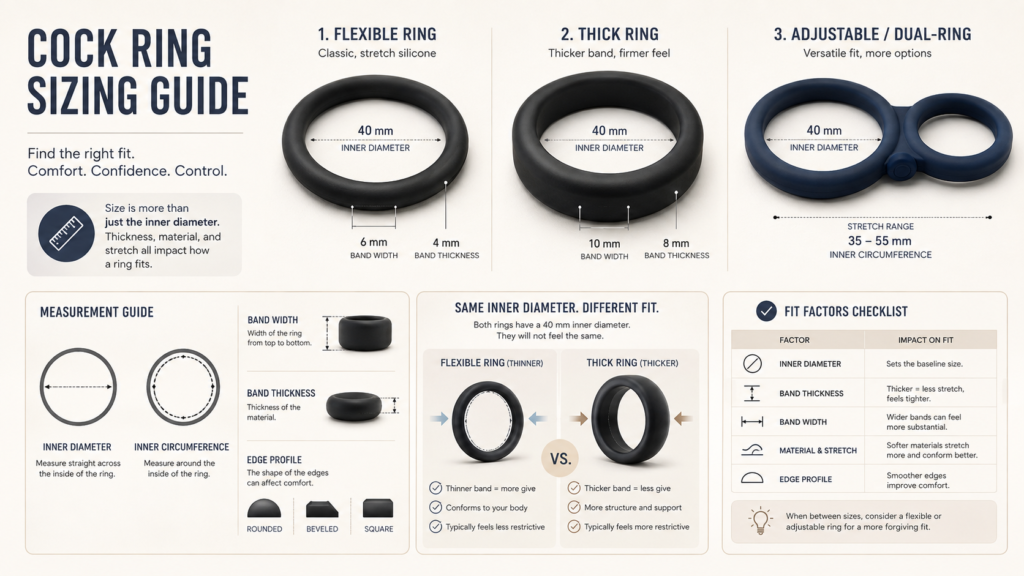
This guide focuses on sizing information rather than general product definitions or a broad materials overview. For that background, read our guide to cock ring types, materials, and safety.
Why Is Cock Ring Sizing Harder Than Reading One Measurement?
A diameter looks precise, but it can create false confidence when the rest of the product’s construction is missing from the listing.
Cock ring size cannot be predicted from inner diameter alone. Cross-section, thickness, elasticity, hardness, shape, and material recovery affect how much pressure a ring applies and how easily it can be positioned or removed.
Consider two simple rings with the same unstretched inner diameter. One may have a thin, highly flexible band. The other may have a thick, firm cross-section. Although their listed diameter is identical, they may differ in:
- The force needed to stretch them
- How much they can expand during normal positioning
- How strongly they return toward their original shape
- How pressure is distributed across the band
- How easy they are to grip and remove
- How much their edges press into the body
This is the gap in many product listings. Diameter describes the opening at rest. It does not describe the ring’s complete working behavior.
Design also changes the sizing question. A fixed ring, adjustable ring, stretchy loop, or dual-ring model should not share an identical sizing template. Medical information published by the Sexual Medicine Society of North America distinguishes fixed-diameter rings from adjustable designs with snaps, closures, or drawstrings. It also notes that simple stretchy rings are available in different sizes and thicknesses, while dual designs may encircle both the penis base and scrotum.
A useful cock ring sizing guide should therefore answer three separate questions:
- What are the ring’s dimensions before stretching?
- How does the material and design behave during expansion?
- How can the ring be removed promptly if the fit is unsuitable?
Without those answers, a number that looks exact may still leave consumers and customer-service teams guessing.
How Should Inner Diameter, Circumference, Thickness, and Stretch Range Be Recorded?
Incomplete measurements make products difficult to compare, especially when one seller lists diameter and another lists circumference.
An inner diameter cock ring measurement should be taken across the internal opening while the product is unstretched and resting in its intended shape. Listings should also provide inner circumference where useful, band thickness, band width, shape, and a verified stretch specification for that SKU.
Inner Diameter
For a circular ring, inner diameter is the straight-line distance from one inside edge to the opposite inside edge, passing through the center. The band itself should not be included.
If a flexible ring does not remain perfectly circular when resting, one number may be insufficient. Retailers can list the internal width and internal height instead, supported by a diagram that shows where each measurement was taken.
Inner Circumference
Circumference describes the distance around the inside of the ring. For a truly circular opening, circumference can be calculated from diameter:
Inner circumference = inner diameter × π
However, this calculation should not be presented as an exact physical measurement when the ring is oval, irregular, textured, or easily deformed. In those cases, suppliers should confirm how the stated circumference was obtained.
Band Width and Thickness
These terms are sometimes confused:
- Band width describes how broad the contact surface is.
- Band thickness describes the depth or cross-section of the material.
- Edge profile describes whether edges are rounded, flat, tapered, or sharply defined.
A broader contact area may distribute pressure differently from a narrow band. A thick round ring may also require more force to stretch than a thin ring made from a similar material. These factors explain why comparing diameter alone may fail.
Stretch Range
A stretchy cock ring size should not be described only as “highly stretchable.” Buyers need to know how the supplier established the stated range and whether the figure represents:
- Maximum physical extension before damage
- A recommended working range
- An adjustable closure range
- A temporary display measurement
- A verified internal diameter range for ordinary positioning
These meanings are not interchangeable. Maximum extension is not automatically a suitable wearing size. Retailers should avoid converting a dramatic laboratory or marketing stretch figure into a comfort claim.
All measurements should identify the unit used, such as millimeters or inches, and specify whether the values are unstretched, stretched, or adjustable.
How Do Material Recovery and Cross-Section Change Perceived Tightness?
The word “soft” does not reveal how a ring behaves after it has been stretched. Recovery can matter as much as initial flexibility.
Material recovery describes how strongly and quickly a stretched ring returns toward its original dimensions. Combined with hardness and cross-section, it affects perceived tightness, pressure distribution, positioning, and removal even when two products share the same unstretched diameter.
A flexible ring can require relatively little force to expand but still recover firmly once released. Another ring may feel firmer when first handled but change shape more gradually. Product descriptions should not turn either behavior into a universal fit promise.
Several properties work together:
| Product Detail | What It Describes | Why It Matters for Fit |
|---|---|---|
| Unstretched inner diameter | Opening size at rest | Provides the starting dimension |
| Material hardness | Resistance to surface indentation | Influences how firm the product feels |
| Elasticity | Ability to deform under force | Affects positioning and expansion |
| Recovery | Return toward the original shape | Influences ongoing compression |
| Band cross-section | Shape and size of the band | Changes pressure distribution and stretch effort |
| Edge profile | Shape of the contact edges | May affect comfort and ease of positioning |
| Surface finish | Smooth, matte, or textured exterior | Can affect grip during placement and removal |
Material names alone do not solve this problem. Two products described as silicone may use different formulations, hardness levels, dimensions, and constructions. Product-page writers should use the verified material specification for the exact SKU and avoid assuming that all products within a material category stretch identically.
Batch control also matters for retailers and private label buyers. If the approved sample and later production have different ring dimensions, hardness, or cross-sections, customers may experience inconsistent fit even when the product name and packaging remain unchanged. Buyers should compare production samples with the approved specification rather than relying only on appearance.
This is why how to measure for a cock ring is only half the question. Personal measurement cannot compensate for missing product data. Consumers need a reliable description of both their intended fit and the ring’s actual behavior.
Why Does “One Size Fits Most” Create Avoidable Uncertainty?
Broad sizing phrases simplify packaging, but they can hide meaningful differences between users and products.
“One size fits most” does not identify the ring’s unstretched dimensions, verified adjustment range, material recovery, or intended placement. Retailers should replace or support this phrase with exact SKU-level measurements, clear design information, and an accessible removal method.
The phrase creates several problems.
First, “most” has no defined measurement range unless the seller provides one. Customers cannot tell whether the claim refers to a highly elastic loop, an adjustable closure, or a manufacturer’s general marketing description.
Second, stretchability is not the same as suitable fit. A ring may be physically capable of expanding to a large diameter, but that does not show how strongly it recovers or whether the expanded size is intended for use.
Third, customers may interpret the claim as a comfort or safety guarantee. Individual anatomy, sensitivity, positioning, and product preferences vary, so WMCustomDolls does not recommend universal-fit language without supporting details.
Incomplete sizing information has hidden business costs. It may lead to:
- Discomfort or difficult removal
- More pre-sale sizing questions
- Customer-service escalation
- Hygiene-related return complications
- Product-page inconsistency
- Incorrect comparisons between SKUs
- Confusion when production batches feel different
- Packaging that overstates the usable size range
A better product page can say that a ring is flexible or adjustable while still listing its actual dimensions. For example, it can identify the unstretched internal diameter, closure positions, band width, and supplier-verified working information without promising that the product will fit every buyer.
For health and safety, users should follow the instructions supplied with the exact model and remove a ring promptly if it causes pain, numbness, marked swelling, coldness, discoloration, or other concerning symptoms. Rigid rings can create an entrapment risk if they cannot be removed, and the SMSNA notes that some rigid metal designs may require emergency assistance in severe cases. If a ring cannot be removed, seek urgent medical help rather than continuing to pull or waiting for the problem to resolve. This is general education, not personal medical advice.
How Can Sizing Advice Fail Across Single and Dual-Ring Designs?
A single-loop measurement cannot automatically be applied to products with two loops, attachments, closures, or asymmetrical shapes.
Sizing advice must match the product’s design. Single rings need one clearly defined internal opening, while dual-ring models require separate dimensions for each loop, their connection, intended orientation, and removal sequence. Adjustable products need closure-based ranges rather than a single diameter.
Single Flexible Rings
For a simple loop, the product page should state:
- Unstretched internal diameter
- Band width and thickness
- Cross-section shape
- Verified material
- Relevant stretch information
- Intended orientation
- Removal instructions
Even this apparently simple design cannot be understood from diameter alone. A thick circular band and a thin flat band may behave differently at the same opening size.
Adjustable Rings
Snap, drawstring, hook, or sliding closures require another approach. A useful chart should list the internal size at each closure position or the verified adjustment range. It should also show how the release works.
The SMSNA describes snap and drawstring designs as adjustable to individual anatomy and notes that easy removability is an important design feature.[1] Retail listings should still avoid treating adjustability as universal compatibility.
Dual-Ring and Penoscrotal Designs
A dual design needs at least two sets of internal dimensions. It may also require:
- Distance between the loops
- Connector width and flexibility
- Orientation diagram
- Identification of the larger and smaller loop
- Separate band dimensions
- Instructions for positioning and removal
The SMSNA identifies penoscrotal rings as two connected loops intended to encircle different areas simultaneously. Because the loops have different roles, listing one penis ring size for the complete product is not enough.
Rings With Attachments
Vibrating units or decorative attachments can affect balance, access, and removal. Product-page writers should show whether the attachment is removable and whether it blocks the ring’s release mechanism.
Common measuring advice fails when it assumes every design is a circular, independent loop. A consumer can measure carefully and still receive an unsuitable product if the listing omits the second loop, adjustment points, connector, or attachment geometry.
What Is a Better Sizing Framework for Listings, Packaging, and Support?
Consumers need enough information to compare products, while support teams need consistent terms that do not imply guaranteed fit.
A reliable sizing framework identifies the design first, records every unstretched inner dimension, documents material and stretch behavior, explains band thickness and edges, confirms the removal method, and translates verified SKU data into a clear chart.
We recommend the following sequence.
1. Identify the Design Type
State whether the product is a single flexible ring, fixed ring, adjustable ring, dual-loop design, or ring with an attachment. Avoid placing different constructions under one generic sizing statement.
2. Record Unstretched Inner Dimensions
Measure the product at rest. For circular rings, list inner diameter. For oval or irregular designs, list inner width and height. Dual designs need separate measurements for each loop.
3. Document Material and Stretch Information
Use the supplier’s verified material description for the exact SKU. State how the stretch or adjustment range was established, and do not confuse maximum extension with a recommended fit range.
4. Review Thickness and Edge Profile
List band width, thickness, cross-section, and edge shape. Clear product diagrams often communicate these details better than text alone.
5. Confirm Removal
Instructions should explain how the product opens, releases, stretches off, or separates. If the design has a closure, show it clearly instead of hiding it in lifestyle photography.
6. Build the Sizing Chart
A practical chart may use the following fields:
| Listing Field | Information to Provide |
|---|---|
| SKU or model | Exact product identifier |
| Design | Single, adjustable, dual, or attached |
| Inner dimensions | Unstretched diameter or width and height |
| Band dimensions | Width, thickness, and cross-section |
| Material | Verified SKU-specific specification |
| Adjustment or stretch | Method and documented range |
| Edge profile | Rounded, flat, tapered, or other verified shape |
| Removal | Stretch-off, snap, drawstring, hook, or other mechanism |
| Measurement tolerance | Supplier-confirmed tolerance where available |
| Units | Millimeters and inches where useful |
Retailers should sample multiple sizes when a product line offers them. Multi-size sampling helps teams compare differences in dimensions, stretch behavior, packaging labels, and removal access before placing a larger order. It cannot guarantee fit for every customer, but it can expose unclear charts and inconsistent specifications.
Product descriptions should use the same measurements as packaging and customer-service scripts. Our guide to adult toy product descriptions explains how structured, verifiable details can make listings more useful.
WMCustomDolls supports wholesale buyers with mixed product selection, OEM or private label coordination, production follow-up, and packaging support.[1][3] Retailers can also review our wholesale couples toys when comparing current product options.
FAQ
How Is Cock Ring Size Usually Measured?
Cock ring size is usually stated as the internal diameter of the unstretched opening. Circular products may also show inner circumference, while oval or irregular rings should include internal width and height. Buyers should confirm that the measurement excludes the band itself and check band thickness, material behavior, design, and removal method before comparing sizes.
Does a Stretchy Cock Ring Need an Exact Size?
A stretchy ring still needs meaningful sizing information. Flexibility may allow a wider fit range, but “stretchy” does not explain how far the ring is intended to expand, how strongly it recovers, or how pressure is distributed. Check the unstretched inner diameter, band dimensions, verified material information, stretch guidance, and removal instructions for the exact model.
What Should a Cock Ring Sizing Chart Include?
A useful chart should include the exact SKU, design type, unstretched inner diameter or dimensions, band width and thickness, material, adjustment or documented stretch range, edge profile, and removal method. Dual rings need separate measurements for both loops and their connector. The chart should also identify units and distinguish resting dimensions from stretched or adjustable values.
Conclusion
The right cock ring size cannot be predicted from one diameter or a “one size fits most” claim. Buyers need unstretched inner dimensions, material behavior, cross-section, stretch or adjustment information, and a clear removal method.
Planning a Wholesale Order?
Share your product interests, estimated quantity and destination market with our team.
Request Wholesale Information