


Blog
TPE vs Silicone Sex Dolls: Which Has the Lower Total Cost of Ownership?

A lower purchase price can lose its advantage when care, storage, handling, damage, packaging, and after-sales support create additional costs.
On this page 8 sections
Neither TPE nor silicone has the lowest total ownership cost in every case. TPE dolls often start with a lower purchase price, while silicone models may justify a higher upfront cost when their care requirements, finish, repair options, and supplier support reduce later expenses. The better-value choice depends on the exact SKU, not the material label alone.
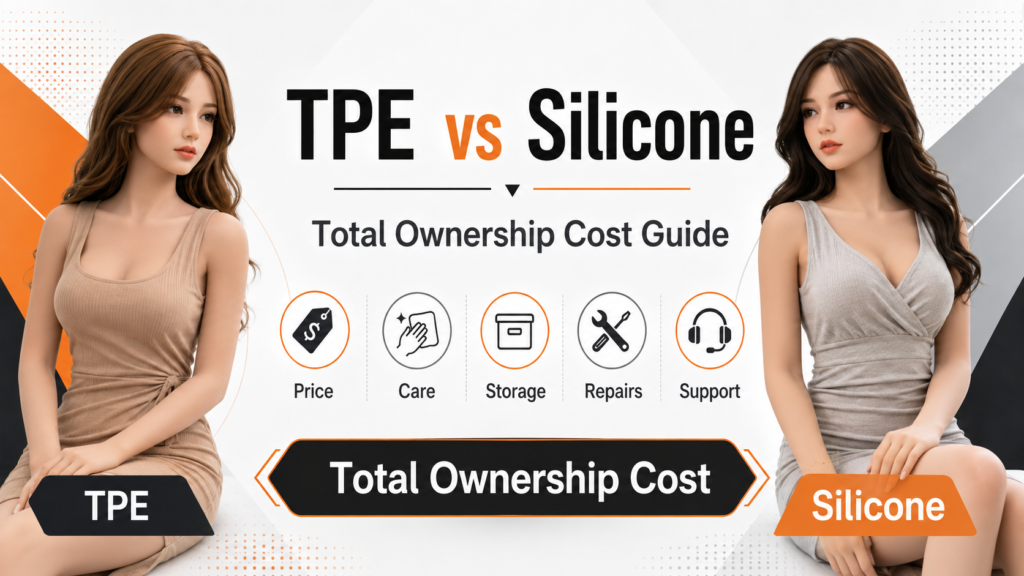
At WMCustomDolls, we treat the material label as the beginning of a comparison, not the final verdict. Our website separates TPE and silicone as material categories while also organizing dolls by brand, size, body type, price, and weight, reflecting the wider range of variables involved in product selection.
Why Is the Cheapest Material Not Always the Lowest Cost?
Headline price attracts attention, but it does not show what an owner or retailer may spend after delivery.
The lowest-priced model is not necessarily the lowest-cost model. Total ownership cost includes the product, freight, handling, cleaning supplies, storage, protective packaging, repairs, returns, staff time, and customer support required throughout the intended ownership or sales period.
A useful comparison begins with acquisition cost but does not stop there. For an individual buyer, the calculation may include:
- Product price and selected options
- Payment and currency-conversion fees
- Shipping and delivery arrangements
- Suitable cleaning and care products
- Storage equipment and protective coverings
- Handling aids, if needed
- Replacement accessories
- Available repairs and their shipping cost
- Time required for routine care
Retailers have a wider cost structure. Their calculation may include landed cost, warehouse handling, packaging materials, listing preparation, staff training, customer questions, returns, replacement parts, and after-sales coordination.
This explains why a generic claim such as “TPE is cheaper” or “silicone lasts longer” cannot settle the decision. An initial price difference is only one line in the calculation. The exact formulation, finish, body design, skeleton, joints, weight, packaging, and supplier support can change the result.
Use a simple ownership formula:
Total ownership cost = acquisition + delivery + care + storage + handling + repair exposure + support burden
Not every cost can be predicted precisely. Buyers should record confirmed costs, estimate uncertain costs as a range, and mark unavailable information for supplier verification. This is more dependable than assigning one universal winner to all TPE or silicone products.
What Can a Material Label Confirm?
A broad material name can organize a catalog, but it cannot confirm every property of a finished doll.
A TPE or silicone label identifies the supplier-stated material category. It does not automatically confirm formulation, surface finish, firmness, staining behavior, weight, joint design, cleaning compatibility, repair method, or expected lifespan. Those points require model-specific documentation.
WMCustomDolls includes silicone, TPE, and PVC as separate material categories, but its doll selection also spans multiple brands and physical specifications. This distinction matters because two models in the same material category may not be interchangeable.
What to verify for TPE material
For a model described as using TPE material, request:
- The exact component or body area covered by the description
- Supplier care and cleaning instructions
- Guidance about possible oil transfer
- Clothing and surface-contact precautions
- Approved storage position
- Recommended maintenance products
- Written repair options and limitations
- Instructions for avoiding deformation or pressure marks
TPE formulations can vary significantly across different material families and grades. Buyers should not infer a grade, composition, firmness, or staining resistance from the acronym alone. For a technical overview of how TPE chemistry and formulation affect material properties, see this thermoplastic elastomer guide.
What to verify for silicone material
For a model described as using silicone material, request the same level of detail:
- Component-level material description
- Surface finish and pigmentation information
- Model-specific cleaner guidance
- Clothing and staining precautions
- Joint and skeleton information
- Repair method and eligible damage types
- Storage instructions
- Written limitations for the finish and detailed areas
A silicone label does not prove that every component is silicone. Internal structures, joints, inserts, connectors, or other parts may use different materials. It also does not establish a universal level of durability.
For a broader discussion of silicone selection, readers can use our silicone sex doll buyer’s guide. The purpose here is narrower: translating documented product differences into ownership and support costs.
How Do Care and Storage Change Ownership Cost?
Routine care may look inexpensive until incompatible products, staining, storage space, or repeated handling add time and expense.
Care and storage affect ownership cost through cleaning supplies, drying time, surface maintenance, protective materials, space requirements, and damage prevention. Buyers should follow the manual for the exact SKU because one universal cleaner or storage method may not suit every TPE or silicone model.
The relevant question is not simply which material is “easy to maintain.” Instead, ask what the specific model requires after normal handling.
A practical maintenance cost record should include:
| Cost area | Information to verify |
|---|---|
| Cleaning | Approved method and incompatible products |
| Drying | Required process and areas needing attention |
| Surface care | Supplier-recommended products and frequency |
| Stain prevention | Clothing, fabric, and contact precautions |
| Storage | Position, support, covering, and space |
| Handling | Weight, lifting points, and joint precautions |
| Supplies | Included items and expected replacements |
Staining and material contact
Dark, highly dyed, or untested fabrics may present a staining concern for some products. The level of exposure can depend on the exact surface, pigment, duration of contact, pressure, temperature, and fabric.
Retailers should avoid statements such as “silicone never stains” or “all TPE stains easily.” Neither statement accounts for SKU-specific finishes or test conditions. Request written clothing guidance and, where practical, review current samples using a documented process before publishing a claim.
Oil transfer is another product-specific issue often associated with discussions of TPE. Buyers should request the model’s handling, storage, and surface-care instructions instead of assuming every formulation behaves identically.
Storage and handling
Storage cost includes more than an empty closet. A heavier model may need additional planning for movement, shelving, supports, or packaging. WMCustomDolls already provides weight-based navigation across its doll selection, demonstrating why weight is a distinct purchase variable rather than merely a material characteristic.[3]
For detailed routine guidance, see our silicone doll FAQs and care tips. Always give the exact model manual priority if its instructions differ from general advice.
Which Damage Risks Depend on Construction?
Material matters, but many common damage risks arise from the complete product architecture rather than the outer material alone.
Tears, pressure marks, joint damage, finish wear, connector problems, and packaging damage can depend on thickness, weight, internal structure, joints, detailed areas, handling, and storage. Compare construction and written limitations before treating material as a durability score.
For example, a thin or highly detailed area may require more careful handling than a thicker section of the same material. A heavy body can place different demands on lifting, repositioning, packing, and storage than a lighter model. Joint range and skeleton design may also influence handling requirements.
Buyers should request answers to these questions:
- Which areas need special handling?
- What is the stated joint range or movement guidance?
- Where should the model be lifted or supported?
- Which types of damage may be repairable?
- Are repair materials or instructions available?
- Does repair require return shipping?
- Which cosmetic variations are considered normal?
- Which actions may affect after-sales eligibility?
Repairs are not one standard service
A repairable surface issue on one SKU may not be repairable in the same way on another. Material formulation, color matching, finish, location, depth, embedded details, and supplier policy can all affect the available remedy.
Ask whether a repair option means:
- A buyer-applied repair kit
- Written remote guidance
- Replacement of a removable component
- Paid professional repair
- Return to a service location
- No supported repair for that damage type
The possible cost should include materials, labor, two-way shipping, customs or route-specific charges where applicable, and the time the product remains unavailable.
Packaging also influences damage exposure. Protective supports, joint positioning, internal clearance, carton strength, and handling labels may matter during shipment and storage. WMCustomDolls describes privacy-focused packaging and order coordination as part of its support for business buyers, but the available solution should be confirmed for each product and project.
How Should Buyers Compare Two Real SKUs?
Comparing broad materials encourages assumptions; comparing two documented SKUs reveals the costs that actually influence the decision.
Use the same checklist for both products: documented material, finish, dimensions, weight, care, storage, handling, repairs, packaging, warranty or support terms, and delivered cost. Mark every unsupported claim as unverified rather than filling gaps with a general material stereotype.
A side-by-side worksheet might look like this:
| Comparison field | SKU A | SKU B |
|---|---|---|
| Brand and model | Verify | Verify |
| Material scope | Exact components | Exact components |
| Surface finish | Supplier description | Supplier description |
| Dimensions and weight | Current specification | Current specification |
| Care procedure | Manual reference | Manual reference |
| Staining precautions | Written guidance | Written guidance |
| Oil-transfer guidance | Written guidance | Written guidance |
| Storage position | Defined method | Defined method |
| Handling restrictions | Defined method | Defined method |
| Repair options | Scope and cost | Scope and cost |
| Packaging | Included protection | Included protection |
| Delivered price | Product plus delivery | Product plus delivery |
| Support terms | Written policy | Written policy |
| Unknowns | List separately | List separately |
Begin with products that meet the required dimensions, weight, appearance, and configuration. Buyers can review available sex doll models before requesting model-specific documentation.
Next, estimate costs over a chosen comparison period. We do not recommend publishing a universal lifespan for either material because lifespan depends on the SKU, construction, handling, care, storage, and usage conditions. Instead, compare costs under clear scenarios.
For example:
- Low-maintenance scenario: expected supplies and standard storage only
- Moderate-cost scenario: additional care products, handling equipment, or replacement accessories
- Higher-risk scenario: one repair, extra shipping, or a support case
This does not predict what will happen. It helps buyers see whether a small purchase-price advantage remains meaningful when uncertain costs are included.
The final decision may favor TPE for one pair of models and silicone for another. That is not a contradiction. It is the result of comparing complete products instead of category slogans.
What Should Wholesale Buyers Request?
Wholesale buyers need repeatable data because one undocumented difference can affect product pages, packaging, training, returns, and customer expectations across many units.
Retailers should request a current SKU sheet, component-level materials, dimensions, weight, manuals, care limitations, repair policies, packaging details, samples, and written after-sales terms. The same approved information should be used across listings, staff guides, packaging, and customer support.
A wholesale request file should cover:
Product and material information
- Brand, model, SKU, and configuration
- Material description by relevant component
- Finish, color, dimensions, and weight
- Skeleton and joint information
- Current options and exclusions
- Sample or document revision date
Ownership and support information
- Approved cleaning and maintenance instructions
- Storage and handling guidance
- Staining and clothing precautions
- Repairable and non-repairable damage categories
- Repair materials, labor, and shipping responsibility
- After-sales evidence requirements
- Written limitations and claim procedure
Packaging and logistics information
- Product and packed weight
- Inner and outer carton dimensions
- Protective supports and included accessories
- Privacy or private-label packaging options
- Carton configuration
- Route-specific shipping considerations
- Replacement packaging availability
WMCustomDolls supports brands, wholesalers, and distributors with product selection, sourcing coordination, order follow-up, and selected packaging solutions.We also support mixed wholesale orders and OEM or private-label projects, with current options depending on the product and order details.
Retailers should calculate:
Commercial ownership cost = landed cost + warehouse handling + packaging + content preparation + staff training + expected support burden + return and repair exposure
The figure does not need to be perfectly predictive. Its purpose is to prevent a low unit price from hiding a high service burden. It also helps purchasing, content, operations, and customer-service teams work from the same assumptions.
FAQ
Is Silicone Always More Durable Than TPE?
No universal conclusion should be made from material names alone. Durability may depend on formulation, thickness, finish, internal construction, detailed areas, joints, handling, care, and storage, so buyers should compare model-specific documentation and written limitations.
Can One Cleaner Be Used for Every Material?
Not safely as a general rule. Use only the cleaning method and products approved for the exact SKU, and request written guidance when the manual does not identify compatible or incompatible cleaners.
Which Material Is Easier for Retailers to Support?
The easier product to support is usually the one with clearer documentation, stable specifications, practical packaging, defined care instructions, available repair options, and responsive after-sales coordination. Material may influence support needs, but it does not determine the entire workload.
How Can Buyers Compare Costs Without a Published Lifespan?
Use documented acquisition, delivery, maintenance, storage, packaging, and repair costs, then create low-, moderate-, and higher-cost scenarios. Avoid turning those scenarios into a guaranteed lifespan or performance promise.
Conclusion
The better TPE vs silicone sex dolls decision comes from comparing complete SKUs and support costs. Contact WMCustomDolls for wholesale, mixed-order, or OEM/private-label sourcing support.
Planning a Wholesale Order?
Share your product interests, estimated quantity and destination market with our team.
Request Wholesale Information