


Blog
Medical-Grade vs Food-Grade Silicone Bullet Vibrators: What Buyers Should Verify

Authoritative grade labels can become misleading when buyers cannot identify the silicone, formulation, evidence, tested sample, claim scope, or related production SKU.
Silicone bullet vibrator grade claims should define the exact material or formulation covered, supporting document, tested sample, and connection to the production SKU. Neither “medical-grade” nor “food-grade” automatically describes or approves the complete electronic product.
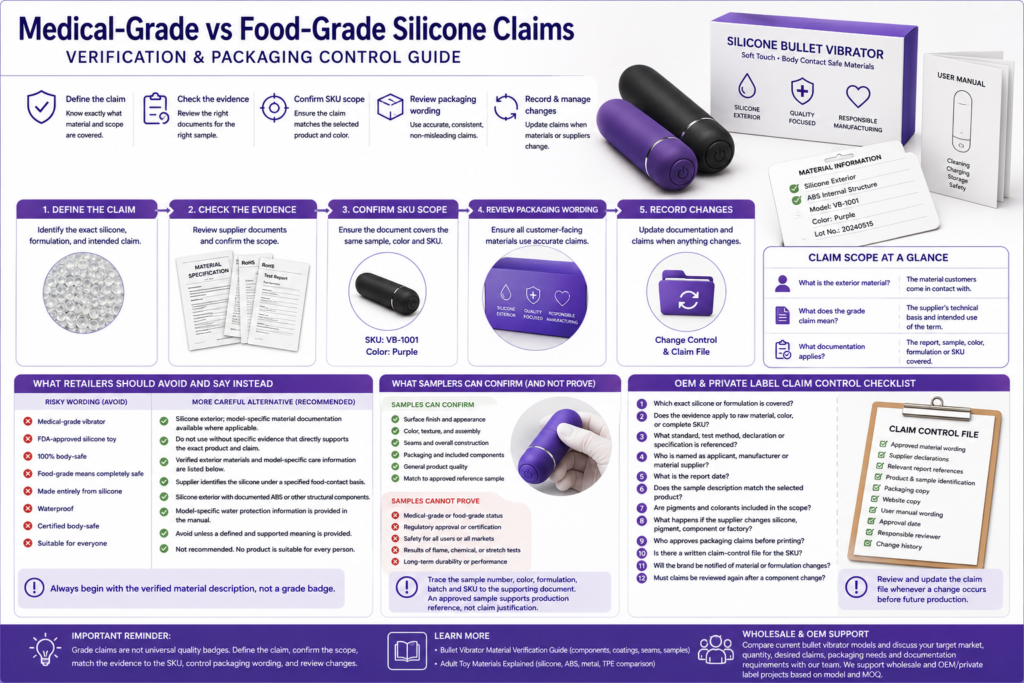
This is a claim-verification and packaging-control guide, not a general material inspection guide. For component-level construction, coatings, seams, and physical checks, see our Bullet Vibrator Material Verification guide.
At WMCustomDolls, we support wholesale buyers with product selection, customization, production coordination, and shipment communication. Our wholesale services also include mixed product selection and OEM/private label coordination, depending on the model and project details.
Why Can Medical-Grade and Food-Grade Silicone Claims Confuse Buyers?
“Medical-grade” and “food-grade” sound like universal quality levels, but their meaning depends on the referenced material, requirement, test scope, and intended application.
A grade claim may apply to raw silicone, a specific colored formulation, or another defined sample. It does not automatically cover pigments, adhesives, seals, controls, electronic parts, packaging, or the finished silicone bullet vibrator sold under a particular SKU.
The central issue is the difference between a material claim and a finished-product claim.
A material supplier may provide information about one silicone formulation under stated conditions. That information can be relevant, but it should not be expanded into a claim that the entire assembled product is medical, medically approved, food-contact approved, or suitable for every customer and market.
For example, a report may cover:
- An uncolored silicone raw material
- One specific silicone formulation
- A defined color or pigment combination
- A sample prepared by the material manufacturer
- A component submitted by the product factory
- A finished model identified by a specific SKU
These scopes are not interchangeable. Evidence for clear, unpigmented silicone may not support the same wording for a pink, purple, or black production formulation. A report covering raw silicone may not address the finished product’s pigments, adhesives, buttons, seals, charging components, internal structure, printed markings, or assembly process.
What does “medical-grade” mean in this context?
“Medical-grade” generally suggests that a material is intended to meet a defined requirement associated with a medical application or sector. However, the term alone does not identify the requirement, test method, intended contact conditions, or regulated application.
A medical-grade silicone vibrator claim does not automatically mean that the finished product is a medical device. It also does not establish medical approval, therapeutic value, suitability for every user, or approval by a particular government agency.
Buyers should ask the supplier to define the claim in writing. If the answer is simply “high-quality silicone” or “our factory always uses medical silicone,” the claim is not specific enough for packaging approval.
What does “food-grade” mean in this context?
“Food-grade” generally relates to suitability for specified food-contact applications under particular requirements and conditions. It does not automatically verify the complete construction or intended use of an adult product.
A food-grade silicone sex toy claim should not be treated as a universal safety badge. The supplier should identify the silicone, applicable basis, formulation, and scope of the evidence. Buyers must then decide whether the wording is relevant and acceptable in the destination market.
Use these three questions to keep the review focused:
| Claim-scope question | What buyers should establish |
|---|---|
| What exact material or formulation is covered? | Raw silicone, colored formulation, molded exterior component, or another identified sample |
| What does the grade claim mean? | The defined requirement, specification, declaration, or test basis behind the term |
| What documentation applies? | The report, date, applicant, sample description, color, model, and connection to the production SKU |
Acceptable wording and compliance requirements may differ between destination markets. Retailers should review the intended country, sales channel, and marketplace policies before publishing or printing a grade claim.
What Can Retailers Say Without Overclaiming?
A large grade badge can turn a narrow raw-material statement into a broad finished-product promise that the available evidence does not support.
Retailers should begin with the verified material description and add grade wording only when its scope is defined and supported. Avoid claims such as “100% safe,” “completely safe,” “FDA-approved,” or “suitable for everyone” unless directly supported by applicable product-specific evidence.
The safest product copy usually starts by telling the buyer what the exterior is made from. It can then explain any supported grade information in a limited and accurate way.
For example: Exterior material: Silicone exterior with documented structural components. Model-specific material documentation may be available where applicable. Follow the supplied manual for cleaning, charging, storage, and care.
This wording does not imply medical approval. It also avoids suggesting that every component is made from silicone.
A content team should compare proposed claims against the available evidence before approving product pages, marketplace data, or packaging:
| Risky wording | More careful alternative |
|---|---|
| Medical-grade vibrator | Silicone exterior; model-specific material documentation available where applicable |
| Medically approved silicone | Do not use unless applicable evidence directly supports the exact product and approval claim |
| FDA-approved silicone toy | Do not use without specific evidence that directly supports the exact product and claim |
| 100% body-safe | Verified exterior materials and model-specific care information are listed below |
| Completely safe for everyone | Avoid; suitability and care depend on the product, user, and supplied instructions |
| Food-grade means safer | Identify the exact food-contact basis and the material covered without making a comparative safety promise |
| Food-grade electronic product | State whether the claim applies only to a specified silicone formulation |
| Made entirely from silicone | Silicone exterior with documented ABS or other structural components |
| Certified medical-grade | Name the actual certification or evidence only when its scope and relevance have been verified |
| Chemical-free silicone | Avoid; silicone is itself a material composed of chemicals |
| Hypoallergenic | Avoid unless appropriate evidence directly supports this claim for the relevant product and market |
A statement may be technically true for a raw material but misleading when placed beside an image of the finished product. Content teams should ask how an ordinary customer is likely to understand the wording, badge, or icon.
The same control should apply to page titles, specification tables, FAQs, advertisements, marketplace attributes, and customer-service answers. Repeating unsupported wording across several channels does not make it more reliable.
When readers need a general comparison of silicone, ABS, metal, or TPE rather than grade-claim analysis, direct them to Adult Toy Materials Explained. Keeping basic material education separate helps purchasing and content teams focus on the narrower question: what exactly does this grade claim cover?
What Can Samples Confirm—and What Can They Not Prove?
A polished sample may look convincing, but its appearance cannot establish a medical-grade or food-grade classification.
Samples can confirm general construction, color, finish, assembly, seams, and packaging. They cannot independently prove a silicone grade claim, so the sample identity must be traceable to the relevant formulation, document, color, batch, and production SKU.
An approved sample is still useful. It can show whether the planned product, package, label, and printed grade wording match the version under review. Buyers may retain it as a production reference, but it does not replace relevant supplier declarations, specifications, or reports.
Informal flame, chemical, stretching, or odor tests cannot establish that silicone is medical-grade or food-grade. Such methods may damage the sample, create misleading conclusions, or introduce risks without answering the claim-scope question.
Keep this short traceability checklist with the sample:
- Supplier sample number
- Product model and SKU
- Silicone formulation or material code
- Selected color
- Sample or batch date
- Supporting document reference
- Claim scope stated by the supplier
- Approval status and reviewer
For detailed checks involving components, coatings, seams, finish, odor, or color transfer, use the separate material verification guide. Those physical checks support product approval, but they should not be presented as proof of a grade claim.
How Should Grade Claims Appear on Packaging and Instructions?
A carefully qualified website statement can still become misleading when the retail box uses a medical symbol, certification-style badge, or unsupported grade icon.
Packaging, product pages, manuals, marketplace attributes, and support scripts should use the same approved claim wording. Grade statements must identify their scope and cannot replace model-specific instructions for cleaning, charging, storage, or water protection.
Private label brands should review every place where customers, distributors, marketplaces, or authorities may encounter the claim:
- Front, back, and side panels of the retail box
- Material icons and feature badges
- Product inserts and quick-start cards
- Full user manuals
- Online titles and descriptions
- Technical specification tables
- Marketplace attribute fields
- Distributor catalogs
- Advertising graphics
- Customer-service scripts
- Wholesale quotations and sales sheets
Review graphics as carefully as words
A symbol can communicate a stronger claim than the text beside it. An unsupported medical cross may imply healthcare approval. A shield, checkmark, laboratory icon, or certification-style seal may suggest independent verification even if it is only a decorative graphic.
Brands should avoid:
- Unsupported medical crosses
- Healthcare or hospital symbols
- Certification-style seals without a defined basis
- Food-related icons that imply formal certification
- “Medical-grade certified” badges without applicable evidence
- “100% safe” or “certified body-safe” graphics
- Government-agency logos used without authorization
- Grade badges that do not identify what material they cover
If a supplier offers pre-designed packaging with these graphics, do not assume they have already been reviewed for the destination market. Ask for the basis of each claim and icon before approving artwork.
Keep wording consistent across all channels
A box that says “medical-grade silicone,” a manual that says only “silicone,” and a supplier specification referring to “food-contact silicone raw material” present three different messages. The project should be paused until the intended wording and evidence are aligned.
A simple approval matrix can prevent this problem:
| Communication point | Claim-control check |
|---|---|
| Retail box | Uses the approved material and grade wording |
| Material badge | Has a defined meaning and evidence basis |
| Product insert | Does not broaden the claim |
| User manual | Matches the model and approved specification |
| Website listing | States the claim scope accurately |
| Marketplace field | Does not force an unsupported classification |
| Customer-service script | Uses the same approved explanation |
| Wholesale catalog | Identifies the correct model and formulation |
A grade claim also cannot replace care information. The manual must still explain cleaning, drying, charging, storage, compatible products, and inspection according to the specific model.
A silicone exterior does not automatically make the complete electronic product waterproof. Water-protection wording should come from model-specific documentation, not from the silicone grade or the appearance of a sealed surface.
Before final artwork is printed, brands should send the box, insert, manual, online copy, and relevant icons through one approval process. Buyers planning branded packaging can discuss artwork and claim coordination through our OEM and Private Label support. WMCustomDolls provides privacy-focused packaging and OEM/private label coordination for selected projects, with available options depending on the product and order details.
What Should OEM and Private Label Buyers Approve Before Bulk Production?
Printing before claim approval can create avoidable packaging waste, delayed launches, listing revisions, and inconsistent distributor information.
OEM buyers should approve the claim definition, evidence scope, sample linkage, production SKU, packaging wording, responsible reviewer, and change-control procedure before bulk production. Every grade claim should have a written record showing why it was accepted and when it must be reviewed again.
Start with specific questions rather than asking only whether the silicone is “medical-grade” or “food-grade”:
- Which exact silicone material or formulation is covered?
- Does the evidence apply to raw material, the selected color, a molded part, or the complete SKU?
- What standard, test method, declaration, or supplier specification is referenced?
- Who is named as the applicant, manufacturer, or material supplier?
- What is the document or report date?
- How is the tested or declared sample identified?
- Does the sample description match the selected product?
- Are pigments and colorants included within the documented scope?
- Is the production factory using the same formulation as the reviewed sample?
- Does the claim apply to every color or only specified colors?
- Are adhesives, seals, controls, and other components outside the claim scope?
- Who approves packaging claims before artwork is released?
- Who confirms the website and marketplace wording?
- What happens if the silicone, pigment, component, or factory changes?
- Will the brand receive written notice of material or formulation changes?
- Must the claim be reviewed again after any component or supplier change?
- Is an approved production reference retained?
- Is there a written claim-control file for the SKU?
What belongs in a claim-control file?
A claim-control file creates one reference point for purchasing, design, content, compliance, customer service, and supplier-management teams. It shows which wording was approved, what supported it, and whether a later change requires another review.
The file may contain:
- Approved material description
- Approved medical-grade or food-grade wording, if used
- Written definition of the claim
- Supplier material declarations
- Relevant specification or report references
- Applicant, manufacturer, and material supplier details
- Product, formulation, color, and sample identification
- Production SKU and model number
- Approved packaging copy
- Website and marketplace copy
- Manual and insert wording
- Approved icons and graphics
- Approval date
- Responsible reviewer
- Destination markets considered
- Known limitations or excluded components
- Change history
- Supplier change notifications
- Reapproval records
The file should not simply store documents. It should explain the relationship between each document and the final claim. A raw silicone report should be labeled as raw-material evidence rather than silently treated as finished-product approval.
Build change control into the purchase process
Silicone product claim control must continue after the first order. A product can retain the same external design while its material supplier, formulation, pigment, factory, or component source changes.
Purchase agreements and supplier procedures should state which changes require notification. Relevant examples may include:
- New silicone supplier
- Different formulation or material code
- Changed pigment or colorant
- New production factory
- Revised molding process
- Substituted component
- Updated adhesive or seal
- New product color
- Changed document or report status
After a change, the brand should determine whether existing evidence still applies. Packaging, website copy, marketplace fields, and customer-service language may need to be reviewed again before future production.
A previous approval should not be treated as permanent if the material, formulation, product configuration, evidence, or destination market changes.
WMCustomDolls supports mixed wholesale orders, product sourcing, and OEM/private label projects for retailers, brands, wholesalers, and distributors. Buyers can compare current bullet vibrator models and send our team their target market, quantity, desired claims, packaging needs, and documentation requirements.
FAQ
What does medical-grade silicone mean for a bullet vibrator?
It should refer to a defined silicone material or formulation supported under a stated requirement or specification. It does not automatically mean the complete bullet vibrator is a medical device, medically approved, or suitable for every person or market.
Can retailers claim food-grade silicone?
Retailers should use the claim only when relevant evidence supports the exact silicone, formulation, and intended wording. Food-contact documentation for a raw material does not automatically establish a general quality or safety claim for the assembled adult product.
Does a raw silicone report cover the complete electronic product?
Usually not unless the document specifically identifies and evaluates the complete finished product. A raw-material report may exclude pigments, adhesives, seals, buttons, charging parts, structural components, assembly, and other elements of the production SKU.
What should private label buyers verify before printing packaging?
Buyers should verify the claim definition, document scope, material or formulation, selected color, sample identity, production SKU, destination market, and approved wording. They should also review icons, manuals, online copy, and the process for handling future material or supplier changes.
Conclusion
Define every grade claim, confirm its scope, match it to the material or SKU, control published wording, and review production changes. Contact WMCustomDolls for wholesale sourcing and OEM/private label coordination.