


Blog
Body-Safe Bullet Vibrators: What Should Buyers Check Beyond the Label?

“Body-safe” sounds reassuring, but the phrase alone does not identify a product’s material, coating, colorants, finish, or supporting supplier information.
On this page 7 sections
A body safe bullet vibrator should have clearly identified materials, a stable and cleanable surface, suitable care instructions, and supplier specs that support its retail claims. Buyers should verify the complete construction, inspect samples, and avoid treating “body-safe” as a substitute for material details.
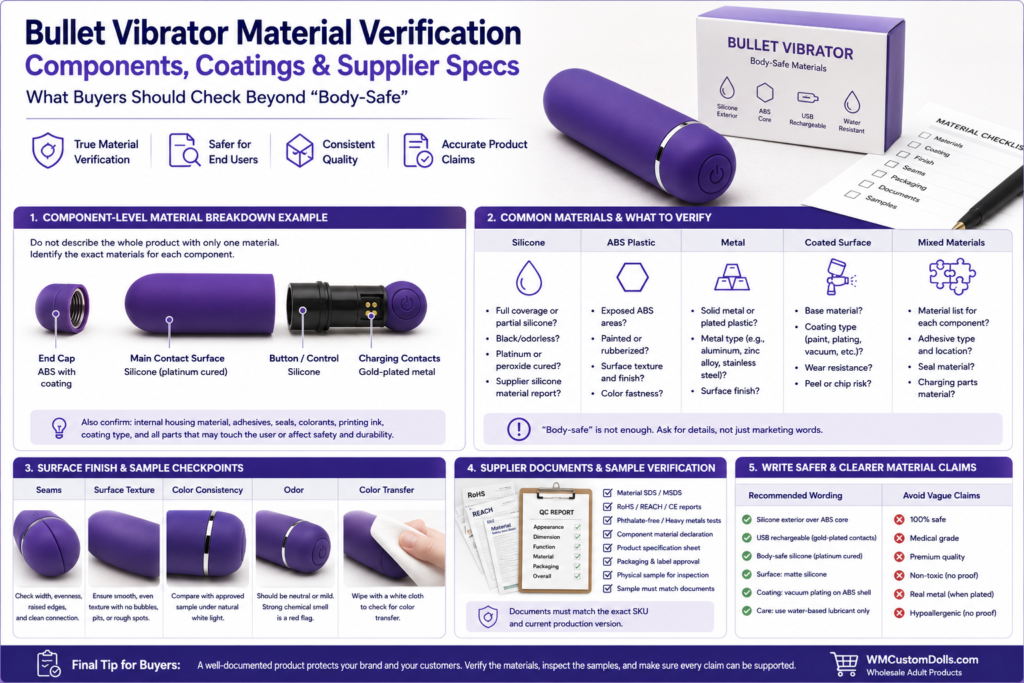
WMCustomDolls includes bullet vibrators within its broader adult toy categories and supports mixed wholesale selection and private label projects.In our experience, responsible sourcing starts with a specific question: what exactly is the customer touching, and what evidence supports the product-page wording?
Why Does “Body-Safe” Need Clear Material Information?
A broad safety phrase without a material breakdown leaves retailers unable to verify claims, answer care questions, or compare products from different suppliers.
“Body-safe” should be supported by the exact exterior materials, coatings, colorants, adhesives, and relevant supplier documentation. Retailers should identify both the contact surface and underlying structure rather than describing the entire product as silicone, ABS, or metal when it uses several materials.
Most compact electronic products contain more than one material. A silicone bullet vibrator may have a silicone outer layer over an ABS structure, plus a separate button, charging contact, seal, adhesive, or decorative coating. A metal-finish product may use a metal shell, plated plastic, or a coating designed to look metallic.
Buyers should request a component-level breakdown:
| Product component | Information to request |
|---|---|
| Main contact surface | Exact material and finish |
| Internal housing | Structural material |
| Button or control | Material and any coating |
| End cap | Material, seal, and attachment method |
| Charging contacts | Contact material or finish |
| Printed details | Ink, paint, or marking method |
| Adhesives | Areas where adhesive is used |
| Colorants | Relevant supplier declaration or specification |
Terms such as “premium,” “skin-friendly,” “non-toxic,” and “safe silicone” are not precise material names. They may be used in marketing, but they should not replace a verified composition statement.
Retailers should also check whether “silicone” describes the entire exterior or only one section. If the product combines silicone and ABS, the listing should say so. This makes cleaning instructions clearer and helps support teams answer customer questions without guessing.
How Do Silicone, ABS, Metal, and Coated Surface Listings Differ?
Material categories can look simple in a catalog, but vague wording may hide whether the surface is solid, overmolded, plated, painted, or coated.
Silicone listings should clarify whether silicone covers the full contact surface. ABS listings should identify exposed plastic and coated sections. Metal listings should name the alloy or documented metal type when available, while coated products should state the substrate and surface treatment separately.
The following comparison helps buyers identify missing information:
| Listing term | Useful supporting detail | Wording to question |
|---|---|---|
| Silicone exterior | Coverage, finish, underlying structure, care limits | “Premium silicone material” |
| ABS body | Exposed ABS areas, surface texture, painted sections | “Body-safe plastic” |
| Metal shell | Documented metal type, finish, coating, care notes | “Luxury metal” |
| Metallic finish | Substrate, plating or coating method, wear guidance | “Metal vibrator” |
| Soft-touch coating | Base material, coating composition, stability | “Soft skin surface” |
| Mixed material | Component-by-component description | One material applied to the whole product |
Silicone often provides a soft-touch, nonporous surface when properly manufactured, but the word itself does not confirm formulation, finish quality, or compatibility with every cleaner. Buyers should request the supplier specification and inspect the physical sample.
ABS is a rigid engineering plastic commonly used for housings. A smooth ABS surface may be straightforward to wipe, but retailers should verify whether it is exposed, painted, rubberized, or covered by another material.
Metal can provide a firm, smooth shell, yet the exact material and surface treatment still matter. Retailers should not describe a plated plastic body as solid metal. They should also avoid unverified claims about stainless steel, aluminum, or other alloys.
Coated finishes deserve particular attention because their long-term condition depends on the substrate, coating quality, storage, cleaning products, and normal wear. A retailer’s care instructions should match the specific finish and manual rather than relying on generic advice.
WMCustomDolls features selected silicone toys and supports wholesale-ready product selection for retail and private label buyers.Buyers can explore our bullet vibrator product category before requesting model-specific material details.
What Surface Finish, Odor, Seam, and Color Transfer Checks Matter?
A specification may look complete on paper while the sample shows a rough seam, unstable coating, persistent odor, or coloring that transfers during handling.
Inspect samples under neutral lighting for uniform texture, controlled seams, secure material transitions, unexpected odor, sticky areas, loose coatings, and color transfer. Compare multiple units where possible because one presentation sample cannot confirm batch-level consistency.
Begin with a clean, unused sample. Record the model, batch or sample date, color, packaging condition, and inspection environment. This creates a useful reference if later production units differ.
Check the following points:
- Surface texture is reasonably consistent
- Seams are controlled and not separating
- Material transitions do not have sharp or lifted edges
- Buttons and end caps fit evenly
- The surface is not unexpectedly sticky, oily, cracked, or peeling
- Printed markings are secure
- Color does not transfer during the supplier-approved test
- Odor is not unusually strong or persistent
- The charging area is clean and correctly assembled
- The sample matches its specification and approved images
A visible seam is not automatically a defect. Some molding and assembly methods naturally leave a seam line. Buyers should define acceptable seam appearance with close-up reference photos instead of using subjective instructions such as “no seam.”
Odor also needs careful wording. A temporary packaging smell does not by itself identify the material or prove that a product is unsafe. However, a strong, unusual, or persistent odor should be documented and discussed with the supplier before approval.
Do not perform improvised chemical, heat, flame, or aggressive stretching tests. These may damage the sample and do not replace appropriate documentation or laboratory testing. If formal testing is required for a target market, buyers should agree on the test scope, sample source, laboratory, and applicable requirements with a qualified compliance professional.
After inspection, clean the sample only according to its manual. Use a material-compatible cleaner, keep unprotected charging areas dry, and allow the product to dry completely before charging or storage.
What Can Supplier Documents and Samples Confirm?
A generic certificate or polished sample is not enough when it cannot be linked to the exact model, material, production party, or current order.
Supplier documents should identify the tested or declared material, model, manufacturer, date, and relevant standard or test scope. Samples can confirm finish, seams, odor, assembly, packaging, and care wording, but buyers should verify that documents and samples correspond to the production SKU.
Start with a written supplier specs request rather than asking only, “Is this body-safe?” A useful request may include:
- Exact model number and product name
- Component-level material declaration
- Available test reports or compliance documents
- Report date and tested sample identification
- Manufacturer or applicant name
- Test method, scope, and result pages
- Colorant or coating information
- Cleaning and storage instructions
- Water-protection statement
- Packaging and manual files
Check whether the document applies to the complete product or only a raw material. A report for one silicone compound may not cover the assembled electronic product, its colorants, printed markings, adhesive, charging contacts, or coating.
Buyers should also check that the report is readable, current enough for the intended purpose, and connected to the supplier and SKU. A logo or “passed” statement without test details provides limited verification.
The physical sample should match the documentation in color, construction, finish, control design, charging method, and packaging. For larger orders, the approved sample can become the production reference. The purchase agreement or QC checklist should define how substitutions and material changes are handled.
WMCustomDolls works with manufacturing partners to support supply coordination and product consistency, while our team provides order follow-up for brands, wholesalers, and distributors. We also support mixed wholesale orders and OEM/private label projects, depending on the product and order details.
Buyers considering OEM and private label support can send us their target material, market, quantity, packaging needs, and documentation requirements. Our team can help review current options, but buyers should still assess any market-specific compliance obligations with appropriate specialists.
How Can Retailers Write Safer Material Claims?
Overly broad claims may create customer expectations that the specifications, packaging, manual, or supplier documents cannot support.
Retailers should name verified materials, distinguish contact surfaces from internal structures, explain relevant coatings, and provide model-specific care instructions. Avoid absolute claims such as “100% safe,” and ensure every product-page statement matches the supplier specs, sample, packaging, and manual.
A precise product-page statement is more useful than a promotional phrase. For example:
Material: Silicone contact surface with ABS structural components. Please review the supplied manual for cleaning, charging, storage, and compatible product guidance.
If the entire surface composition has not been verified, do not write “100% silicone.” If a product has a metallic coating over ABS, do not list the material simply as metal.
Retail product pages should include:
- Verified exterior material
- Other exposed materials
- Coating or finish details where relevant
- Charging-port design
- Documented water-protection wording
- Approved cleaning method
- Compatible or incompatible cleaner guidance
- Storage instructions
- A reminder to follow the specific product manual
Retailers should avoid medical-grade, antibacterial, hypoallergenic, chemical-free, FDA-approved, or completely safe claims unless suitable evidence specifically supports that wording. “Body-safe” is better used as a general category supported by transparent details, not as a guarantee.
Private label packaging requires the same discipline. The retail box, insert, online listing, marketplace data, and customer support script should use consistent material wording. If the supplier changes a coating, colorant, factory, or component, the brand should review whether existing claims remain accurate.
For range planning, buyers can review adult toy wholesale options or contact our sourcing team. Send us your target material, price band, expected quantity, market, and packaging requirements so we can help compare suitable current options.
FAQ
What makes a bullet vibrator body-safe?
A responsible assessment considers verified exterior materials, surface stability, cleanability, construction quality, suitable instructions, and supporting supplier information. No product should be described as completely risk-free, and users should always follow the specific manual for cleaning, charging, care, and storage.
Is silicone always the best material?
No material is automatically the best choice for every customer or product design. Silicone may offer a soft-touch, nonporous exterior, while ABS and suitable metal surfaces may provide smooth, rigid alternatives; the formulation, finish, construction, documentation, and intended care all matter.
What should buyers check in samples?
Check the material against the supplier specs, then inspect surface consistency, seams, transitions, odor, color stability, buttons, caps, charging areas, packaging, and care instructions. When possible, compare several units and retain an approved reference sample for production QC.
Conclusion
Verify materials, finishes, documents, samples, and retail wording together. Contact WMCustomDolls for wholesale sourcing, mixed orders, OEM/private label support, or range planning.
Planning a Wholesale Order?
Share your product interests, estimated quantity and destination market with our team.
Request Wholesale Information