


Blog
How to Clean an Egg Vibrator: What Changes by Material, Seams, Retrieval Cords, and Charging Contacts?

One cleaning routine does not fit every egg vibrator. Materials, seams, retrieval features, buttons, charging areas, and water protection can all change what the manufacturer recommends.
On this page 9 sections
The safest way to clean an egg vibrator is to follow the exact model instructions first, then pay extra attention to its surface material, seams, retrieval cord or tail, controls, charging system, and any areas where different components meet.
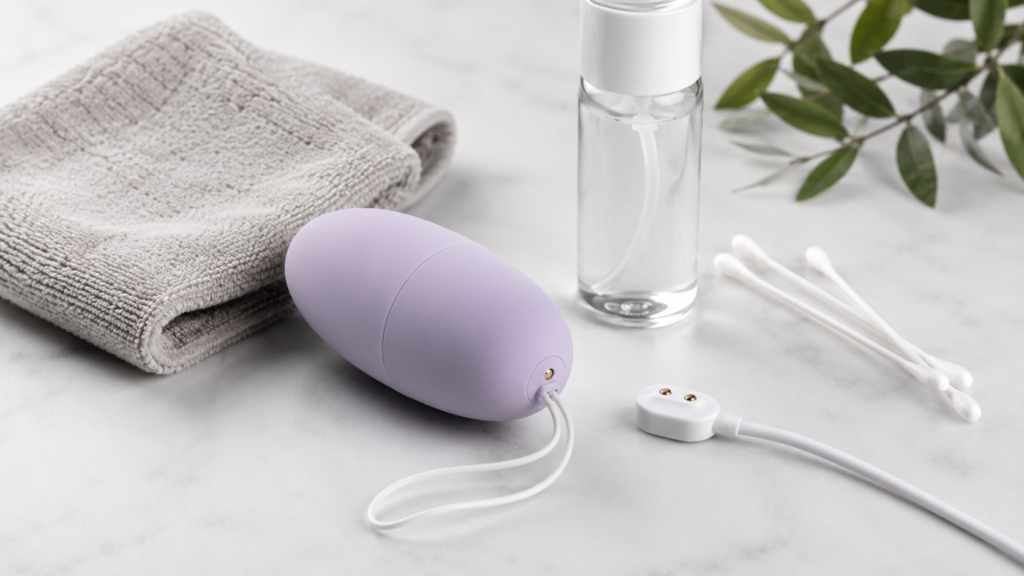
Generic “soap and water” advice can be too broad for a product that combines soft surfaces, hard shells, electronics, controls, charging contacts, and retrieval components in one small body. This guide focuses on the parts of an egg vibrator that can change the cleaning routine rather than repeating general sex toy cleaning advice. If you need product examples, browse our egg vibrators and check the care instructions supplied with the exact model.
Why Does Egg Vibrator Geometry Change Cleaning?
Smooth-looking products can still have seams, recesses, transitions, and component junctions that need more attention than the main surface.
The shape of an egg vibrator affects where residue or moisture may remain after use. Button recesses, retrieval-cord junctions, charging areas, and visible seams should therefore be included in the cleaning routine without assuming that every product can be rinsed or submerged.
- Where residue collects: Seam lines, button edges, retrieval-feature junctions, and other recessed areas can hold more residue than broad, smooth surfaces. Check these areas visually rather than cleaning only the center of the body.
- Why transitions matter: Some eggs combine different materials or separate molded components. If the exact construction creates an exposed edge, seam, or recess, clean around that transition carefully and follow the model’s water-care instructions.
- Button and light windows: Recessed buttons or indicator areas may need a gentle wipe around the edges. Avoid directing liquid into openings unless the manufacturer specifically permits that cleaning method.
- Retrieval-cord exit: The point where a cord, tail, loop, or tab meets the main body can be another area where residue or moisture remains. Clean the junction according to the product instructions and make sure it is dry before storage.
- Practical tip: Before the first cleaning, identify the visible seams, controls, charging area, retrieval junction, and any other transitions on the exact model. These are the areas worth checking after the broad surface has been cleaned.
Geometry Hotspots and Actions
| Hotspot | Typical Issue | Gentle Action (if not fully submersible) |
|---|---|---|
| Seam lines | Residue along visible joins | Gentle wipe; follow model-specific water guidance |
| Button recess | Film around edges | Wipe carefully without forcing liquid into gaps |
| Material transition | Residue around exposed edges | Clean the visible transition; dry thoroughly |
| Cord exit/eyelet | Residue or retained moisture | Clean junction according to the manual; dry fully |
| Charging cutout/contacts | Moisture before charging | Follow cleaning guidance; dry fully before power |
How Do ABS, Silicone Overlays, and Mixed Materials Affect Care?
A material label such as “ABS + silicone” does not necessarily explain which material forms the contact surface or how every component should be cleaned.
The correct routine depends on the exact product construction, surface finish, coating, water protection, and manufacturer instructions. Do not infer rinsing or immersion suitability from material names alone.
- ABS shells: ABS may form the main shell or one structural component of an egg vibrator. Check whether the surface is plain ABS, coated, partly covered, or combined with another material before choosing a cleaning method.
- Silicone overlays: Some products use silicone on all or part of the outer contact surface. Where silicone meets another component, clean the visible transition gently rather than pulling at the edge or assuming the entire device is one continuous material.
- Coatings and paints: A hard plastic surface may also use paint, a soft-touch finish, or another coating. Strong solvents, abrasive pads, or cleaners not approved for the model may damage these finishes, so follow the exact care instructions.
- Mixed constructions: A product may combine silicone, ABS, buttons, seals, charging contacts, or other materials. Treat the device as one documented product rather than creating separate cleaning rules solely from the material list.
- Drying: Let the product dry according to the manufacturer’s guidance before storage or charging. Avoid using heat simply to speed up the process unless the instructions specifically allow it.
Materials & Care Considerations
| Construction Type | What to Confirm | Care Focus |
|---|---|---|
| ABS shell | Surface finish and water guidance | Gentle cleaning; protect coatings |
| ABS + silicone surface | Exact contact surface and seams | Clean visible transitions carefully |
| Coated/painted shells | Cleaner compatibility | Avoid unsupported solvents/abrasives |
| Contacts/charging area | Exact water-care instructions | Ensure area is dry before charging |
What Should Be Checked Before Using Water-Based or Other Lubricants?
Lubricant choice can affect both the product surface and the amount of residue left behind after use.
Check the exact model’s lubricant guidance before choosing a product. Water-based lubricants are commonly used with many adult toys, but compatibility should still be confirmed for the relevant material, coating, and SKU rather than treated as universal.
- Read the manual: Use the lubricant types recommended for the exact model. If the documentation does not provide compatibility guidance, confirm with the seller or manufacturer before making a material-specific recommendation.
- Why residue matters: Different lubricant formulas leave different amounts of residue. Pay additional attention to seams, retrieval junctions, and other recessed areas if residue is visible after cleaning.
- Silicone surfaces: Do not assume that every lubricant is compatible simply because the product uses silicone somewhere in its construction. Follow the manufacturer’s guidance for the exact contact surface.
- Application tip: Avoid unnecessarily coating charging areas, buttons, seams, or retrieval junctions with lubricant. Apply it to the intended contact surface according to the product instructions.
- B2C note: If a lubricant or cleaner causes irritation or an unexpected surface change, stop using it and check the product and lubricant guidance before continuing.
- Where to learn more: We maintain a general overview of water-based lubricant for adult toys. Use that as broader context while keeping the exact egg vibrator instructions as the primary reference.
Lube Compatibility Checks
| Step | What to Confirm |
|---|---|
| Manual guidance | Allowed lubricant types for the exact model |
| Surface construction | Verified contact-surface material and finish |
| Component protection | Avoid unnecessary residue around electronics |
| Clean-up plan | Check seams and retrieval junctions for residue |
How Should Seams and Retrieval Cords Be Cleaned and Dried?
Seams and retrieval components deserve attention because their shape and materials may differ from the main surface.
Clean visible seams and retrieval strings, tails, loops, or tabs according to the exact model instructions. Avoid aggressive pulling, unnecessary saturation, or improvised cleaning methods, and make sure the junction is dry before storage.
- Seam cleaning: Use the cleaning method approved for the product and pay attention to visible joins where residue remains. A soft cloth or another manufacturer-approved tool may help without damaging the surface.
- Retrieval strings/tabs: Different products may use molded silicone tails, coated cords, textile-like strings, loops, or other designs. Do not assume they can all be soaked or cleaned in the same way.
- Exit point hygiene: Check the point where the retrieval feature meets the main body. Clean visible residue without forcing liquid into the junction, and follow any model-specific drying instructions.
- Replacement and damage: If a string, tail, loop, or attachment point becomes frayed, loose, cracked, or otherwise damaged, stop using the product and consult the seller or manufacturer rather than attempting an unsupported repair.
- Drying routine: After cleaning, make sure seams, retrieval components, and their junctions are dry before returning the product to a closed pouch, connecting a charger, or storing it.
Seam & Cord Care Snapshot
| Area | Method (unless immersion is allowed) | Drying Focus |
|---|---|---|
| Seam lines | Clean gently according to product guidance | Check visible joins before storage |
| Cord body | Follow care instructions for its material | Ensure retrieval component is dry |
| Cord exit/eyelet | Clean visible residue around the junction | Check for retained moisture |
| Tabs/pull handles | Wipe as documented; inspect attachment | Dry edges and attachment point |
What Do Charging Contacts and Water Wording Change?
Water protection determines how far the cleaning routine can go.
Terms such as “washable,” “water-resistant,” “waterproof,” and a documented IP rating should not be treated as interchangeable. Follow the exact model instructions around charging contacts or ports and make sure the charging area is fully dry before connecting power.
- Interpreting wording: Check what the manufacturer actually allows. One model may permit rinsing while another may require wipe-down cleaning even when the products look similar.
- Contacts and charging areas: Exposed magnetic or pin-style contacts do not automatically prove or disprove water resistance. Their cleaning should follow the device’s documented water protection, but they should be dry before charging.
- Port plugs: If the model uses a covered charging port, follow the instructions for cleaning and closing that area. Do not force, remove, or modify plugs unless the manual directs you to do so.
- Charging practice: Connect power only after the charging area is dry. If residue remains on exposed contacts, use the cleaning method recommended for the exact product rather than applying sprays or liquids without guidance.
- Remote and water ratings: The egg and its remote may have different water-care instructions. Do not apply the egg’s waterproof or rinse guidance to the controller unless the controller documentation supports it.
- For product research: Our overview of waterproof rechargeable adult toys explains rechargeable and water-protection terminology at a broader level. Always pair that information with the exact model manual.
Contacts & Water Wording Checklist
| Item | What to Do |
|---|---|
| Water wording | Follow the exact model instructions |
| Contacts/ports | Clean as documented; ensure dry before charging |
| Drying time | No universal time; wait until charging area is fully dry |
| Remote rating | Follow separate remote instructions where applicable |
Should the Remote Be Cleaned the Same Way as the Egg?
Not necessarily.
The remote is a separate electronic component and may have different materials, seals, battery compartments, and water-care instructions from the egg itself.
Treat the remote according to its own documentation rather than assuming it shares the vibrator’s waterproof or washable rating.
- Separate ratings: A waterproof or washable egg does not automatically mean the supplied remote can be rinsed or submerged. Check the instructions for both components separately.
- Cleaning approach: If the manual describes the remote as wipe-only, use that method. Do not spray, soak, or rinse the controller simply because the egg itself allows more water exposure.
- Buttons and seams: Clean around remote buttons and joins without forcing moisture into gaps. Follow the manufacturer’s guidance if residue collects around controls.
- Storage: Allow both the egg and remote to dry according to their instructions before placing them together in a closed pouch or storage container.
- Support scripting: Retailers should keep the remote’s water-care wording separate from the egg’s specifications so customers are not accidentally given one cleaning routine for two different electronic components.
Remote Care Summary
| Component | Cleaning Method | Notes |
|---|---|---|
| Remote body | Follow the remote-specific manual | Do not assume egg water rating applies |
| Buttons | Clean gently according to instructions | Avoid forcing liquid into gaps |
| Battery compartment | Keep internals dry unless stated otherwise | Follow battery-handling guidance |
What Should Retailers Put on a Model-Specific Care Card?
Generic care text can create confusion when different egg vibrators use different materials, retrieval designs, charging systems, and water-protection levels.
A useful care card should reflect the exact SKU rather than copying one “wash with soap and water” paragraph across every vibrator in the category.
Include the model’s current water wording, material and lubricant guidance, seam or retrieval care, charging precautions, remote instructions, drying requirements, and storage notes where relevant.
- Components list: Identify the outer or contact-surface material, retrieval feature, controls, and charging method using the current product documentation.
- Allowed water exposure: Use the manufacturer’s actual wording rather than upgrading “washable” or “water-resistant” into “fully waterproof.”
- Lube guidance: Repeat the exact model’s lubricant recommendation rather than applying one material rule to the entire category.
- Seam and cord care: Include simple instructions where these features require additional attention, without creating unsupported cleaning procedures.
- Contacts and charging: Make it clear that the charging area should meet the product’s drying requirements before power is connected.
- Remote instructions: Add separate care guidance when the controller’s water protection differs from the egg itself.
- Storage: Keep storage advice consistent with the model instructions rather than using one universal rule for every egg vibrator.
- B2B/OEM: For private-label products, the care card, packaging, manual, and PDP should all describe the same current construction and care requirements. For help with model-specific documentation, contact us.
Model-Specific Care Card Template
| Section | Example Entry (replace with model’s exact wording) |
|---|---|
| Water wording | Use the exact manufacturer water-care statement |
| Lube guidance | Use the lubricant recommendation for the specific model |
| Cleaning steps | Follow the approved surface and seam-cleaning method |
| Cord care | State retrieval-component care where applicable |
| Contacts/charging | Ensure charging area is fully dry before connecting power |
| Remote care | Use separate controller instructions if required |
| Drying & storage | Follow the exact model’s drying and storage guidance |
If you’re building or supporting a range, explore our egg vibrator catalog and reach out for model-specific packaging content and care-card coordination.
FAQ
Can every egg vibrator be rinsed under water?
No. Water protection varies by model. Some products may allow rinsing while others require more limited cleaning. Follow the exact manual rather than judging from appearance, materials, or charging design alone.
How should a retrieval string be cleaned?
Follow the instructions for the exact retrieval material and model. Avoid aggressive pulling or unnecessary soaking, clean the visible junction carefully, and make sure both the retrieval feature and attachment area are dry before storage.
Is water-based lubricant always the best choice?
Not universally. Water-based lubricants are commonly recommended for many adult toys, but the exact product guidance should decide compatibility. If the manual is unclear, confirm with the seller or manufacturer before making a material-specific recommendation.
How long should charging contacts dry before charging?
There is no universal drying time. Follow the model instructions and connect power only when the charging contacts, port, and surrounding area are fully dry.
Conclusion
How to clean an egg vibrator depends on more than the material listed on the product page. Seams, retrieval cords or tails, buttons, mixed-material transitions, charging contacts, the remote, and the exact water-protection wording can all change what the manufacturer recommends. Start with the model manual, clean the areas where residue can remain without exceeding the permitted water exposure, and make sure the charging area and other relevant components are fully dry before storage or power connection. For retailers, model-specific care cards are more useful than copying one generic cleaning routine across every egg vibrator because they keep the PDP, packaging, and customer support aligned with the product actually being sold. Browse our Egg Vibrators or contact WMCustomDolls for wholesale selection, packaging, and private-label coordination.
Planning a Wholesale Order?
Share your product interests, estimated quantity and destination market with our team.
Request Wholesale Information