


Blog
Body-Safe Anal Toys for Retailers: How to Check Materials, Finish, Labels, and Supplier Specs

Retail teams need verification steps, not generic definitions.
On this page 9 sections
Keep “body-safe” concise: non-porous contact surfaces, smooth finish, secure control features, and clear care labeling—then verify with supplier specs, packaging files, and batch QC. Our team supports wholesale, OEM/private label, and mixed orders with coordinated communication from inquiry to delivery.
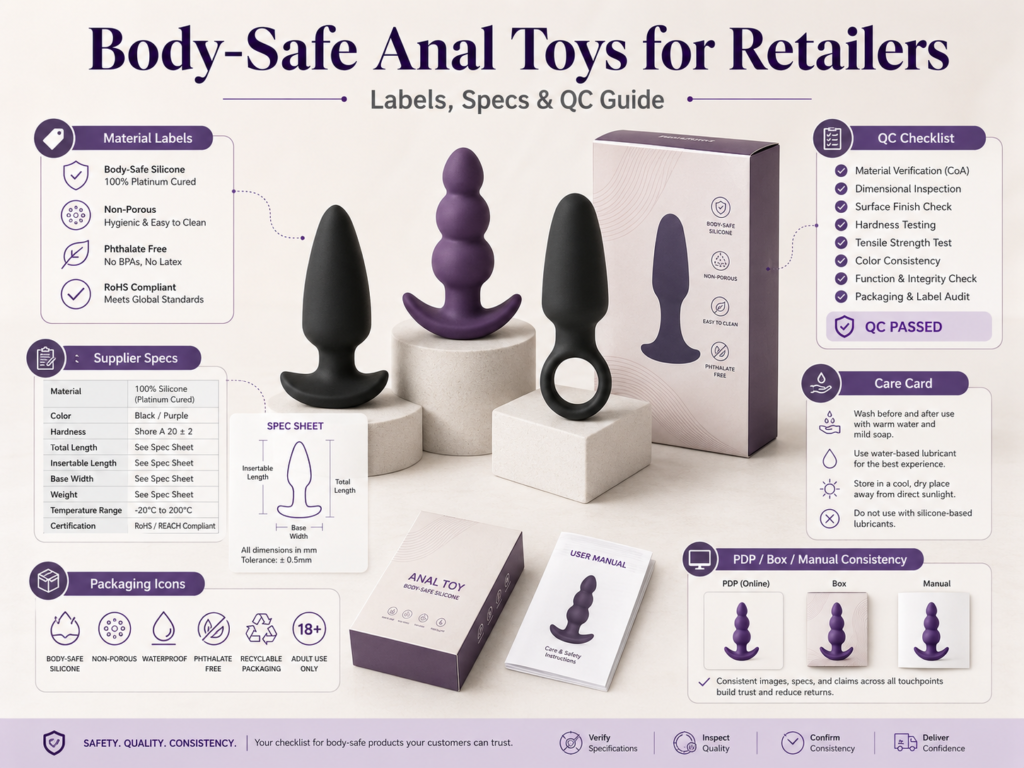
We organize core categories—including Toys > Anal Toys—to help buyers plan assortments and compare SKUs efficiently before private label or mixed wholesale orders. For sensitive categories, we also provide privacy-focused packaging options that align with your brand requirements and market norms .
What “Body-Safe” Means in a B2B Verification Context
Retailers need standards that can be checked and repeated.
Define “body-safe” at SKU level: non-porous contact surface, smooth seams, stable control features, conservative care language, and matching documentation across PDP, box, and manual. Then verify with samples and a signed spec sheet.
Start with a one-page definition in your category playbook: contact surface type, finish standard, acceptable seam size, control feature geometry (e.g., retrieval handle or base), lubricant guidance, and water wording tiers. Keep it short and testable. Lock these details into a supplier spec sheet and require the same language on your PDP and packaging. Request photos or videos of the final finish prior to mass production. Align your internal QA checklist with the spec sheet so incoming inspections focus on the same metrics. We help teams formalize these documents and match them to category placement in your Anal Toys catalog for easier onboarding and replenishment, with clear communication from inquiry to delivery.
Supplier Spec Sheets and Material Disclosure Checklist
Paperwork prevents guesswork.
Request a dated spec pack per SKU: contact surface material, finish notes, dimension table, control feature dimensions, lubricant guidance, water wording, charging details (if vibrating), and care notes. Include photos that match these specifications.
A reliable spec pack drives consistent listings and packaging. Require:
- Contact surface material and firmness notes
- Dimension chart (insertable length, max diameter, neck/base metrics or handle length)
- Finish standard and seam tolerance
- Button layout and charging type for vibrating SKUs, with conservative runtime ranges
- Care wording, lubricant guidance, and water wording that match the product’s design
- Photo angles to be replicated on PDP and box (side profile, top-down base/handle, macro of finish)
Use a document control number and versioning. Keep a signed “golden sample” and a measurement report as the reference for IQC/OQC. Our team supports wholesale and OEM/private label projects with documented specs and coordinated supplier communication, helping ensure alignment between catalog placement, online copy, and packaging deliverables.
Packaging Labels, Care Cards, and PDP/Manual Consistency
Inconsistent wording creates returns and support tickets.
Standardize icons and copy: material, water-based lubricant compatibility, cleaning method aligned to water wording, storage pouch, charging, and brief cautions. Use the same text across PDP, box, and manual.
Build a packaging icon set and wording library that legal, marketing, and QC approve once, then reuse. Keep claims conservative—avoid absolute “waterproof” or “medical-grade” language unless validated for that SKU. On vibrating items, show charging type and a realistic runtime range. Ensure PDP bullet points mirror the same sequence and wording as the box and manual. Include a small care card that repeats the essential icons and a quick-start diagram for buttons. We provide privacy-focused packaging solutions for sensitive categories and can align iconography and copy across your assortment so retail teams and customers see consistent guidance online and in-hand.
Finish, Seams, and Firmness: Quick QC Checks Retailers Can Apply
A five-minute inspection can catch most issues.
Check five points per SKU: surface uniformity, seam smoothness, control feature geometry, firmness vs. spec, and button/port placement for vibrating products. Record results against your golden sample.
- Surface: look for texture uniformity, color consistency, and even matte/gloss levels.
- Seams/Edges: run a fingertip over typical seam paths; note any raised edges or rough areas.
- Control Features: measure base width or handle length per spec; confirm ergonomic contour.
- Firmness: simple squeeze test against reference; flag deviations.
- Electronics: check button tactile feedback, charging port position, and a brief functional run.
Use a 5–10 unit sampling plan on incoming lots for fast triage. Photograph any deviations next to a ruler. This simple process reduces rework and prevents inconsistent batches from reaching PDPs and shelves. We can help set these checklists and train teams to apply them consistently across Anal Toys lines in your catalog.
Claim Wording Governance and Risk Control
Claims should be consistent, conservative, and repeatable.
Use tiered water wording and avoid absolutes. Keep safety and material language factual, short, and aligned to the spec sheet, packaging, and PDP. Require supplier sign-off on all public copy.
Establish a wording matrix that maps each claim to validation. Example: “Water-resistant—wipe clean” vs. “Waterproof—brief rinse,” matched to port design and test notes. For materials and safety, stick to contact surface identification and basic care directives without medical or therapeutic claims. Prohibit words like “100% safe,” “medical-grade” (unless validated), or universal lubricant compatibility. Lock this matrix into your content guidelines and packaging briefs. We assist brands and distributors in aligning claims across online listings and printed materials, and in updating content when product revisions are approved through change control.
OEM/Private Label Process Control: Golden Sample to Change Log
Control the parts before they control your catalog.
Set a gated process: approved golden sample, signed spec sheet, artwork lock, pilot run sign-off, and a change log for revisions. Tie every revision to a new packaging version and PDP update.
- Golden Sample: approve finish, dimensions, and electronics (if any); tag and store.
- Spec Sheet: freeze dimensions, finish tolerance, icons, and wording; versioned and dated.
- Artwork Lock: align PDP bullets with box and manual; approve icon set and claim matrix.
- Pilot Run: small batch for OQC; record measurements and photos.
- Change Control: supplier submits revision summary; you assign a new version; packaging/PDP updated in sync.
This structure preserves consistency across replenishments and avoids mixed information in the market. Our team supports OEM/private label programs with supplier coordination and documentation so your assortment remains coherent across the Anal Toys category and broader catalog.
Retail Asset Standards: Photos, Dimensions, and Templates
Customers compare faster with standardized assets.
Require the same image angles and size tables for every SKU family. Side profile with dimension overlay, top-down base or handle shot, macro of finish, packaging hero, and care card image.
Publish a dimension table that uses the same fields across the family (e.g., insertable length, maximum diameter, neck/base or handle metrics). Use one background color, consistent lighting, and the same overlay style on dimension images for web and box. Store asset templates in a shared library so new SKUs slot in quickly. For vibrating SKUs, include a close-up of the button layout and charging point. Tie photo captions to the wording matrix so claims stay consistent. This discipline shortens PDP build time and reduces content errors. We can provide asset checklists and coordinate supplier-side image capture aligned with your retail standards across mixed wholesale and private label orders.
FAQ
What should a retailer request in a material and spec disclosure?
Ask for a dated spec pack with contact surface material, dimension table, finish/seam tolerances, control feature geometry, lubricant guidance, water wording, and charging details if applicable. Our team helps coordinate supplier documentation for wholesale and private label orders.
How do we keep PDP, box, and manual content consistent?
Create a wording matrix and icon set, then lock them in the spec sheet and artwork. Use the same bullet sequence across PDP and packaging, and require supplier sign-off for any edits. We support packaging and content alignment with privacy-focused solutions.
What’s a simple incoming QC process for anal toy SKUs?
Compare units to your golden sample and spec sheet: check surface, seams, control features, firmness, and electronics layout. Record measurements and photos, and apply a small sampling plan for each lot. We can help set checklists and training for your team.
Do you support mixed orders and OEM/private label coordination?
Yes. We support mixed wholesale orders, OEM/private label projects, and flexible product selection with coordinated communication from inquiry to delivery. Anal Toys are part of our core categories, which helps structure assortments and planning.
Conclusion
Focus on verifiable specs, consistent labels, disciplined QC, and conservative claims. Contact wmcustomdolls to plan wholesale assortments and private label documentation with coordinated support from inquiry to delivery.
Planning a Wholesale Order?
Share your product interests, estimated quantity and destination market with our team.
Request Wholesale Information