


Blog
Anal Beads and Butt Plugs for Retailers: How to Separate Categories, Specs, and Packaging

Shoppers compare beads and plugs differently. Mixed labeling drives confusion and returns.
On this page 8 sections
Create separate categories for anal beads and butt plugs, publish consistent size specs and comparison photos, and align packaging icons and care notes to reduce questions and improve conversion. We support wholesale, OEM/private label, and privacy-focused packaging for retail lines.
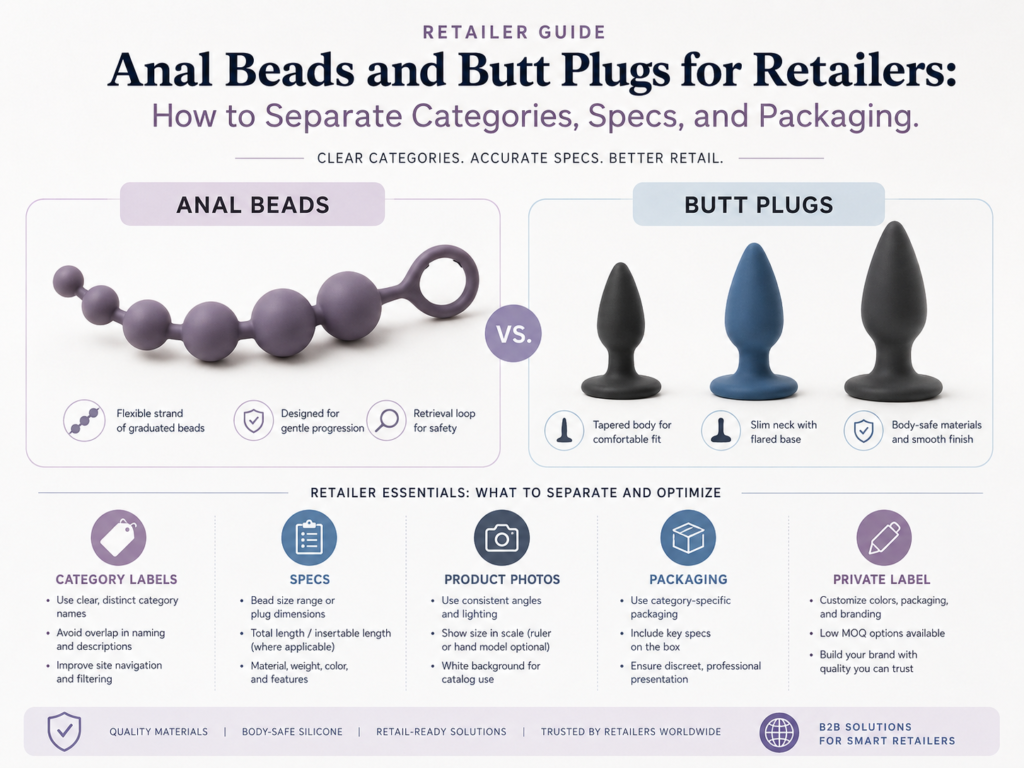
Our site organizes toys under clear product menus, including Anal Toys, which helps teams plan and source related SKUs efficiently across categories. In our experience, consistent labels, spec tables, and discreet packaging reduce support tickets and make private label launches smoother for buyers and distributors .
Why Retailers Should Separate Anal Beads and Butt Plugs
Blending beads and plugs under a generic “anal toy” label confuses shoppers and staff.
Use distinct categories and filters so customers can compare the right dimensions and features quickly. Clear naming improves navigation and reduces pre-sale questions, especially when listings and packaging mirror the same spec language.
Retailers benefit from dedicated pages for each format because shoppers evaluate them in different ways. Beads are compared by total length, bead progression, and handle/loop design, while plugs are compared by insertable length, maximum diameter, neck thickness, and base width. When these formats sit together without filters, buyers struggle to scan, and support teams spend more time clarifying basics. We recommend adding a top-level split under your Anal Toys menu: “Anal Beads” and “Butt Plugs,” with focused filter groups on each page. This structure aligns with how many of our B2B clients present their assortments and reflects how our own product menus help buyers locate the right SKUs efficiently across the Toys > Anal Toys area . Our team supports this planning with retailer-ready spec sheets and coordinated packaging so your web copy and on-box icons stay consistent from inquiry to delivery.
Category Labels That Reduce Buyer Confusion
Clarity starts with navigation and filters.
Recommended labels: Anal Beads, Butt Plugs, Beginner Anal Toys, Vibrating Anal Toys, and Anal Training Kits. Keep each page’s filters relevant to that product type and consistent across SKUs.
- Anal Beads: group non-vibrating and vibrating strands with filters for total length ranges, bead diameter ranges, flexibility, handle/loop style, and vibration on/off.
- Butt Plugs: group tapered plugs by insertable length bands, maximum diameter bands, neck thickness, base width, firmness, and vibration on/off.
- Beginner Anal Toys: show smaller, simple designs from both categories with conservative copy and clear dimension tables.
- Vibrating Anal Toys: for shoppers focused on power and controls, collect vibrating beads and plugs with filters for charging type, runtime ranges, button vs remote, and conservative water wording.
- Anal Training Kits: bundle size-progressive sets, label each size step numerically, and show the full kit dimension chart.
These labels map directly to customer intent and simplify content creation for PDPs and packaging. We coordinate category planning and packaging alignment for wholesale, OEM, and private label runs with privacy-focused designs and clear icon sets for retail teams.
Product Specs Retailers Should Publish
Specs should answer comparison questions without a chat.
For beads: show total length, bead diameter range, handle/loop detail, flexibility, and material type. For plugs: insertable length, maximum diameter, neck thickness, base width, firmness, and material type. Use the same order and units across all PDPs.
- Anal Beads:
- Total length and insertable portion
- Bead diameter range (smallest to largest)
- Handle or loop length and shape
- Strand flexibility (simple scale or note)
- Material type and conservative care notes
- Butt Plugs:
- Insertable length
- Maximum diameter at the widest point
- Neck thickness and height
- Base width with a photo overlay
- Firmness (simple scale or note)
- Material type and conservative care notes
Shoppers compare by numbers. Avoid “small/medium/large” without measurements. Keep units in millimeters or inches consistently. List vibration and charging only when relevant, with realistic runtime ranges and water wording. We can help unify spec sheets across product lines and ensure specs match packaging and online copy for wholesale and private label programs.
Product Photos That Help Customers Compare
Good photos reduce returns and support tickets.
Use side-profile photos, a handle/loop close-up for beads, a base-width photo for plugs, dimension overlays, a packaging photo, and a care card photo. Keep angles and backgrounds consistent across variants.
A consistent photo template lets customers compare SKUs quickly. For beads, show a straightened side profile with diameters labeled at the first, middle, and last bead. Add a close-up of the handle or loop to show grip and finish. For plugs, shoot a side profile with tip, taper, neck, and base clearly visible, then add a top-down base-width shot with an overlay. Dimension overlays should be legible on both desktop and mobile. Include a packaging hero shot and a care card shot that displays icons for material, lubricant compatibility, cleaning method, charging type, and water wording. Align these visuals with your spec tables to avoid conflicting information. Our team supports packaging and asset coordination so your web images, on-box printing, and manuals share the same measurements and icons from sourcing to delivery.
Packaging Icons and Care Notes for Private Label
Icons help customers understand care without long text.
Include icons for material, water-based lubricant compatibility, cleaning method, water wording, storage pouch, and charging (if vibrating). Use discreet, brand-safe packaging language. Keep the same icon set on box, manual, and PDP.
Private label packaging should prioritize clear, conservative information. Material labels and water-based lubricant icons set basic care expectations. Cleaning icons should match the product’s water wording. For vibrating SKUs, add charging type (magnetic or pin) and an estimated charging time and runtime range. Include a pouch icon if provided. Use a small quick-start panel for button layout or travel lock if relevant. Keep terminology consistent across packaging, manuals, and online listings to reduce support escalation. We offer privacy-focused packaging solutions and coordinate icon sets and spec alignment across product families for brands, wholesalers, and distributors . Our operational model emphasizes clear communication through the ordering and production cycle, helping you maintain consistency from inquiry to delivery.
How to Build a Balanced Retail Assortment
A compact, consistent lineup sells better than a scattered catalog.
Start with one beginner bead set, one S/M/L plug family, one vibrating bead option, one vibrating plug option, and one premium/private label kit. Keep dimensions, photos, and packaging icons consistent across the range.
- Beginner Bead Set: a graduated strand with a reliable handle/loop and clear total length and bead diameters.
- S/M/L Plug Family: same silhouette across sizes with insertable length, max diameter, neck, and base documented.
- Vibrating Bead Option: mirror the best-selling strand; add conservative runtime and charging notes.
- Vibrating Plug Option: mirror the best-selling plug silhouette; keep controls tactile and button location clear.
- Premium/Private Label Kit: bundle a shape family with a pouch, care card, and discreet packaging for gift-friendly positioning.
Use standardized spec tables, image templates, and icon sets to keep comparisons clear. This approach simplifies replenishment and training for store staff. We support mixed wholesale orders, OEM/private label projects, and manufacturing coordination with privacy-focused packaging and retailer-friendly spec sheets to keep your assortment consistent and retail-ready.
FAQ
What specs should retailers show for anal beads?
Publish total length, insertable portion, bead diameter range, handle or loop length, flexibility notes, material type, and vibration/charging only if applicable. Use consistent units and keep care wording conservative to avoid mismatched expectations.
What specs should retailers show for butt plugs?
List insertable length, maximum diameter, neck thickness and height, base width, firmness notes, material type, and vibration/charging details when relevant. Add a top-down base-width photo and a side profile with a dimension overlay for quick comparison.
How should anal beads and butt plugs be categorized?
Create separate categories for Anal Beads and Butt Plugs with relevant filters for each format. Add Beginner Anal Toys, Vibrating Anal Toys, and Anal Training Kits to align with shopper intent and simplify navigation. Our menus and support model reflect category clarity for buyers.
What should private label packaging include?
Use icons for material, water-based lubricant compatibility, cleaning method, water wording, charging type (if vibrating), and a pouch if included. Keep a small quick-start section and align copy across box, manual, and PDPs. We coordinate packaging and icon sets for OEM/private label programs.
Should retailers sell beads and plugs in the same collection?
You can group them within an “Anal Toys” hub, but keep separate subcategories and filters so shoppers can compare properly. Align specs, photos, and icons across both ranges for a cohesive experience. We help plan category labels and assets across wholesale and private label lines.
Conclusion
Clear categories, consistent specs, and aligned packaging reduce confusion and returns. Contact wmcustomdolls to plan wholesale assortments, OEM/private label packaging, and mixed-order execution with reliable coordination.
Planning a Wholesale Order?
Share your product interests, estimated quantity and destination market with our team.
Request Wholesale Information