


Blog
Discreet Egg Vibrator: Noise, Consent, Privacy, and Public-Use Boundaries—What Counts as Discreet?

“Discreet” can sound like a promise that nobody will notice the product, but real privacy depends on more than motor noise. Clothing, phone notifications, indicator lights, app settings, control access, and the setting itself can all affect how private the experience feels.
A discreet egg vibrator should be understood as a product designed for responsible, private, consensual use with realistic noise expectations, appropriate phone or app privacy, and a clear way to stop or control the device. It should not be marketed as universally invisible or suitable for use anywhere.
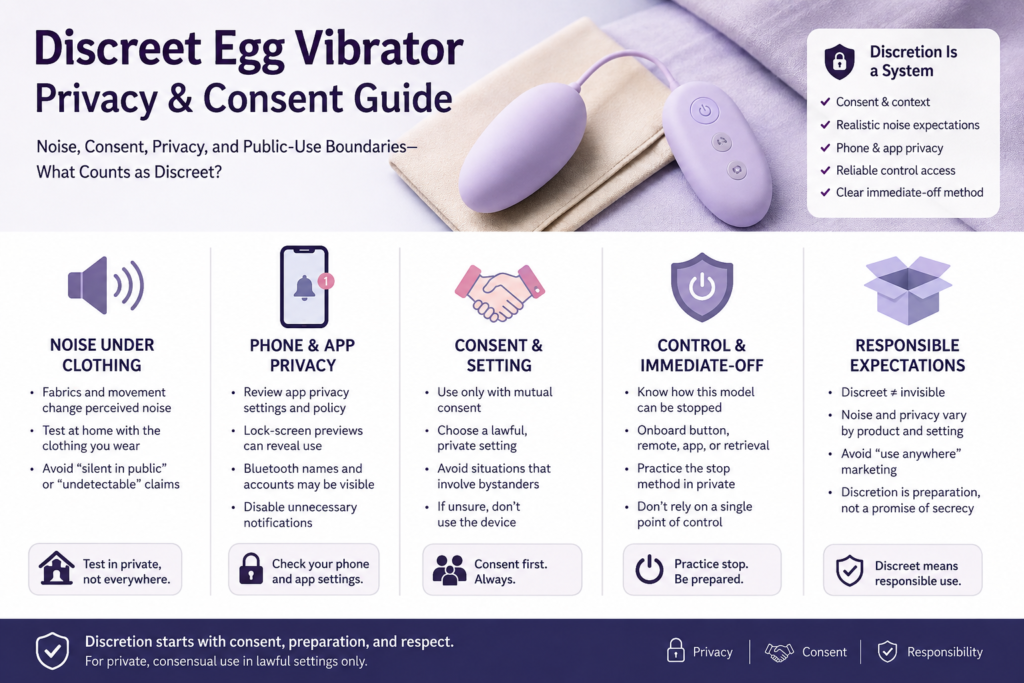
Product pages often use “quiet,” “wearable,” “remote-controlled,” and “discreet” together, even though they describe different parts of the experience. A quiet motor does not guarantee privacy, a remote does not guarantee control in every situation, and a wearable design does not remove the need for consent and an appropriate setting. This article explains what “discreet” can reasonably mean without turning it into a promise of invisibility. If you’re evaluating models or writing product copy, explore our egg vibrators and see our overview of remote-control adult toys.
Why Is a Discreet Egg Vibrator More Than a Noise Claim?
Quiet operation is only one part of discretion.
A discreet experience also depends on the setting, mutual consent, visible indicators, app or phone behavior, and the way the exact product can be controlled or stopped.
- Discretion is contextual. The same product may feel unobtrusive in one private setting and more noticeable in another because clothing, surrounding surfaces, phone alerts, or product indicators can change the experience.
- Core elements to check:
- Consent and context: use only with clear mutual consent in lawful, private settings.
- Noise expectations: review the exact SKU’s documented noise information where available rather than relying on “silent” claims.
- Visual signals: check whether LEDs, screens, or other indicators are visible during normal operation.
- Control reliability: understand whether the product uses onboard controls, a remote, an app, or a combination.
- Phone privacy: review notification previews, account behavior, and other app-visible information where relevant.
- Why “quiet” can still be misleading: A motor may be described as quiet while clothing, nearby objects, or phone notifications make the overall setup more noticeable.
- For product writers: Avoid broad lines such as “discreet anywhere” or “completely invisible.” More accurate wording can describe the product as intended for private, consensual use with model-specific noise and control information.
How Can Body Contact and Clothing Change Perceived Noise?
A tabletop sound check does not necessarily represent how a wearable product will sound in every real-use situation.
Clothing, soft surfaces, nearby hardware, and movement can change how vibration noise is perceived. That is why “quiet” should be treated as a model-specific description rather than a guarantee that the product will be inaudible.
- Contact changes sound: Fabric and surrounding surfaces can change how vibration is transmitted or perceived compared with a product operating freely on a desk.
- Movement matters: Sitting, standing, or changing position can alter how the device contacts clothing or nearby objects. Avoid assuming that one static sound check represents every condition.
- Fabric differences: Different garments can change perceived noise in different ways, but retailers should not create universal rules for denim, knitwear, shapewear, or other clothing types.
- Pattern choice: Different vibration settings may sound different depending on the exact motor and programming. Do not assume that pulsing, steady, or high-intensity modes follow one universal noise pattern.
- Practical approach: If noise matters to the buyer, use the exact product’s available documentation and keep retail wording conservative. A buyer can also evaluate the product privately in the clothing and setting relevant to them.
- B2B note: Avoid phrases such as “silent in public” or “undetectable.” If the supplier provides measured noise information, keep any test conditions attached to that data.
Clothing and Noise Snapshot
| Clothing/Context | Possible Effect on Noise | What to Check in Private |
|---|---|---|
| Soft clothing | May change perceived sound | Compare with the exact model privately |
| Structured clothing | Contact points may affect sound | Check seams or nearby hardware |
| Closer-fitting clothing | Changes contact with the product | Avoid universal noise assumptions |
| Looser clothing | Sound may vary with movement | Evaluate in the intended private setting |
What Privacy Issues Come From Phones, Apps, and Notifications?
Connected products can reveal information through the phone even when the vibrator itself is relatively quiet.
App names, pairing prompts, Bluetooth device names, lock-screen notifications, account history, and partner-control features can all affect privacy depending on the exact app and phone settings.
- App privacy basics: Review the official app settings, account requirements, and privacy policy. Do not assume that an app automatically hides product use or activity.
- Lock-screen exposure: Notification previews or banners may display information depending on the app and phone settings. Users should review the privacy controls available on their own device.
- Bluetooth identification: Device names may appear in pairing menus. Some products may support renaming while others do not, so do not promise a neutral device name unless the actual system supports it.
- Account considerations: Connected apps may use accounts, partner invitations, history, permissions, or cloud-based services. Retailers should describe these functions accurately rather than promising anonymity or complete privacy.
- Offline alternative: If the product offers onboard controls or a dedicated local remote, those functions can be documented separately from app-based control. Do not imply that offline control is available unless the exact SKU supports it.
- B2B implication: Product pages should separate wearable design, remote control, app features, and privacy information. If app behavior changes by software version, keep public wording tied to the current documented system. See our remote-control adult toys overview for broader system context.
Why Do Consent and Setting Rules Matter?
Discretion starts with boundaries, not with technology.
Adult products should only be used with clear mutual consent and in lawful, private settings. A discreet design does not make every location appropriate.
- Consent is ongoing: Partnered use requires clear agreement, and either person should be able to stop the activity at any time.
- Setting boundaries: A product should not be used in ways that involve non-consenting bystanders. Workplaces, schools, public transport, and many shared spaces may also have rules or laws that make sexual activity inappropriate or prohibited.
- Keep language careful: Retailers should avoid marketing phrases that encourage “use anywhere” or imply that discretion removes the need to consider the setting.
- When unsure, choose privacy: If the rules of a location are unclear, a private alternative is the better choice.
- B2B training: Customer-service and marketing language should keep “discreet” connected to privacy, consent, and responsible use rather than public thrill-seeking.
Consent & Setting Checklist
- Confirm mutual consent.
- Choose a lawful, private setting.
- Review noise, controls, and phone privacy beforehand.
- Avoid situations involving non-consenting bystanders.
- If the setting is unclear, choose a private alternative.
What Backup Off Function Should Be Accessible?
A discreet product should have a clearly documented way to stop or control it, especially when a remote or app is involved.
The exact method varies by SKU. Some models include onboard controls, others rely mainly on a remote, and app-controlled products may behave differently when the connection is lost.
- Onboard controls: If a physical button is present, confirm what it actually does—such as power off, basic mode changes, or another documented function.
- Remote dependency: If the device requires a remote for normal control, state that clearly rather than implying that every function remains available directly on the egg.
- App control realities: Connected systems can lose pairing or connectivity. The manual should explain what happens when the app disconnects and how the product can be stopped or recovered.
- Retrieval is separate: A retrieval string, tail, loop, or tab is a handling feature, not automatically an electronic stop function. Follow the manufacturer’s intended-use instructions.
- Training and packaging: Retail packaging or quick-start information should make the control and stop method clear enough that buyers do not have to guess during use.
Immediate-Off Quick Plan
- Confirm the documented onboard control, if present.
- Understand how the remote stops the exact model.
- Review app disconnect behavior where applicable.
- Know the product’s documented retrieval and removal method.
Which “Public Play” Claims Should Retailers Avoid?
Discretion claims become risky when they turn into promises that a product can be used unnoticed in any setting.
Retailers should avoid language that implies universal silence, invisibility, or permission to use the product anywhere.
- Claims to avoid:
- “Silent in public” or “undetectable.”
- “Use anywhere,” “public-ready,” or location-specific public-use promises.
- “App control guarantees privacy.”
- Why they fail:
- Perceived noise varies by product, setting, clothing, and movement.
- Phone or app notifications may reveal connected activity.
- Remote or app connections may not behave identically in every condition.
- A quiet product does not remove consent or setting requirements.
- Safer copy patterns:
- “Designed for private, consensual use.”
- “Quiet-operation claims vary by model and setting.”
- “Review app privacy and control settings before use.”
- Experience framing: Position discretion around privacy, preparation, and control rather than public-use excitement. This creates more realistic expectations and reduces unsupported marketing claims.
Retail Copy Guardrails
| Risky Phrase | Why Risky | Safer Replacement |
|---|---|---|
| “Use anywhere” | Ignores setting and consent | “For private, consensual settings” |
| “Silent in public” | Noise varies by product/context | “Designed for relatively quiet operation” where supported |
| “Undetectable app” | Apps may show notifications or history | “Review the app’s privacy settings before use” |
How Can Packaging Describe Discretion Without Promising Invisibility?
Packaging can communicate privacy features without suggesting that the product will be impossible to notice.
The strongest wording explains the exact product’s control, noise, app, and privacy features while keeping consent and setting boundaries clear.
- What to include:
- A clear private, consensual-use statement.
- Model-specific quiet/noise wording where supported.
- A reminder to review phone or app privacy settings for connected models.
- The exact stop/control method.
- LED or indicator information where relevant.
- Format tips:
- Keep instructions short and tied to the actual SKU.
- Avoid “invisible,” “undetectable,” or universal public-use promises.
- Link to official app information where software features matter.
- B2B workflow:
- Keep product, packaging, PDP, and customer-service wording aligned.
- Verify that current samples match the LED, control, remote, and app features described on the package.
- Update software-related wording when the app or control system changes.
- Better decision framework for buyers and writers:
- Confirm a private, consensual context → understand the exact noise claim → review phone/app privacy → understand control access → keep public copy within what the SKU actually supports.
If you need help building packaging panels or writing conservative product copy, explore our egg vibrator collection and contact us for wholesale, OEM/private label, or mixed-order support.
FAQ
Does a quiet lab test mean the product is discreet when worn?
Not necessarily. Perceived sound can change with clothing, movement, surrounding surfaces, and the exact vibration setting. Use model-specific noise information where available and avoid treating one test condition as a universal result.
Should retailers advertise egg vibrators for public use?
We do not recommend broad public-use claims. More responsible product copy focuses on private, consensual settings and realistic noise, privacy, and control information.
What app settings can reveal product use?
Depending on the app and phone, notification previews, pairing prompts, device names, account information, or activity history may be visible. Review the exact app’s privacy options and official policy rather than assuming that connected use is automatically private.
Why is an accessible off function important?
Remote or app connections can fail or become unavailable. Buyers should understand the exact model’s documented stop or control method so they know what remains available if a controller or connection is lost.
Conclusion
A discreet egg vibrator should not be marketed as invisible, universally silent, or appropriate for every setting. Discretion is better understood as a combination of realistic noise expectations, mutual consent, a lawful and private context, phone or app privacy, and clear control access for the exact model being used. Retailers should keep those claims tied to current SKU documentation instead of turning “quiet,” “remote-controlled,” or “wearable” into promises of undetectable public use. Clearer wording helps buyers understand what the product actually offers while keeping privacy, consent, and control at the center of the experience. Browse our Egg Vibrators or contact WMCustomDolls for wholesale selection, packaging, and private-label coordination.
Planning a Wholesale Order?
Share your product interests, estimated quantity and destination market with our team.
Request Wholesale Information