


Blog
Egg Vibrator Motor and Vibration Modes: Why 10 Patterns Tell You Less Than You Think?

Ten vibration modes sound impressive, but the number alone does not tell you how different those modes feel, how easy they are to control, or how consistently the product delivers them.
Egg vibrator vibration modes describe the settings available in the control system. Real performance also depends on the exact motor arrangement, outer construction, control logic, battery behavior, noise, and how clearly the device separates intensity from pattern changes.
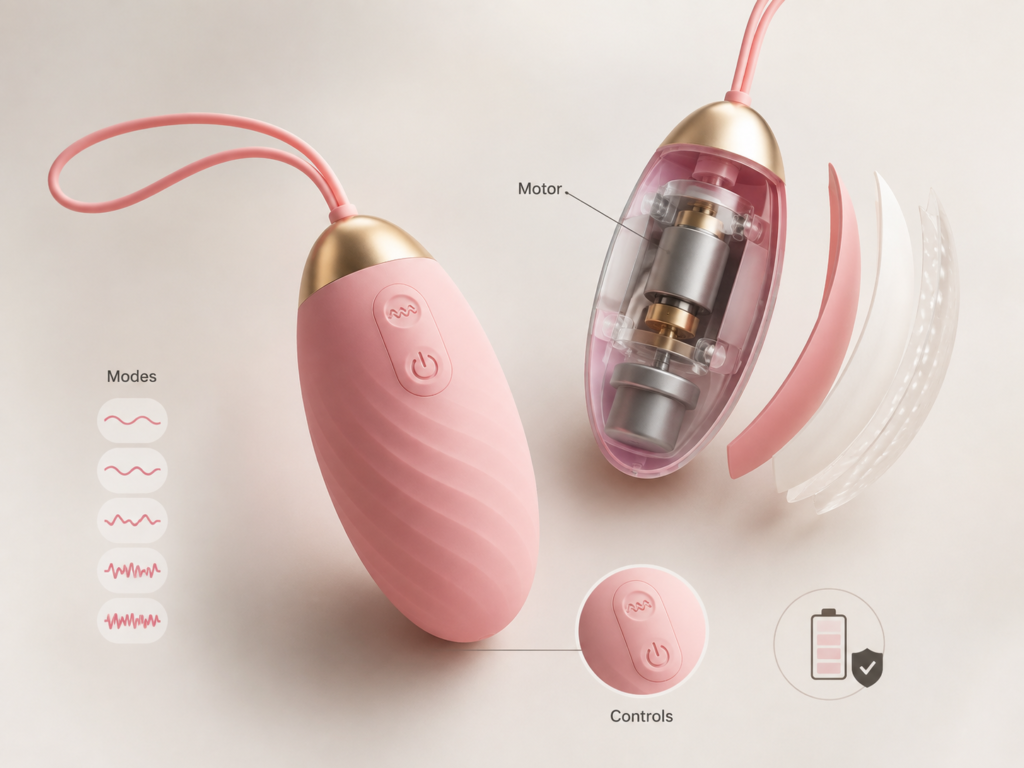
Two egg vibrators can both advertise “10 modes” and still provide very different user experiences. One may offer clear differences between settings and independent intensity control, while another may cycle through several patterns that feel very similar. Construction and controls also affect how those settings reach the outer surface. This guide explains what to compare beyond the headline number. If you’re evaluating options, browse our egg vibrators and compare the exact SKU specifications rather than mode count alone.
Why Is Mode Count Not a Performance Metric for Egg Vibrator Vibration Modes?
Mode count tells you how many settings are listed. It does not tell you how distinct those settings feel or how well the product delivers them.
Egg vibrator vibration modes are only one part of the product. Perceived performance can also change with the motor arrangement, product construction, control system, battery condition, and the way the exact model is being used.
Dive Deeper:
- Mode count is not strength. A “10-mode” label may include steady levels, pulse patterns, waves, or other programmed sequences. The number does not prove that one product is stronger than another.
- Construction matters too. Two products using similar control software can still feel different because the motor, shell, outer layer, and overall design are not identical.
- Controls affect usability. A product that separates intensity from pattern selection may feel easier to customize than one that cycles through every setting with a single button, although either system can work well when clearly designed.
- Battery behavior can matter. If output changes as the battery level falls, that behavior should be considered separately from the advertised number of modes.
- Retail impact: Listing several nearly identical products only because they have different mode counts can create unnecessary SKU overlap. Buyers usually benefit more from clear differences in controls, construction, size, or features.
What Matters More Than Mode Count
| Factor | Why It Matters | How to Compare |
|---|---|---|
| Motor arrangement | Can influence where vibration feels strongest | Use supplier information or sample notes |
| Outer construction | Changes how vibration reaches the surface | Compare exact SKU construction |
| Intensity control | Determines how finely output can be adjusted | Check whether intensity is separate |
| Pattern control | Affects access to different sequences | Review button/app/remote logic |
| Battery behavior | May affect consistency over a session | Use current product documentation |
| Memory/off | Changes everyday usability | Check startup, shutdown, and recall logic |
Where Is the Motor Located Inside an Egg Vibrator?
Motor placement can influence where vibration is most noticeable, but placement alone does not predict the final feel.
The exact result depends on the complete product construction, including how the motor is mounted, the shape of the shell, surrounding materials, and the way the control system drives it.
Dive Deeper:
- Tip-biased placement: If the motor is positioned closer to one end, vibration may feel more noticeable in that area. The exact effect depends on the rest of the construction.
- Center placement: A centrally located motor may distribute vibration differently across the body, but this should not be described as automatically more even without product-specific evidence.
- Base-biased placement: A motor positioned nearer the base can create another transfer pattern, but it does not automatically improve stability or performance.
- Mounting matters: The way the motor is fixed inside the product can affect vibration transfer and noise. Use supplier documentation when available rather than inferring the internal structure from feel alone.
- Practical mapping:
- Start with a low or moderate steady setting.
- Compare how vibration feels across different parts of the outer surface.
- Repeat with another documented mode.
- Record observed differences without claiming a specific internal design unless the supplier confirms it.
- B2B note: If motor placement is documented, include it in the product record. If not, describe the observed output zones conservatively rather than turning them into a fixed architecture claim.
Motor Placement & Expected Transfer (General Patterns)
| Placement | Possible Perceived Area | Considerations |
|---|---|---|
| Tip-biased | Tip or forward section | Exact result depends on full construction |
| Center | Middle area | Distribution varies by shell and outer layer |
| Base-biased | Rear or base section | Does not guarantee stronger forward transfer |
How Do ABS Shells, Silicone Layers, and Product Mass Affect Transfer?
Two products with similar motors can still feel different because vibration has to pass through the finished product before reaching the outer surface.
Shell rigidity, outer-layer thickness, product size, and overall construction can all influence the final feel, but these factors should not be treated as universal rules.
Dive Deeper:
- ABS shells: A rigid shell can create a different vibration character from a softer outer construction, but the final feel still depends on the motor, mounting, geometry, and control system.
- Silicone layers: A silicone surface or overmold may change how vibration is perceived compared with exposed hard plastic. Do not assume that thicker silicone always produces one specific result.
- Mixed constructions: Products that combine ABS, silicone, coatings, or other components can transmit vibration differently depending on the exact design. Avoid inferring internal gaps or damping behavior without documentation.
- Product mass: Weight can affect how the device feels in the hand or during use, but heavier does not automatically mean more stable, stronger, or quieter.
- Fit and friction: Surface finish can change contact feel, but it should not be used to predict vibration performance or noise without product-specific evidence.
- Practical comparison:
- Compare products at similar documented settings.
- Note whether the modes feel clearly different.
- Record construction and surface information from the exact SKU.
- Avoid turning one sample observation into a category-wide rule.
Construction Influences
| Factor | What It May Change | What to Verify |
|---|---|---|
| Rigid outer shell | Character of vibration at the surface | Exact construction and sample feel |
| Silicone outer layer | Perceived softness or diffusion | Material and layer description |
| Product size/weight | Overall handling and vibration feel | Exact SKU dimensions and weight |
| Mixed construction | Transfer across different components | Supplier-documented structure |
What Is the Difference Between Speed, Intensity, and Pattern?
Retail terminology is not always consistent, which is why product pages can become confusing.
In many listings, “speed” or “intensity” refers to stronger or weaker vibration levels, while “pattern” or “mode” refers to changes in rhythm or sequence. The exact terminology should follow the product documentation for the SKU.
Dive Deeper:
- Speed vs intensity: Some manufacturers use these words interchangeably, while others separate them. Do not assume every product uses an engineering definition such as RPM or amplitude.
- Pattern content: Patterns may include pulses, waves, ramps, or other sequences. A larger pattern count does not guarantee that every setting will feel clearly different.
- UI clarity: Some products use separate controls for intensity and pattern, while others use one button to cycle through settings. Both can work well when the sequence is easy to understand.
- Test approach:
- Identify what the manual calls speed, intensity, mode, or pattern.
- Check whether intensity can be adjusted independently.
- Compare whether the available patterns remain distinguishable at different settings.
- Keep retail wording aligned with the manufacturer’s terminology.
- For deeper theory, see our general vibration patterns guide. Then apply the same terminology carefully to the exact egg vibrator being listed.
Speed, Intensity, Pattern—Quick Map
| Parameter | What It Usually Describes | Why It Matters |
|---|---|---|
| Speed | A manufacturer-defined vibration level | May overlap with “intensity” wording |
| Intensity | Stronger or weaker output level | Helps buyers understand adjustment |
| Pattern | Rhythm or sequence of vibration | Adds variety beyond steady settings |
How Do Battery State and App Control Affect Consistency?
Battery and connected controls can affect the overall experience, but their impact varies by model.
The key point is not to assume that every rechargeable egg changes output in the same way as the battery level falls, or that app control always changes vibration strength.
Dive Deeper:
- Battery behavior: Some products may maintain similar performance through much of the charge cycle, while others may behave differently as power becomes low. Use the current SKU documentation or sample observation.
- Low-battery behavior: Products may use LEDs, app notices, vibration cues, reduced output, or automatic shutdown. Record the exact behavior where documented.
- App vs remote control: An app may offer a different control interface from a hardware remote, but this does not automatically mean stronger or finer output. Describe the actual control options.
- Connectivity: If the app disconnects, confirm what the exact model does—continue, pause, stop, or require reconnection. This is a usability issue rather than a mode-count issue.
- Practical test:
- Compare the product at normal operating conditions.
- Note any documented low-battery behavior.
- Confirm what remains controllable if the app or remote disconnects.
- Avoid creating a fixed “fresh vs partial battery” benchmark for all products.
- Category context: For deeper discussion of runtime and charging claims, see our Egg Vibrator Battery Life guide. This article stays focused on how control and consistency relate to vibration modes.
Battery & Control Consistency Checks
| Checkpoint | What to Observe |
|---|---|
| Battery behavior | Any documented change as charge falls |
| Low-battery signals | LED, app, vibration, or shutdown cues |
| App vs remote controls | Differences in available control options |
| Disconnect behavior | Continue, pause, stop, or reconnect |
Which Controls, Memory, and Off Functions Should Be Tested?
Usability can make a small number of well-designed modes feel more useful than a longer list that is difficult to navigate.
The control system should make it clear how to change settings, stop the device, and return to a preferred mode when the product supports memory.
Dive Deeper:
- Memory behavior: Some eggs remember the last mode or intensity, while others restart at a default setting. Neither behavior is automatically better, but it should be documented.
- Button layout: Separate controls may make pattern and intensity selection easier to understand, while single-button systems can still work well when the sequence is clear.
- Lock function: If a travel lock exists, explain how it works. Do not assume every product includes one.
- Off reliability: Confirm the documented shutdown method. If the device can only be stopped through a remote or app, make that dependency clear.
- LED behavior: Indicators can provide useful feedback, but their brightness and meaning vary by SKU. Do not add discretion claims unless the documentation supports them.
- Packaging and scripts: Quick-start instructions should explain power, mode changes, shutdown, lock behavior, and memory where relevant.
Control & Usability Checklist
| Feature | Why It Matters | How to Check |
|---|---|---|
| Memory (mode/int) | Helps users understand startup behavior | Power cycle and note documented state |
| Off function | Clarifies shutdown method | Follow exact manual instructions |
| Lock | Prevents accidental activation where supported | Confirm lock/unlock steps |
| Button layout | Affects ease of navigation | Compare how settings are accessed |
| LED indicators | Provides status feedback | Record documented meanings |
How Should Retailers Compare Two “10-Mode” Eggs?
Two products that both advertise “10 modes” should not be treated as identical.
The useful comparison is whether those modes are clearly differentiated, how intensity is controlled, what the product construction is, and how consistent and easy the device is to operate.
Dive Deeper:
- Structure the test:
1) Confirm the exact number and type of documented modes.
2) Check whether intensity is separate from pattern selection.
3) Record the outer construction and material.
4) Compare whether the settings feel meaningfully different.
5) Review the current noise claim without assuming clothing-specific performance.
6) Check battery/runtime information in the separate battery documentation.
7) Confirm memory, off, and lock behavior where supported. - Reduce SKU duplication: If two eggs offer almost the same control system, construction, and user experience, another “10 modes” label may not create meaningful assortment differentiation.
- Copy guidelines: Avoid unsupported “strongest,” “deepest,” or “most powerful” claims. Explain what the product actually offers and how its controls differ.
- Merchandising note: Pattern count can remain a useful product specification, but it should sit alongside construction, control method, dimensions, battery information, and other verified features.
Retail Comparison Worksheet (Fill per model)
| Dimension | Egg A Notes | Egg B Notes |
|---|---|---|
| Documented modes | ||
| Separate intensity control | ||
| Control method | ||
| Shell/overlay construction | ||
| Perceived mode differences | ||
| Noise claim | ||
| Battery/runtime info | ||
| Memory/off/lock |
Need help turning worksheets into copy? Review our approach to adult toy product descriptions and contact our team for SKU-specific support and packaging inserts.
FAQ
Do more vibration modes mean stronger performance?
Not by themselves. Mode count only tells you how many settings are listed. Perceived strength and overall performance also depend on the exact product construction, control system, motor arrangement, battery behavior, and how clearly the different settings are delivered.
What is the difference between speed and pattern?
Manufacturers do not always use the same terminology. “Speed” or “intensity” often describes stronger or weaker vibration levels, while “pattern” usually describes changes in rhythm or sequence. Check the exact SKU documentation before using these terms in retail copy.
Can the same motor feel different in two egg shells?
Yes. The finished product construction can change how vibration reaches the outer surface, so products using similar motors can still feel different. Avoid assuming one shell material or thickness always creates the same result.
Should retailers publish “strong vibrations” without measured evidence?
It is better to keep the wording specific to the available evidence. If measured or supplier-documented performance data is unavailable, describe the controls, settings, construction, and observed differences without turning them into unsupported superlatives.
Conclusion
Egg vibrator vibration modes are useful product specifications, but the number of modes should not be treated as a performance score. Two eggs can both list “10 modes” while differing in construction, control logic, intensity adjustment, battery behavior, noise, memory, and shutdown functions, which can make the actual experience very different. Retailers should compare those details before using pattern count as the main merchandising message, and buyers should look for clear differences between settings rather than assuming that a larger number automatically means stronger or better vibration. Browse our Egg Vibrators or contact WMCustomDolls for wholesale selection, packaging, and private-label coordination.
Planning a Wholesale Order?
Share your product interests, estimated quantity and destination market with our team.
Request Wholesale Information