


Blog
Sex Doll Skin Tone: Why Do Screens, Lighting, and Batch Variation Cause Color Disputes?

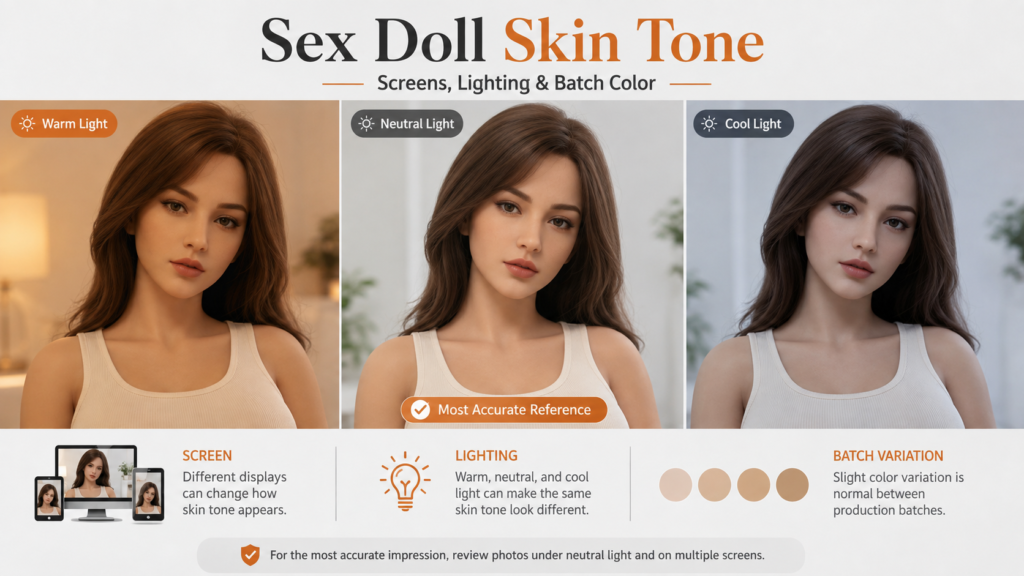
A web swatch may look precise, but relying on it as an exact physical standard can lead to disappointment, delayed approvals, and costly color disputes.
On this page 8 sections
Choosing a sex doll skin tone is a color-management process. Buyers should identify the supplier’s color code, review current neutral-light evidence, confirm the material and finish, approve a dated reference, and document the expected comparison method or variation tolerance when available rather than expect an exact screen match.
At WMCustomDolls, we recommend separating what a screen displays from what a physical product can reliably reproduce. This distinction matters to individual buyers, but it is even more important for retailers and private-label teams managing product pages, packaging, repeat orders, and head-to-body matching.
Why Does the Same Tone Look Different Online?
Two photos of the same product can look like two different colors, making a buyer question which image represents the actual tone.
A tone can look different online because camera white balance, exposure, ambient light, editing, background color, compression, and display settings all affect appearance. Product photos should help identify a color, but they should not be treated as exact physical color standards.
A camera does not record color independently of its surroundings. Warm indoor lighting may make a neutral tone look more yellow or orange. Cool lighting can add a blue or gray cast. Bright exposure may reduce visible depth, while underexposure can make the same surface appear darker and more saturated.
The background also changes perception. A swatch next to bright white may appear darker. The same swatch beside black may look lighter. Strongly colored clothing, walls, or nearby surfaces can reflect color onto the product.
The image then passes through several more stages:
- The camera applies its own color processing.
- Editing software may change white balance, contrast, or saturation.
- The website may compress or resize the file.
- The buyer’s browser interprets the image.
- The display uses its own brightness, color mode, and calibration.
- Ambient light in the buyer’s room changes how the display appears.
This screen difference is why choosing “the closest photo” can fail. A phone in vivid mode, an office monitor, and a dim laptop may show the same file differently. Even a calibrated screen cannot reproduce every physical surface effect because a display emits light while a product reflects it.
Neutral media reduces uncertainty but does not eliminate it. We recommend requesting images taken under consistent, neutral lighting with a plain background and minimal editing. The supplier should identify the exact model, material, finish, and color code shown.
Color-management systems exist because the same digital color data may need different interpretation across capture, display, and output devices. For a technical overview, see the International Color Consortium’s introduction to ICC color management.
Marketing Name vs. Color Code: Which Should Buyers Use?
Names such as fair, natural, tan, or brown sound intuitive, but they may describe different colors across brands, materials, or product lines.
Use the supplier’s documented color code as the primary identifier and treat the marketing name as a customer-friendly label. A code is more stable than a descriptive name, although it still must be linked to the correct material, finish, supplier, and current sample.
Marketing names are useful for browsing skin color options, but they are not universal standards. “Natural” might describe a pale neutral shade for one supplier and a warmer medium shade for another. “Tan” may refer to different undertones or depths depending on the catalog.
A color code reduces ambiguity only when its scope is clear. Before approving it, ask:
- Which supplier or brand owns the code?
- Does it apply to TPE, silicone, or both?
- Is the code the same for the head and body?
- Does the finish affect its appearance?
- Is the code current for this model and batch?
- Is the web swatch based on a physical sample?
- Have the photographs been edited?
- Is there a documented variation tolerance?
A useful color record might read:
| Field | Example of what to document |
|---|---|
| Marketing name | Customer-facing tone name |
| Supplier color code | Exact alphanumeric code |
| Material | Material stated for the selected component |
| Finish | Matte, satin, painted, or supplier-defined finish |
| Component | Head, body, removable part, or complete configuration |
| Reference | Dated sample, swatch, or approved media |
| Lighting | Neutral-light setup used for review |
| Batch or revision | Current identifier where available |
| Variation | Written supplier tolerance or limitation |
These fields prevent a common data problem: reusing one color name across unrelated brands and assuming it represents the same physical color.
WMCustomDolls carries selected dolls across several brands and organizes product choices using practical categories such as brand, body type, size, weight, and material. Color information should receive the same SKU-level treatment rather than being reduced to a generic label.
How Do Material and Finish Affect Color?
A color code may look different when applied to another material or surface finish, even if the pigment description appears unchanged.
Material and finish affect how light is absorbed, reflected, and scattered. TPE and silicone products—or two formulations within one broad material category—should not be expected to display a color identically without model-specific evidence and a matched physical reference.
A material label alone does not confirm the finished color. The visible result can depend on the base material, pigment mixture, thickness, opacity, molding process, surface texture, paint layers, and finishing method. We do not recommend assuming that one color code transfers perfectly between materials or suppliers.
Finish is especially important. A matte surface may diffuse reflections and appear softer or lighter in some lighting. A glossier surface can create bright highlights and deeper-looking shadows. Fine texture may also change the way color appears from different angles.
Added coloring creates another layer. Facial makeup, body shading, freckles, veins, nail color, and other painted details may alter the overall impression without changing the underlying body color. Buyers should distinguish among:
- Base material color
- Surface finish
- Face or body makeup
- Hand-applied shading
- Optional painted details
- Clothing or accessory color reflected onto the surface
The product’s thickness may also affect the visible result in some areas. Thin edges or detailed components can interact with light differently from thicker sections. That does not prove a defect or a different color by itself; it means the review should consider the complete physical product.
When comparing available doll options, buyers should request evidence for the exact head, body, material, finish, and tone combination. WMCustomDolls lists dolls across different brands and includes silicone, TPE, and PVC as material categories, so color assumptions should not be transferred automatically from one category to another.
How Should Buyers Approve a Sex Doll Skin Tone?
An approval based on a screenshot or an attractive promotional image leaves too many variables undefined.
Use a five-step color approval process: supplier code, current physical sample, neutral media, approved reference, and written variation tolerance. The approval should identify the exact SKU, material, finish, components, lighting conditions, and date.
1. Start with the supplier’s code
Record the supplier’s current color code and marketing name. Do not approve only a typed description such as “light” or “tan.” If the supplier has no stable code system, request a dated swatch or sample identifier.
2. Request a current sample
A physical sample is more useful than a web swatch because it can be viewed under different lighting. However, it still needs context. Confirm whether it uses the same material, pigment system, and finish as the ordered model.
For an individual order, a current production photo or sample chip may be the practical evidence available. Wholesale and private-label buyers should consider approving a physical sample when color consistency is commercially important.
3. Review neutral media
Request neutral-light photos and, when available, a short video. Useful media should include:
- A plain neutral background
- A known neutral reference card where practical
- Several viewing angles
- Wide and close-up views
- Minimal or disclosed editing
- The exact head and body configuration
- File names linked to the quotation or SKU
Neutral lighting is not the same as “bright lighting.” The objective is consistent, balanced illumination that avoids strong warm or cool casts.
4. Create an approved reference
The buyer and supplier should identify which evidence controls the order. It may be an approved physical sample, a swatch, or a dated group of neutral-light images. A screenshot from a social media post should not silently become the production standard.
5. Document acceptable variation
Physical production may involve some variation. The supplier should explain what variation may occur and whether a written tolerance or approval boundary is available. If no measurable tolerance exists, record the comparison method and limitation rather than promising an exact match.
WMCustomDolls supports wholesale selection, customization, production coordination, and order follow-up, including mixed-order and selected OEM or private-label projects. Color approvals should still be documented for the exact product and project rather than assumed from general service descriptions.
What Color Variation Should Be Disclosed?
Promising an exact match can create unrealistic expectations when physical materials, hand-applied details, components, and production batches are involved.
Sellers should disclose that screen colors are approximate, physical samples may vary, finishes affect appearance, hand-applied details are not perfectly identical, and repeat batches may show limited differences. Any measurable tolerance should come from documented supplier information rather than an invented universal rule.
A clear disclosure should distinguish among several types of variation:
Screen-to-product variation
The physical product may not look identical to a web swatch because displays emit light and use different settings. This disclaimer should not be used to excuse an entirely wrong code, but it does establish that exact screen matching is not a reliable promise.
Sample-to-production variation
An approved swatch or sample represents a reference, not necessarily a guarantee of pixel-level identity. Buyers should ask whether it was made using the current material, pigment process, and finish.
Batch variation
A new production run may show some batch variation because materials, pigment preparation, finishing, and production conditions can differ between runs. The acceptable range should be written when possible. We should not invent a universal color tolerance because different manufacturers may use different systems.
Component variation
A head and body may be produced separately, use different thicknesses or finishes, or receive different surface detailing. This can create a visible difference even when both components carry the same tone name.
Hand-applied detail variation
Makeup and surface coloring may vary slightly when applied individually. Sellers should identify which details are hand-finished and which differences are expected, if that information is documented.
Honest disclosure reduces remakes, exchanges, delayed approvals, and customer-service disputes. It also helps buyers distinguish normal limited variation from an incorrect configuration. If a seller cannot define the boundary, the listing should tell buyers to request current evidence before ordering.
How Can Repeat Orders Stay Consistent?
A repeat order can drift from the original when teams rely on an old photo, reused marketing name, or undocumented verbal approval.
Repeat-order consistency requires a master color record containing the supplier code, material, finish, approved sample, neutral photos, component match, batch or revision data, and accepted variation. Every reorder should be checked against that record before production or listing updates.
Retailers should maintain one approved color file for each relevant SKU. The file should include:
- Brand and model
- Head and body identifiers
- Supplier color code
- Customer-facing color name
- Material by component
- Finish and painted details
- Approved neutral images
- Physical sample identifier
- Approval date and version
- Applicable batch information
- Written variation limitations
- Person or team responsible for approval
This record should control product pages, marketplace listings, customer-service scripts, private-label packaging, and reorder documents. If teams use different files, a color called “natural” in purchasing may become “light tan” in marketing and “beige” on the package. That inconsistency can create disputes even when the product itself has not changed.
For cross-component matching, approve the assembled configuration rather than separate swatches whenever possible. A head and body viewed individually may look acceptable but show a noticeable contrast when placed together. Neutral photos should show the connection area and the complete product under the same light.
Before a repeat order, ask whether the material, finish, pigment system, supplier code, or component source has changed. If any variable has changed, request updated evidence and treat it as a new color approval.
For private-label packaging, avoid printing a web swatch as though it were an exact product standard. Use it as an approximate color indicator and place the controlling code in the internal specification. Packaging artwork should also be reviewed using suitable proofing methods because printed ink introduces another color system.
WMCustomDolls supports brands, wholesalers, distributors, and retailers with flexible sourcing, professional order coordination, privacy-focused packaging, and selected OEM or private-label solutions. For repeat orders, our team can help coordinate current product information, but buyers should approve the relevant color evidence and limitations in writing.
FAQ
Can a Doll’s Head and Body Match Exactly?
An exact match should not be promised without evidence. Head and body components may differ in material thickness, finish, painted details, production timing, or batch, so buyers should request an assembled neutral-light reference and written matching expectations.
Should Edited Photos Be Used as Color References?
Edited photos can support marketing, but they should not control color approval unless all changes are disclosed and the supplier confirms the reference. A dated, minimally edited neutral-light image or current physical sample is more useful for approval.
What Belongs in a Formal Color Approval?
A color approval should identify the brand, SKU, head, body, material, finish, supplier code, marketing name, approved sample or images, lighting conditions, date, revision, and accepted variation. It should also state which features are optional or hand-applied.
What Should a Buyer Do If No Physical Sample Is Available?
Request current neutral-light photos and video of the exact material, finish, color code, and configuration. Document that approval is based on digital evidence and acknowledge that exact screen matching cannot be guaranteed.
Conclusion
Reliable sex doll skin tone selection starts with codes, current samples, neutral evidence, and written tolerances. Contact WMCustomDolls for product, wholesale, or private-label coordination.
Planning a Wholesale Order?
Share your product interests, estimated quantity and destination market with our team.
Request Wholesale Information