


Blog
Sex Doll Skin Texture: What Can Product Photos Actually Prove?

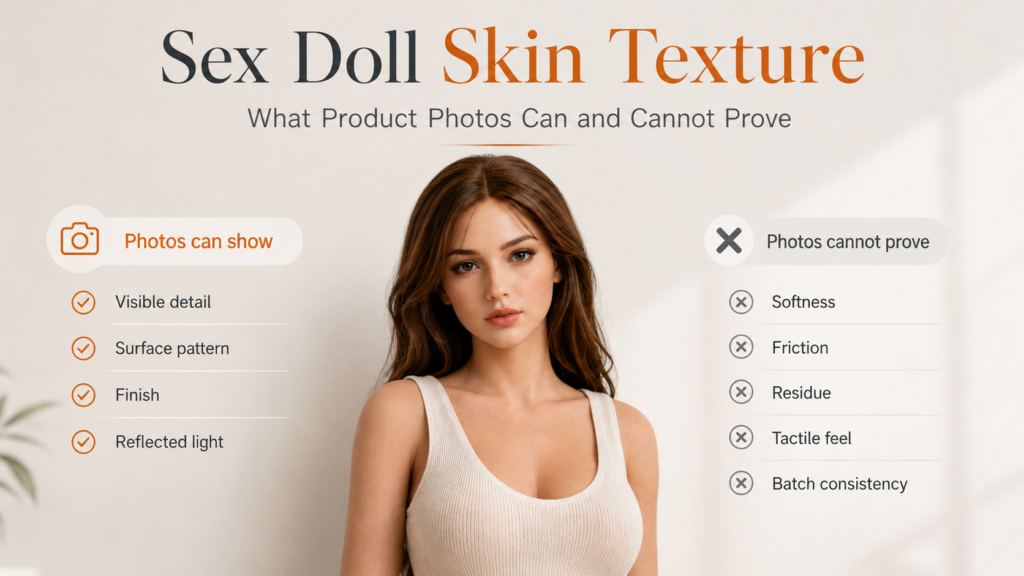
Sharp product photos can reveal fine details, but they can also create expectations about softness, friction, and finish that the images cannot support.
On this page 8 sections
Sex doll skin texture can involve molded detail, surface finish, any confirmed coating, surface consistency, and care requirements. Photos can show visible patterns and reflected light, but they cannot prove tactile feel, friction, residue, coating stability, softness, or consistency between production batches.
At WMCustomDolls, we recommend moving from visual evidence to physical and written evidence. Review neutral images, request close-up video, inspect a current sample when practical, confirm the finish description, check care compatibility, and agree on acceptable variation.
What Does Sex Doll Skin Texture Mean in a Specification?
The word “texture” is often used without defining whether it refers to visible detail, surface feel, finish, or material behavior.
In a useful specification, sex doll skin texture should identify molded surface detail, visible finish, any applied coating, expected surface consistency, and approved care requirements. Softness, friction, residue, and tactile feel should be documented separately rather than inferred from appearance.
Texture is not one property. It is a group of surface characteristics that may come from different parts of the production and finishing process.
Molded texture
Molded texture refers to physical details formed by the mold. These may include fine lines, folds, pores, or other sculpted patterns. Macro photography can show whether such details are visible, but it cannot establish how noticeable they feel to the touch.
Molded details may also look different across body areas. A face, hand, torso, and limb do not necessarily have the same degree of visible definition. Buyers should request close-ups of the specific areas that influence their decision rather than rely on one detailed image.
Surface finish
Finish describes how the surface looks and reflects light. Common descriptions include matte, satin, or glossy, but these are not standardized grades. One supplier’s matte finish may reflect more light than another supplier’s version.
A finish description should state whether the appearance comes from the base material, molding method, powder or maintenance treatment, painted layer, or separate coating when that information is available.
Tactile properties
Softness, tackiness, drag, slipperiness, friction, and residue are tactile or handling properties. They cannot be verified accurately through photographs. Even video provides only indirect clues.
WMCustomDolls lists products across silicone, TPE, and PVC material categories and offers dolls from multiple brands, so texture assumptions should not be transferred automatically from one material or brand to every other product. Buyers should request information for the exact SKU, finish, and current configuration.
Why Can Studio Photos Hide Surface Problems?
Zooming into a polished image feels like careful research, but image resolution does not remove the effects of lighting, styling, or retouching.
Studio photos may hide shine, seams, dust, uneven finish, coating marks, or surface variation through soft lighting, selective focus, flattering angles, editing, and surface preparation. A high-resolution image proves visible detail only under the conditions used to create that image.
Soft, diffused lighting can reduce bright reflections and make a surface look more uniformly matte. Directional light may emphasize molded detail while leaving other areas in shadow. Shallow focus can keep the face sharp while hands, joints, or larger body areas remain blurred.
Preparation also matters. A product may be cleaned, powdered, styled, or positioned immediately before photography. That presentation does not necessarily show how the finish looks after storage, unpacking, routine cleaning, or repeated handling.
Image editing can alter:
- Contrast and visible depth
- Highlights and apparent gloss
- Color and saturation
- Small marks or particles
- Seams and transitions
- Uneven reflections
- Surface consistency across body areas
A matte finish can look glossier under direct light, while a glossy finish can appear subdued under large, soft light sources. Neither result alone confirms a defect. The problem is treating one lighting setup as a complete surface record.
Retail buyers face an extra risk because campaign images may be copied directly into listings. If the delivered product reflects light differently, customers may believe they received another finish. This can create sample disappointment, disputes, returns, and avoidable pressure on customer-service teams.
Ask for neutral-light macro images with minimal editing, but do not treat them as tactile proof. They should be one step in the evidence process, followed by video, documentation, and a sample where the commercial risk justifies it.
How Do Molded Detail, Coating, and Finish Interact?
A detailed mold does not guarantee a convincing final surface if the finish or coating changes how those details appear and feel.
Molded detail creates physical patterns, while finish and coating affect reflectivity, friction, color depth, residue, and how clearly the details remain visible. The final result depends on the complete surface system, not on the mold or broad material label alone.
Fine molded lines may look prominent before finishing but appear softer after a surface layer is applied. A coating may reduce shine, change friction, support a visual effect, or modify how the surface handles. However, buyers should not assume that every model uses a separate coating. That point needs supplier confirmation.
The following fields should be separated in a product specification:
| Surface field | What it should describe |
|---|---|
| Base material | Supplier-stated material for the relevant component |
| Molded detail | Visible patterns formed during molding |
| Finish | Matte, satin, glossy, or another defined appearance |
| Coating | Separate applied surface layer, if confirmed |
| Coloring | Base pigment and added surface details |
| Treatment | Powder, dressing, or other approved maintenance step |
| Tactile description | Supplier-defined feel without human-equivalence claims |
| Variation | Acceptable visual or handling differences |
The phrase realistic skin should be used carefully. It may describe a visual design goal, but it does not prove equivalence to human skin. Retailers can make the description more useful by naming the visible attributes, such as fine molded lines, reduced surface shine, layered coloring, or detailed hands.
Surface consistency also deserves attention. The face, body, hands, feet, and joint areas may not reflect light identically because of their geometry, thickness, texture, coloring, or finish. A separate head and body may also involve component-specific processes.
Buyers can review our available doll categories before requesting exact surface information. Since WMCustomDolls carries selected doll options across multiple brands and material categories, confirmation should remain model-specific.
Which Evidence Can Confirm Texture?
One attractive image is weak evidence, while a structured sequence can separate observable facts from subjective expectations.
Use neutral photographs to assess visible detail, close-up video to inspect reflections, a current sample to assess tactile properties, written finish documentation to define construction, approved care guidance to check compatibility, and batch comparisons to evaluate consistency.
A practical verification process follows six steps.
1. Review neutral images
Request full-body and macro images under neutral, consistent lighting. Ask for the face, hands, torso, limbs, joints, and transitions to be shown. Confirm that the images represent the exact SKU and selected finish.
2. Request close-up video
Video can show how reflections move as the camera or light angle changes. It may reveal uneven gloss, particles, seams, or local finish differences that remain hidden in a single image.
Video still cannot prove softness or friction. It is visual evidence, not a substitute for physical inspection.
3. Inspect a current sample
A sample or representative finish piece can provide direct evidence of touch, friction, dust attraction, residue, and cleaning response. Confirm that it uses the same documented material and finish as the intended model.
For B2B orders, buyers should record the sample date, SKU, supplier, finish, and configuration. An unidentified sample has limited value as a future quality reference.
4. Obtain a finish description
Ask what creates the visible result. Is it molded into the base surface, applied as a coating, produced through a finishing process, or maintained with a care product? If the supplier cannot confirm a detail, record it as unverified.
5. Check care compatibility
Request approved cleaning and maintenance guidance. Do not test unapproved cleaners or treatments based only on generic online advice. Our silicone doll FAQs and care tips provide broader care information, but the exact model manual should take priority.
6. Define defect tolerance
Agree on what counts as acceptable variation and what may qualify as a surface issue. Useful reference points include uneven gloss, visible coating marks, residue, particles, seams, color transitions, and differences between major body areas.
WMCustomDolls states that it works with production partners using quality-control standards to support consistency and customer confidence. For a specific order, buyers should still request the relevant specification, evidence, and approval process rather than assume that a general quality commitment defines every surface tolerance.
How Do Care and Storage Affect the Finish?
A finish that looks consistent when new may change if cleaning, maintenance, contact materials, or storage conditions are incompatible.
Care and storage can affect shine, residue, dust attraction, coating appearance, and surface consistency. Follow the exact model’s approved instructions, use compatible products, avoid unsupported treatments, and record the original finish before evaluating later changes.
Cleaning can remove dust and residue, but an incompatible product may also alter the appearance of a finish or coating. Buyers should request a written list of approved methods and known incompatibilities. A statement such as “easy to clean” is not enough for a careful ownership or retail-support decision.
Storage can introduce other variables:
- Contact with colored fabrics
- Pressure against textured materials
- Dust exposure
- Contact between coated surfaces
- Residue from packaging materials
- Changes caused by unapproved powders or treatments
- Local shine from repeated rubbing or handling
These risks do not affect every product identically. They may depend on the material, finish, coating, storage duration, surrounding conditions, and supplier guidance.
Before first use or display, individual buyers can take neutral-light reference photos. Retailers can do the same when receiving or approving a sample. If the surface later changes, this record helps distinguish the original finish from a maintenance, storage, packaging, or handling issue.
The cost of texture is not limited to the purchase price. It can include approved care products, cleaning time, protective storage, staff training, complaints about residue, and replacements or returns when expectations were based on unsupported claims.
For broader material and quality considerations, see our silicone sex doll buyer’s guide. Texture should still be assessed independently using surface-specific evidence.
How Should Retailers Describe Skin Texture?
Vague promises about softness or human-like feel may attract attention, but they also increase support pressure when buyers interpret them as measurable guarantees.
Retailers should separate visible facts from tactile claims. Describe molded detail and finish from approved evidence, identify coating only when documented, qualify subjective feel, disclose possible variation, and avoid claiming that photographs prove softness or human-skin equivalence.
A strong product description might state that a model has visible molded lines and a supplier-described matte finish. It should not automatically say the surface feels soft, non-sticky, residue-free, or identical to human skin unless suitable SKU-level evidence supports the exact wording.
Retailers should create a surface reference containing:
- Brand, model, and SKU
- Material by relevant component
- Molded-detail description
- Finish name and definition
- Confirmed coating information
- Neutral macro images
- Close-up video reference
- Approved tactile wording
- Care and storage instructions
- Sample approval date
- Batch or revision information
- Acceptable variation
- Escalation criteria for surface complaints
This file can support listings, wholesale catalogs, staff training, customer service, private-label packaging, and repeat-order comparisons.
A sample and production unit may not be perfectly identical. Buyers should ask what variation is expected and whether a written boundary is available. If no measurable tolerance exists, use clear visual criteria and approved reference media instead of inventing a numerical standard.
WMCustomDolls supports brands, wholesalers, distributors, and retailers with flexible sourcing, order coordination, mixed product selection, and selected OEM or private-label projects. Privacy-focused packaging and production coordination are also part of the company’s stated business support, although current options should be confirmed for the specific product and project.
FAQ
Can a Matte Appearance Prove Softness?
No. Matte describes how a surface reflects light, while softness is a physical property that requires tactile or documented evidence. A matte-looking product may still vary in firmness, friction, or residue.
Why Might Different Batches Reflect Light Differently?
Possible causes include differences in material, pigment, molding, surface treatment, coating, maintenance, or photography conditions. Buyers should compare units under the same neutral lighting and request supplier review rather than assume every difference has the same cause.
Should Texture Be Included in a Quality-Control Reference?
Yes, especially for wholesale, repeat orders, and private-label projects. The reference should identify the SKU, molded details, finish, coating status, approved media, sample date, care method, and acceptable surface variation.
Can Close-Up Photos Prove That a Surface Is Residue-Free?
No. Close-up images may reveal visible particles or shine, but they cannot reliably prove friction, transfer, tackiness, or invisible residue. A current sample and documented inspection method provide stronger evidence.
Conclusion
Sex doll skin texture should be verified through neutral media, samples, finish records, care guidance, and agreed tolerances. Contact WMCustomDolls for product selection, wholesale, mixed-order, or private-label support.
Planning a Wholesale Order?
Share your product interests, estimated quantity and destination market with our team.
Request Wholesale Information