


Blog
Cock Ring, Penis Ring, or Erection Ring? How Retailers Should Use Each Term

Similar keywords can lead to very different expectations. Using every synonym everywhere can create duplicate categories, unclear claims, and confusing product feeds.
On this page 8 sections
Retailers can treat “cock ring” and “penis ring” as closely related consumer shopping terms. “Erection ring,” “tension ring,” and “penile constriction ring” often carry stronger erectile-dysfunction or medical-device context, so they require more careful product matching, evidence, and claim control.
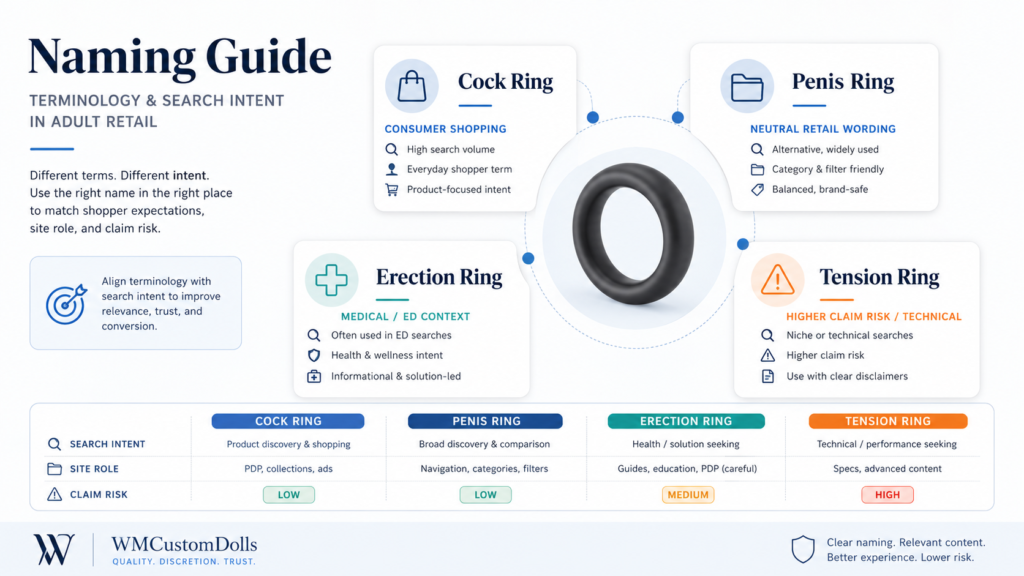
The product’s function does not change simply because its name changes. However, each term can change what shoppers, search engines, marketplaces, and customer-service teams expect to find.
Why Do These Terms Overlap but Carry Different Search Intent?
Keyword tools may place all five terms in one group, but they do not reveal why a person selected a particular phrase.
These terms overlap because they may describe related ring-shaped products, but they do not always express the same intent. “Cock ring” and “penis ring” commonly indicate retail browsing, while “erection ring,” “tension ring,” and clinical wording may indicate erectile-dysfunction research or use with a vacuum device.
The hidden difference is not necessarily the physical object. It is the user’s expected context.
A shopper entering “cock ring” may expect an adult product category with flexible, adjustable, rigid, vibrating, or couples-oriented designs. Someone entering “penis ring” may want similar products but prefer more neutral wording. In contrast, a search for “erection ring for ED” may come from a reader seeking information related to a health concern.
Medical sources use formal wording in contexts that connect constriction rings with erectile function and vacuum erection devices. The Sexual Medicine Society of North America uses “penile constriction rings” and discusses some models specifically designed for use with vacuum erection devices as part of erectile-dysfunction care. Consumer health content also recognizes cock ring, penis ring, tension ring, and constriction ring as overlapping names, while separating recreational use from use related to erectile dysfunction.
That overlap creates an SEO challenge. A retailer may stock one product relevant to several terms, but that does not justify building five near-identical categories.
A Practical Intent Map
| Term | Likely Primary Context | Recommended Site Role | Claim Risk |
|---|---|---|---|
| Cock ring | Consumer shopping and adult-product browsing | Main category label or product keyword | Moderate |
| Penis ring | Consumer shopping with more neutral wording | Synonym in copy, filters, or selected titles | Moderate |
| Erection ring | Function-led or ED-related research | Carefully scoped informational copy | Higher |
| Tension ring | Vacuum-device, ED, or technical context | Use only when product context supports it | Higher |
| Penile ring | Neutral, formal, or anatomical wording | Supporting synonym or educational copy | Moderate |
| Penile constriction ring | Clinical or technical context | Medical-context education with sourcing | Higher |
This map describes typical intent, not a universal rule. Search results differ by market, language, device, and platform. Retailers should review current search results and marketplace policies before finalizing taxonomy.
Cock Ring: Why Is It the Broad Consumer Category Term?
A familiar category label helps shoppers, but it should not be repeated mechanically across every URL, heading, filter, and product title.
“Cock ring” is usually the clearest broad consumer category term for adult retail navigation. It can cover related product designs without implying that every SKU treats erectile dysfunction, but the category should still use accurate dimensions, materials, features, and care information.
For many adult-product stores, cock ring category naming matches established consumer language. WMCustomDolls already places Cock Rings within its Toys navigation, alongside categories such as Anal Toys, Bullet Vibrators, Dildos, and Vibrators. That existing structure supports using one recognizable consumer term as the category anchor rather than creating several competing category pages.
A strong category page might use:
- Navigation label: Cock Rings
- Category H1: Cock Rings for Wholesale and Retail Selection
- URL:
/cock-rings/ - Introductory synonym: Also commonly searched as penis rings
- Filters: Flexible, adjustable, rigid, vibrating, single loop, dual loop
- Product attributes: Inner dimensions, material, stretch or adjustment details, removal method
This structure allows a retailer to address related searches without fragmenting the catalog.
The term can also support commercial pages because it is familiar and concise. However, writers should avoid forcing it into every sentence. Awkward repetition can reduce readability and make the copy look less reliable.
Our existing guide to cock ring types, materials, and safety can support general educational intent. A category page should instead help visitors browse products, compare verified attributes, and move toward a purchase or wholesale inquiry.
Where “Cock Ring” Works Best
Use it naturally in:
- Main consumer navigation
- Category headings
- Product-type filters
- Retail product titles
- Commercial buying guides
- Internal anchor text
- Search-feed product types, where platform rules allow it
- Customer-service language that reflects the shopper’s wording
Avoid creating separate “cock ring,” “cock rings,” and “cock ring toys” categories when they contain the same inventory. Those variations are better handled through one canonical category, natural copy, and relevant metadata.
Penis Ring: When Is This Synonym More Useful?
Some retailers avoid “penis ring” because they already use “cock ring,” but excluding the synonym can narrow the language available to customers.
“Penis ring” is a common consumer synonym with shopping intent similar to “cock ring.” Retailers can use it in product descriptions, supporting headings, on-site search, metadata, and customer support without creating a second category that duplicates the same products.
Consumer health information explicitly identifies penis ring as another name for a cock ring. That supports synonym use, but it does not mean the terms need separate landing pages.
A penis ring may be the better wording when:
- A marketplace prefers neutral anatomical language
- Packaging is intended for a broad retail environment
- A product title needs to be understood outside specialist adult retail
- Customer-service teams are responding to a shopper who uses that term
- A multilingual catalog maps more naturally to anatomical wording
- An SEO writer needs a secondary phrase without repeating the primary term
For example:
Preferred product title:
Flexible Silicone Cock Ring with Adjustable Closure
Natural supporting copy:
This flexible penis ring has a documented adjustment range and a quick-access closure.
The synonym broadens language while keeping the page focused on one product.
When a Separate Page May Be Justified
A separate page should exist only if its purpose is genuinely different. An educational article explaining cock ring vs penis ring terminology can answer a clarification query. A second commercial category showing the same products, filters, and copy usually offers little added value.
Before creating a new URL, ask:
- Does the search result page show a different intent?
- Will this page answer a different question?
- Does it contain a different product selection?
- Can it stand alone without copying the main category?
- Is there a clear internal-linking role?
If most answers are no, keep one primary category and use “penis ring” as a synonym.
Terminology alone does not verify material, size, architecture, performance, or intended use. Those details must come from the exact SKU specification.
Why Do Erection Ring and Tension Ring Create Stronger Medical Expectations?
Function-led wording can imply more than a standard retail label, especially when it appears beside erectile-dysfunction language.
“Erection ring” and “tension ring” may signal that a shopper is researching erectile function or a ring intended for use with a vacuum erection device. Retailers should not use those terms to imply treatment, clinical suitability, or device compatibility unless the exact product and supporting documentation justify that context.
Authoritative medical usage makes this distinction important. The SMSNA discusses penile constriction rings in connection with maintaining an erection and notes that some are specifically designed for use with vacuum erection devices. WebMD also uses “tension ring” and “constriction ring” as related terms, then discusses separate considerations when a ring is used for erectile dysfunction or with a pump.
This does not mean every page containing the phrase erection ring becomes medical content. The surrounding wording matters. However, the term can raise reader expectations about:
- Erectile-dysfunction support
- Compatibility with a vacuum erection device
- Clinician guidance
- Sizing for a defined therapeutic purpose
- Usage limits and contraindications
- Evidence supporting performance claims
- Whether the item is a consumer toy or part of another system
A standard adult retail product should not be described as treating, curing, correcting, or preventing erectile dysfunction without appropriate evidence and regulatory review. It should also not be presented as compatible with a specific pump merely because both items use a ring-shaped component.
Claim-Control Examples
| Risky Wording | Why It Creates Risk | Better Retail Wording |
|---|---|---|
| “Treats erectile dysfunction” | Makes a treatment claim | Describe only verified product construction and intended consumer use |
| “Medical erection ring” | Suggests medical status or evidence | Use the verified product name without adding “medical” |
| “Works with all penis pumps” | Makes an unsupported compatibility claim | Name only verified compatible systems, if documented |
| “Guaranteed to maintain erections” | Promises an outcome | Avoid guaranteed performance wording |
| “Clinically safe tension ring” | Implies evidence and universal safety | State verified dimensions, material, and removal design |
| “Doctor-approved penile ring” | Requires specific substantiation | Do not use unless documented and legally suitable |
Medical terminology should appear in carefully scoped educational content when it helps readers distinguish consumer products from rings intended for a clinical or vacuum-device context. Health concerns should be discussed with a qualified healthcare professional. This article provides terminology and catalog guidance, not medical advice.
How Does Inconsistent Naming Create SEO, Support, and Compliance Problems?
Adding every synonym to every location may appear thorough, but it often produces a catalog that neither people nor search engines can interpret clearly.
Inconsistent naming can create duplicate categories, competing URLs, mismatched feeds, unclear packaging, and accidental medical claims. The solution is one primary taxonomy, controlled synonyms, SKU-level specifications, and consistent wording across navigation, product pages, packaging, and support materials.
Keyword Cannibalization
Suppose a retailer publishes these category URLs:
/cock-rings//penis-rings//erection-rings//tension-rings/
If all four pages contain the same SKUs and near-identical text, search engines may struggle to identify which page should rank for related queries. Internal links may also split authority across several URLs.
This is not useful intent coverage. It is duplication with different labels.
A better model uses one primary commercial category and supports distinct informational searches with articles. For example:
/cock-rings/— commercial category/cock-ring-vs-penis-ring/— terminology guide/cock-ring-sizing/— sizing research/adjustable-vs-rigid-cock-rings/— comparison intent
Each URL then serves a separate task.
Feed and Marketplace Confusion
Naming can change as information moves from the supplier sheet to the product information management system, marketplace feed, and packaging. A “silicone penis ring” in one file may become a “medical erection ring” in another because someone treats the terms as unrestricted synonyms.
That change is not harmless. It may alter the perceived intended use and trigger marketplace review or customer questions.
Customer-Service Friction
Support teams need to recognize synonyms without making unsupported claims. If a shopper asks whether a product is a tension ring for a particular pump, the answer should come from documented compatibility—not from the fact that “tension ring” sometimes overlaps with “cock ring.”
Useful support practice includes:
- Repeat the customer’s wording for clarity
- Identify the exact SKU
- Confirm dimensions and design
- Check documented intended use
- Verify compatibility rather than assuming it
- Avoid diagnosing health concerns
- Refer medical questions to a qualified professional
Inconsistent Packaging
Packaging should not use “cock ring” on the front, “ED ring” in instructions, and “medical tension ring” in a barcode feed unless those choices are deliberate and supported. The product name, intended context, specifications, warnings, and care language should remain aligned.
Our guide to adult toy product descriptions offers further guidance on building useful listings from verifiable product information.
What Naming Framework Should Retailers Use?
A terminology policy is most useful when it can be applied by SEO writers, catalog managers, packaging teams, and customer support without constant reinterpretation.
Map each term to search intent, choose one primary category label, place consumer synonyms naturally in copy, reserve medical-context terms for accurately scoped content, and standardize the final terminology across the website, packaging, feeds, translations, and supplier documents.
Step 1: Map the Search Intent
Review the actual results for each target phrase in the intended market.
Classify the term as:
- Commercial category browsing
- Product comparison
- Terminology clarification
- Health information
- Vacuum-device compatibility research
- Brand or model search
Do not assume that close keyword variants always deserve the same page.
Step 2: Select One Primary Category
For an adult retail or wholesale catalog, “Cock Rings” is usually a practical primary label. WMCustomDolls already uses that category within its Toys navigation.[3][4]
Use one preferred label in:
- Navigation
- Breadcrumbs
- Category H1
- Canonical category URL
- Product-type field
- Internal reporting
Step 3: Assign Controlled Synonyms
A controlled vocabulary keeps language flexible without creating duplicate taxonomy.
| Term | Recommended Role |
|---|---|
| Cock ring | Primary consumer category |
| Penis ring | Consumer synonym and neutral title variation |
| Penile ring | Formal supporting synonym |
| Erection ring | Intent-specific educational or documented product wording |
| Tension ring | Vacuum-device or medical-context wording when supported |
| Penile constriction ring | Formal medical-context terminology |
| ED ring | Avoid as a casual synonym; use only in properly scoped content |
On-site search can map these terms to the same category without creating separate indexable archives.
Step 4: Build Product Titles From Verifiable Features
A product title should identify the item rather than collect every possible keyword.
A practical structure is:
Brand or line + verified material or feature + primary product term + distinguishing design
Examples:
- Flexible Silicone Cock Ring with Snap Adjustment
- Dual-Loop Penis Ring with Removable Vibrating Unit
- Fixed-Size Cock Ring with Magnetic Opening
Avoid titles such as:
Cock Ring Penis Ring Erection Ring Tension Ring for ED
That title is awkward, keyword-stuffed, and potentially medical in its positioning.
Step 5: Standardize Every Channel
Create a terminology sheet covering:
- Website navigation
- Product titles
- Product descriptions
- Packaging
- Instruction manuals
- Merchant feeds
- Marketplace listings
- Customer-service scripts
- Supplier specification sheets
- Multilingual catalogs
WMCustomDolls supports wholesale product selection, mixed orders, OEM and private label coordination, production follow-up, packaging support, and shipment communication. For private label work, we recommend approving terminology at the same time as product specifications and packaging copy, not after artwork is complete.
Step 6: Treat Translation as Intent Mapping
Literal translation may introduce a clinical term even when the English source uses consumer language. Each translated label should be checked for:
- Local consumer usage
- Medical meaning
- Marketplace acceptance
- Search intent
- Cultural tone
- Consistency with the product’s documented purpose
Keep a multilingual glossary with one preferred category term and approved synonyms for each market. Translators should also flag words that imply treatment, certification, professional endorsement, or pump compatibility.
Retailers and private label buyers can explore our wholesale couples toys or contact our team to discuss product selection, mixed orders, wholesale sourcing, and OEM or private label coordination.
FAQ
Is a Penis Ring the Same as a Cock Ring?
In ordinary consumer shopping, “penis ring” and “cock ring” are commonly used for closely related products, and consumer health information recognizes them as alternative names. However, retailers should still verify each SKU’s design, dimensions, placement, and intended use rather than assuming that naming proves product equivalence.
Should Stores Use “Erection Ring” in Product Titles?
Only when the wording accurately reflects the documented product context and does not create unsupported medical or performance claims. Because “erection ring” can attract erectile-dysfunction intent, many adult retailers are better served by using “cock ring” or “penis ring” in standard titles and addressing medical-context terms in carefully sourced educational content.
Can Different Names Cause Duplicate Categories or Keyword Cannibalization?
Yes. Separate cock ring, penis ring, erection ring, and tension ring categories can compete when they display the same products and satisfy the same intent. Use one canonical commercial category, map synonyms through on-site search, and create separate articles only when they answer genuinely different questions.
Conclusion
Use “cock ring” as a broad retail category, “penis ring” as a natural consumer synonym, and medical-context terms only when product evidence and content scope support them. Contact WMCustomDolls for wholesale selection, mixed orders, or private label naming coordination.
Planning a Wholesale Order?
Share your product interests, estimated quantity and destination market with our team.
Request Wholesale Information