


Blog
External-Use Bullet Vibrator Listings: How to Write Clear Product Copy

Vague intended-use wording can confuse customers, create inaccurate expectations, and increase avoidable questions for retailers and support teams.
A clear bullet vibrator product description should identify the product as intended for external use, explain its verified materials and controls, and avoid unsupported use, safety, medical, or pleasure claims. All wording should match the approved sample, packaging, specifications, and product manual.
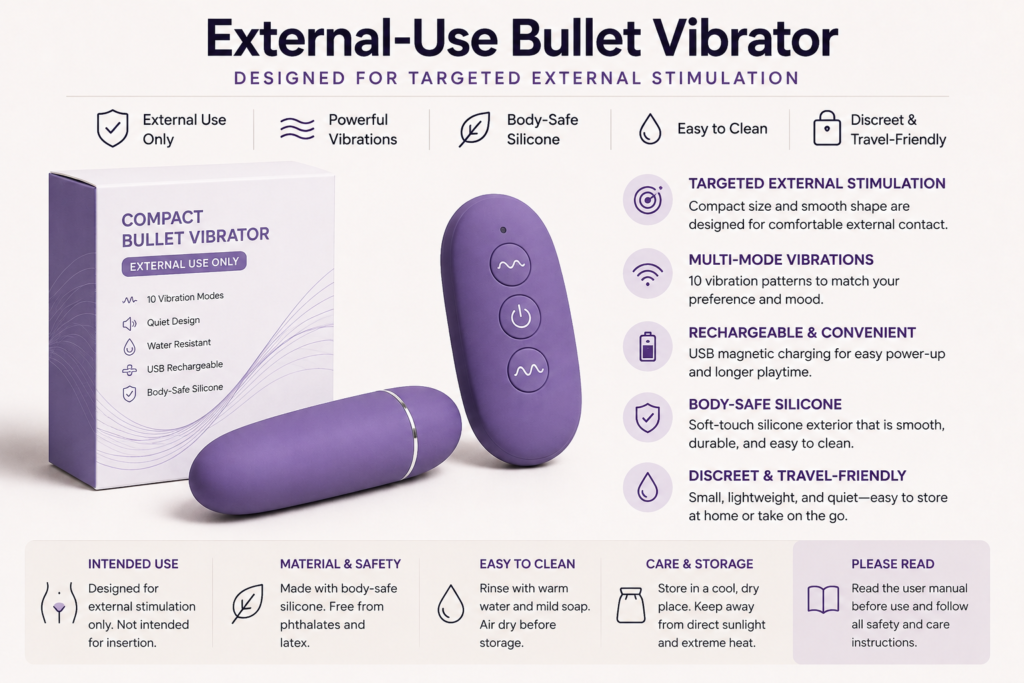
This guide is for retailers, content teams, and private label sellers writing product pages. It focuses on intended-use statements and claim control—not on defining bullet vibrators or comparing vibration patterns.
Why Should External-Use Wording Be the Main Focus?
A compact appearance does not prove that a product is suitable for every use, so leaving its intended application unclear can lead to incorrect assumptions.
Retailers should state “designed for external stimulation” or “for external use only” near the top of the listing. They should not imply suitability for insertion or other uses unless the model’s design and documentation specifically support that wording.
The intended-use statement should be one of the first details customers see. Do not hide it at the bottom of a long description or rely on product photography to communicate it.
A suitable title structure might be:
[Brand or Model] Compact External Bullet Vibrator with [Verified Control Feature]
Another option is:
[Brand or Model] Bullet Vibrator for External Stimulation—[Verified Material or Power Feature]
The product title should describe the item rather than promise a result. Terms such as “external,” “compact,” “rechargeable,” or “one-button” are useful only when they accurately match the product.
The intended-use wording should then appear consistently in four places:
- Product title: Identify the product as an external vibrator where space permits.
- Opening description: State the intended use in one direct sentence.
- Specifications: Add a field such as “Intended use: External stimulation.”
- Instructions and care section: Remind customers to use the product only as directed in its manual.
Useful examples include:
- Designed for external stimulation.
- Compact external vibrator with simple controls.
- Intended for targeted external contact.
- For external use only; follow the supplied product instructions.
- This bullet vibrator for external stimulation is designed for adult personal use as directed in the manual.
Avoid vague wording such as “use anywhere,” “suitable for every activity,” or “enjoy it any way you want.” These phrases provide little practical information and may imply applications that have not been verified.
Retailers should also avoid assuming that all bullet-shaped products have the same intended use. The approved manual and specification sheet should guide the listing. If the documentation only supports external use, the product page should not expand that claim.
Build the title from verified facts
Before publishing a title, content teams should confirm:
- Brand and model name
- Intended external use
- Exterior material
- Control type
- Power or charging method
- Documented water protection
- Included accessories
A title does not need to contain every specification. Its main job is to identify the product accurately. Secondary details can appear in the feature list and specification table.
How Should a Bullet Vibrator Product Description Explain Shape and Controls?
Overwritten sensation language can distract from the details customers actually need, including tip shape, dimensions, button placement, and charging method.
Describe observable product features first. A bullet vibrator product description can explain whether the tip is rounded or tapered, whether the body is firm or silicone-covered, and how its buttons work without promising a particular physical response.
Shape wording should remain factual and restrained. For example, a tapered tip may be described as designed for more focused external contact, while a rounded or broader surface may distribute contact across a larger area. These descriptions explain the design without claiming that every customer will have the same experience.
A useful specification table might include:
| Product field | Clear wording example |
|---|---|
| Intended use | Designed for external stimulation |
| Tip profile | Rounded or tapered, based on the sample |
| Exterior material | Supplier-documented silicone exterior |
| Internal structure | ABS or other documented material |
| Dimensions | Exact length and width |
| Controls | One-button or multi-button operation |
| Power source | Rechargeable or replaceable battery |
| Charging method | Magnetic, pin, USB, or other verified type |
| Water protection | Exact documented claim or rating |
| Package contents | Product, cable, manual, pouch, or other included items |
Controls deserve more detail than “easy to use.” If one button handles both power and setting changes, explain which action requires a short press and which requires a long press. If the product has separate buttons, identify their functions in the text or a product diagram.
Retailers should also distinguish confirmed specifications from subjective descriptions. “One-button control” is a verifiable feature. “Effortless for everyone” is not. “Compact size” may be useful, but exact measurements give customers better information.
Copy about sensation should use conservative phrases such as:
- Designed for focused external contact
- Rounded surface for smooth external placement
- Tapered tip for more targeted contact
- Multiple settings for individual preference
- Firm internal structure with a soft-touch exterior
Avoid detailed usage techniques. A concise direction to begin at a comfortable setting, stop if discomfort occurs, and follow the model-specific manual is sufficient.
What Material and Care Details Belong in the Listing?
Calling a product “premium” or “body-safe” without supporting details does not tell the customer what its surface is made from or how it should be maintained.
State the documented exterior and structural materials, verified water protection, charging design, and manual-approved cleaning method. Keep care notes brief, and do not use medical-grade, hypoallergenic, waterproof, or safety claims unless product-specific evidence supports them.
A product described simply as “silicone” may actually have a silicone exterior over a firm ABS structure. If that is the documented construction, say so. Do not imply that every component uses silicone.
Material wording can include:
- Silicone exterior over an ABS structure
- Smooth silicone-covered surface
- ABS control or base section
- Soft-touch exterior finish
- Documented material details available in the specifications
Retailers should use the exact water-protection wording provided for the model. A sealed-looking design is not enough to support “waterproof.” If only part of the product is water-resistant, the description must make that distinction clear.
Cleaning and care notes do not need to dominate the page. A concise section can tell customers to switch the product off, clean it using the method stated in the manual, keep unprotected charging points away from moisture, and allow it to dry before charging or storage.
The listing should also remind customers to inspect the product before use and stop using it if they notice damage to the surface, seams, charging area, or controls. The specific product manual should always take priority because materials and construction vary by model.
For private label projects, the same material and care wording should appear across the product page, box, insert, and manual. Conflicting statements can increase customer uncertainty and make support responses harder to manage.
What Product Claims Should Retailers Avoid?
Aggressive claims may sound persuasive, but unsupported use, safety, medical, and pleasure statements can create compliance risks and unrealistic customer expectations.
Product pages should avoid guaranteed pleasure, universal suitability, medical benefits, absolute safety, and unsupported material or water-protection claims. Replace them with verifiable statements about intended use, construction, controls, dimensions, power, care, and package contents.
The most reliable approach is to describe what the product is and how it is designed, rather than promising what every customer will experience.
| Avoid this claim | Use this clearer wording instead |
|---|---|
| Guaranteed pleasure | Designed for targeted external stimulation |
| Perfect for everyone | Compact option that may suit customers seeking focused external contact |
| Completely safe | Use only as directed and follow the supplied safety instructions |
| Medical-grade silicone | Silicone exterior, when supported by product documentation |
| Hypoallergenic | State the verified material without predicting individual reactions |
| Fully waterproof | State the documented water-protection claim or rating |
| Silent | Low-noise design, only when supported by testing |
| Use anywhere | Intended for external use as directed in the manual |
| Works instantly | Simple controls designed for straightforward operation |
| The most powerful option | List verified control levels or technical specifications |
| Suitable for every use | Designed for the intended use stated in the product manual |
| Guaranteed satisfaction | Explain features and allow customers to judge suitability |
A clitoral stimulation vibrator can be identified directly when that wording reflects its documented intended use. “Designed for external clitoral stimulation” is clear and restrained. It should not be followed by claims promising a specific response or guaranteed result.
Retailers should review four claim categories carefully:
Unsupported use claims
Do not imply suitability for internal use, anal use, couples use, bath use, or other applications unless the product documentation supports them. Compact size alone is not evidence of suitability.
Pleasure and performance claims
Avoid words such as “guaranteed,” “instant,” “ultimate,” and “perfect.” Performance descriptions should focus on verified controls or settings rather than a promised personal outcome.
Safety and material claims
Do not use “100% safe,” “medical grade,” “non-toxic,” or “hypoallergenic” as general marketing phrases. State the documented material and provide suitable care instructions instead.
Medical or therapeutic claims
Do not claim that the product treats pain, improves health, provides therapy, or produces medical benefits. An ordinary retail listing should remain focused on the product’s intended external use and verified specifications.
Before publication, content teams should ask:
- Can this statement be verified from the approved sample or documentation?
- Does it describe a feature instead of guaranteeing an outcome?
- Does it match the package, manual, and support information?
- Could a customer interpret it as supporting an unverified use?
If a statement fails any of these checks, revise or remove it.
How Can Retailers Keep Listings Consistent?
Customers may lose confidence when the title, feature bullets, specifications, images, package, and manual provide different information.
Use one approved product data sheet as the source for all retail copy. Check the intended-use statement, materials, measurements, controls, charging method, water protection, included accessories, and care guidance before publishing or printing packaging.
A simple content approval workflow can reduce errors:
- Inspect and approve the physical sample.
- Confirm the product’s intended use with the supplier.
- Record verified materials, measurements, controls, and charging details.
- Review water-protection documentation.
- Confirm every item included in the package.
- Compare the listing with the packaging and manual.
- Remove unsupported safety, medical, use, and pleasure claims.
- Repeat the review if the model, components, or packaging change.
Images should match the final product. If the listing shows a magnetic charging cable, but the retail package includes a pin-style cable, customers may assume the wrong item was shipped. The same applies to button counts, colors, surface finishes, accessories, and control symbols.
Private label sellers should approve copy before packaging production begins. Translations should preserve the intended-use limitations rather than replacing careful wording with broader marketing language.
What Should Buyers Include in a Wholesale Product Inquiry?
A long sales section is unnecessary after a detailed product-copy guide. The CTA should simply invite buyers to share the information needed for product and packaging review.
Retailers can send WMCustomDolls their preferred models, quantities, target market, branding needs, and packaging requirements. Our team can help review current wholesale, mixed-order, and private label options, which may vary by product and project details.
WMCustomDolls supports mixed wholesale orders, flexible product selection, and OEM or private label projects for brands, distributors, and retailers.We can also help coordinate product selection, customization, production, and shipment communication.
Contact our team to discuss external-use product wording, sample review, packaging, or range planning.
FAQ
Are bullet vibrators meant for external use?
Many models are designed for external use, but retailers should not make that assumption from the shape alone. Check the specific product documentation and state the intended use clearly in the title, description, specifications, and manual.
What wording helps first-time buyers?
Use direct phrases such as “designed for external stimulation,” “compact external vibrator,” and “one-button control.” Include exact materials, dimensions, charging details, water protection, package contents, and a reminder to follow the product manual.
Should retailers mention clitoral stimulation directly?
Yes, if that is the product’s documented intended use. “Designed for external clitoral stimulation” is clearer than vague pleasure language, but it should not be combined with guaranteed outcome claims.
What should every external-use product specification include?
Include intended use, dimensions, exterior and structural materials, control layout, power source, charging method, documented water protection, package contents, and concise care instructions.
How can private label sellers prevent inconsistent claims?
Use one approved specification sheet for the online listing, box, insert, manual, and support script. Review all wording again whenever the product design, accessories, materials, or packaging change.
Conclusion
Clear intended-use wording and conservative claims make listings more useful. Contact WMCustomDolls to discuss wholesale sourcing, mixed orders, packaging, or private label planning.
Planning a Wholesale Order?
Share your product interests, estimated quantity and destination market with our team.
Request Wholesale Information