


Blog
Prostate Massager Design Anatomy: Curve, Flexible Neck, Base, and OEM Specs

Spec decisions drive margin, returns, and customer satisfaction—but most listings don’t show what matters.
On this page 10 sections
This B2B/OEM guide focuses on design anatomy and sourcing specs: curve angle, neck flex, base geometry, silicone finish, motor placement, waterproof wording, packaging files, and QC standards for private label programs. We support mixed wholesale and private label coordination with clear communication from inquiry to delivery.
What Is a Prostate Massager in Product Design Terms?
Category definitions often blur when specs are incomplete.
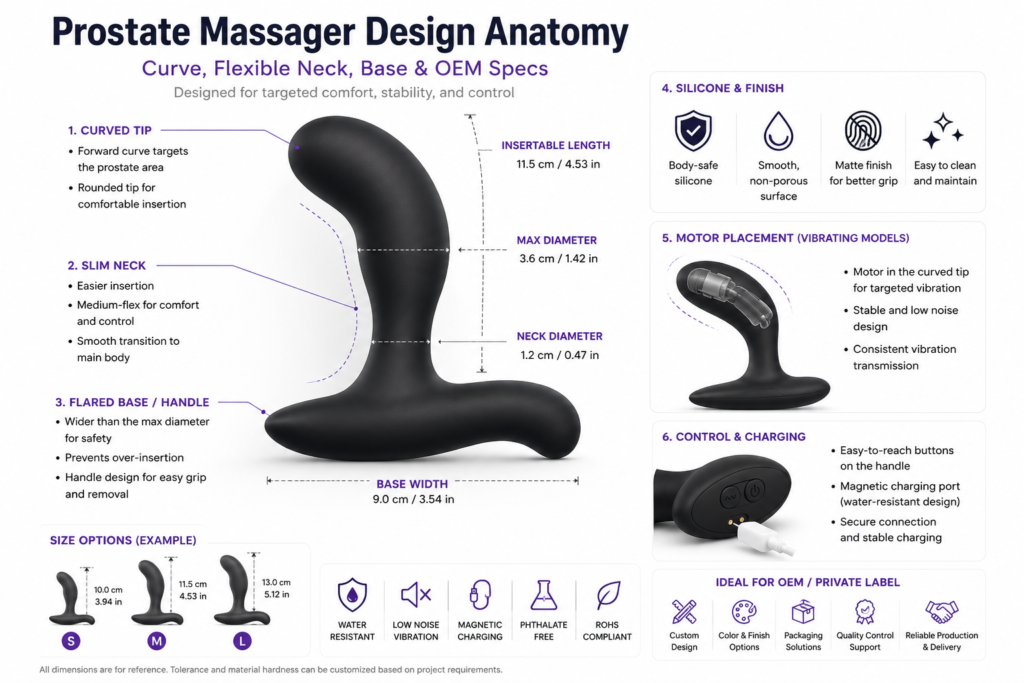
In product terms, a prostate massager is a curved anal toy with a targeted arc, a slim neck, and an external base or handle; many variants add a vibrating module. This article focuses on structural and sourcing specifications rather than consumer how‑to content. Our team supports wholesale, OEM/private label planning, and mixed orders with privacy‑focused packaging and coordinated QC.
Curve Angle and Tip Shape: What OEM Buyers Should Check
Small geometry shifts change real‑world comfort and product fit.
Specify a curve angle and arc that promotes forward contact with a rounded tip, smooth transitions, and documented insertable length and maximum diameter. Use clear side‑profile drawings and keep shape consistent across sizes for predictable lineups and easier retail comparison.
- Curve angle and arc: Define an approximate angle range for the forward arc and keep the radius smooth—avoid sharp bends that create pressure spikes or abrupt shoulders.
- Tip geometry: A rounded tip with a gentle taper guides placement and reduces abrupt transitions. Document the tip radius on drawings where feasible.
- Dimensions to publish: Insertable length, maximum diameter at the widest point, neck thickness, and base width. Side‑profile drawings with callouts help buyers and QC teams speak the same language.
- Size grading: Maintain the same silhouette across sizes (S/M/L) and scale proportionally to ensure consistent feel and merchandising. This supports a “shape family” strategy across standard and vibrating SKUs.
- Tolerance planning: Set acceptable tolerances for maximum diameter and neck thickness based on mold capability and silicone shrink. Align drawings, samples, and spec sheets to reduce back‑and‑forth during production.
- Category context: Keep this geometry guidance aligned with your Anal Toys assortment so spec sheets remain comparable across related SKUs.
Flexible Neck and Base Design: Stability, Comfort, and Control
Neck behavior and base geometry affect both comfort and safety.
Target a medium‑flex neck that yields under light pressure but returns to shape, and keep the base clearly wider than the maximum insertable diameter. Choose an anchor or handle base with rounded edges and a defined grip area for controlled placement and removal.
- Neck flexibility: Overly rigid necks can lever the base; overly soft necks can fold and reduce control. Define a simple bench test (e.g., bend under a known force and record angle), then document an acceptable range for production.
- Base width vs maximum diameter: The base must remain wider than the plug’s widest insertable point to serve as an external stop and stable platform. Record both dimensions and include a base‑width overlay diagram on packaging files.
- Base format:
- Anchor bases hug the body and reduce rotation.
- Handle bases improve grip and directional control.
Either can work if edges are rounded and the base profile remains smooth along its contact points. - Seated comfort and grip: Add shallow surface texture or a mild contour on the handle to improve grip with lubricated hands. Avoid harsh textures that trap residue.
- Documentation: Provide side‑profile photography, a dimension table, and a simplified line drawing with labeled taper, neck, and base. This helps harmonize listings, boxes, and retailer spec sheets.
Silicone Finish, Shore Hardness, and Surface Consistency
Finish quality drives perceived value and return rates.
Specify silicone type, target Shore A hardness, and a matte or satin surface finish with minimal, smoothed seams. Maintain batch and color consistency across SKUs, and verify with first‑article samples and incoming QC.
- Material choice: Silicone is a practical default for prostate massagers due to comfort and care; document the material on packaging and listings without overstating grade or making medical claims.
- Hardness: Target a Shore A range that balances structure with comfort (often mid‑range). Record acceptable tolerance and verify on samples.
- Surface finish: A matte or soft‑touch finish may reduce perceived drag and improve grip. Keep seams minimal and polished smooth where unavoidable.
- Color control: Use a standard color target and verify under consistent lighting. Align color across vibrating and non‑vibrating variants for cohesive merchandising.
- Batch consistency: Include finish and hardness checks in your incoming QC plan. Maintain the same finish and hardness across size steps to keep the user‑perceived feel consistent within a product family.
- Documentation: List material type, finish, and hardness on the spec sheet, and confirm that the box and product page match. We can help coordinate material and finish alignment across your toy assortment and packaging assets .
Motor Placement for Vibrating Prostate Massagers
Vibration performance starts with where the motor sits.
Place the motor in the curved tip or upper body to prioritize forward sensation, stabilize the module to limit rattle, and keep controls tactile on the base or handle. Plan charging‑port placement and sealing with care to support conservative water‑care wording.
- Placement and transfer: A tip‑located motor generally transfers vibration more directly along the arc; body‑located motors can spread sensation but may feel less focused. Prototype both when possible and record user feedback in spec notes.
- Stability and rattle control: Secure the motor within a cradle or channel to reduce internal vibration against the shell. Rattle is a common return driver; note acceptable thresholds in QC.
- Control logic: Use raised, tactile buttons on the base or handle; publish a clear travel‑lock sequence. Remote control support is an add‑on—keep the remote simple, well‑labeled, and documented in the quick‑start card.
- Mode planning: Prioritize 3–5 steady intensities to communicate real motor strength, then add a small set of named patterns. Provide estimated runtime and charging time ranges at realistic intensity levels.
- Documentation and alignment: Ensure control layout, charging type, and runtime notes match across the box, manual, and product page. We can help standardize these assets across related SKUs for private label lines.
Waterproof Wording and Charging-Port Design
Water language must match real construction.
“Waterproof” typically indicates stronger water protection than “water‑resistant,” but buyers should follow device‑specific cleaning instructions and charging‑port guidance. Choose magnetic or self‑sealing pin charging, and keep copy consistent across packaging, manuals, and online listings.
- Charging methods:
- Magnetic pads: Fast and convenient; specify magnet strength and alignment. Keep contacts clean and dry before charging.
- Self‑sealing pinholes: Discreet; confirm the membrane closes fully after charging and document care steps clearly.
- Sealed controls: Buttons and seams in the control area should be well‑integrated. Avoid promising full submersion times unless validated and consistent with the actual enclosure.
- Wording consistency: Use the same waterproof/water‑resistant phrasing across box, manual, and product page to avoid confusion and returns. Conservative, care‑focused language helps manage expectations .
- Cleaning guidance: Provide a clear icon set distinguishing rinse‑safe vs wipe‑clean care. Include a note to power off before cleaning and to dry contacts fully before charging.
Packaging and Instruction Card Requirements for Private Label
Accurate, concise assets reduce support tickets.
Include a dimension chart, curve and base‑width diagrams, lubricant compatibility icon, cleaning icon, charging icon, privacy‑focused packaging, and a quick‑start card. Provide a retailer‑friendly spec sheet that mirrors on‑box icons and website copy for fast onboarding .
- Visuals that matter:
- Side profile with insertable length, maximum diameter, neck thickness, and base width.
- Curve diagram with angle/arc notes.
- Base‑width overlay showing base vs maximum diameter.
- Icons to standardize:
- Material label (e.g., silicone), lube compatibility (e.g., water‑based), cleaning method (rinse or wipe), charging type and time, and water wording.
- Retailer spec sheet: Provide a one‑page sheet summarizing dimensions, material/finish, Shore A, motor specs, control layout, charging, runtime, water wording, and packaging details. Align with product page copy.
- Privacy‑focused packaging: Keep designs discreet and brand‑safe for online and brick‑and‑mortar channels. We provide privacy‑focused packaging solutions for brands and distributors.
- Process support: Our team helps coordinate product selection, customization, production, and shipment with clear, timely communication, which simplifies private label rollouts and replenishment planning .
OEM / Private Label QC Checklist
Clear checkpoints keep batches consistent.
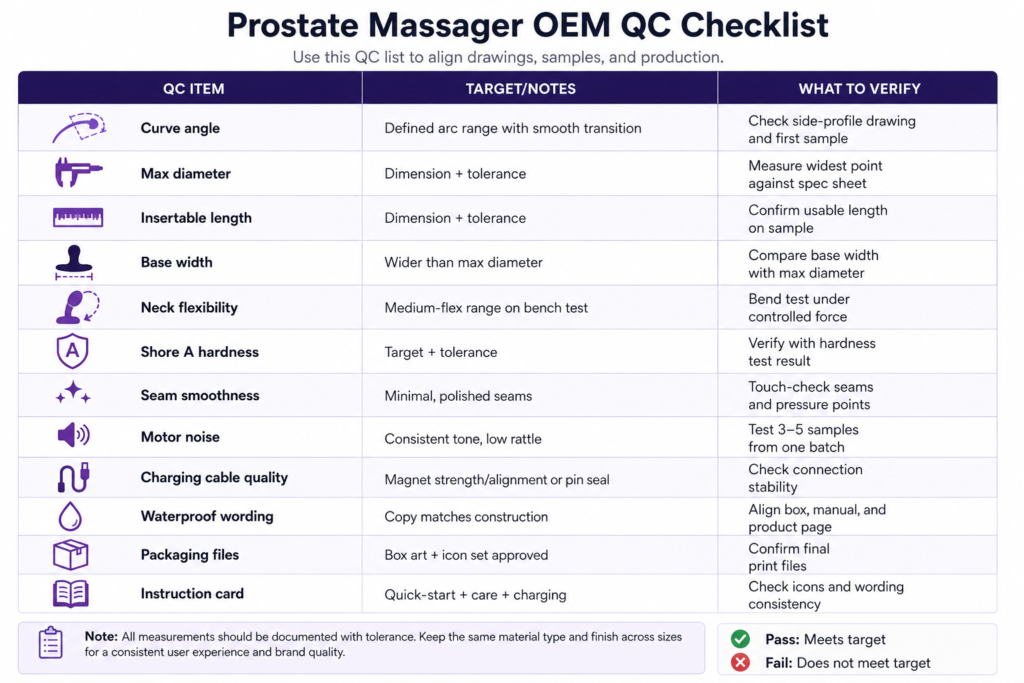
Use this QC list to align drawings, samples, and production:
| QC Item | Target/Notes | What to Verify |
|---|---|---|
| Curve angle | Defined arc range with smooth transition | Check side-profile drawing and first sample |
| Max diameter | Dimension + tolerance | Measure widest point against spec sheet |
| Insertable length | Dimension + tolerance | Confirm usable length on sample |
| Base width | Wider than max diameter | Compare base width with max diameter |
| Neck flexibility | Medium-flex range on bench test | Bend test under controlled force |
| Shore A hardness | Target + tolerance | Verify with hardness test result |
| Seam smoothness | Minimal, polished seams | Touch-check seams and pressure points |
| Motor noise | Consistent tone, low rattle | Test 3–5 samples from one batch |
| Charging cable quality | Magnet strength/alignment or pin seal | Check connection stability |
| Waterproof wording | Copy matches construction | Align box, manual, and product page |
| Packaging files | Box art + icon set approved | Confirm final print files |
| Instruction card | Quick-start + care + charging | Check icons and wording consistency |
We follow clear quality control standards with trusted production partners and privacy‑focused packaging practices to support consistent, retail‑ready outcomes for your business .
FAQ
What specs should buyers confirm before sourcing prostate massagers?
Confirm curve angle, insertable length, maximum diameter, base width, neck flexibility, silicone hardness and finish, motor placement, intensity steps, charging type and time, runtime range, and water wording. Align these with box, manual, and website copy for accuracy.
Why does curve angle matter in prostate massager design?
Curve angle and arc determine forward contact and influence comfort and control. A smooth, rounded tip with a predictable arc tends to offer a more consistent experience across sizes when the silhouette is kept uniform within a product family.
What should packaging include for private label prostate massagers?
Include a dimension chart, curve diagram, base‑width diagram, icons for material, lubricant compatibility, cleaning method, charging, and water wording, plus a quick‑start card. Keep packaging privacy‑focused and consistent with online specs for retailers .
How should suppliers describe waterproof and rechargeable features?
Use conservative, consistent wording across box, manual, and product page. Note charging type (magnetic or self‑sealing pin), charging time, runtime ranges, and cleaning guidance around contacts. Avoid unrealistic submersion claims and keep care instructions clear .
How can retailers compare vibrating and non‑vibrating prostate massagers?
Standardize the silhouette and size tables first. For vibrating variants, add motor placement, intensity steps, control layout, charging type/time, runtime, and water wording. A unified spec sheet simplifies merchandising and customer support .
Conclusion
Our team at wmcustomdolls supports wholesale, OEM/private label assortments with clear specs, privacy‑focused packaging, and coordinated QC from inquiry to delivery. Contact us to plan a shape‑consistent prostate massager lineup with reliable production and support .
Planning a Wholesale Order?
Share your product interests, estimated quantity and destination market with our team.
Request Wholesale Information