


Blog
Hands-Free Bullet Vibrators: What Retailers Should Explain Clearly

“Hands-free” sounds straightforward, but vague listings can hide attachment limits, create unrealistic fit expectations, and increase returns or customer questions.
A hands free bullet vibrator is typically a compact vibrator supplied with, or designed for, a wearable holder or attachment. Retailers should explain how it is secured, where the manufacturer intends it to be positioned, and which movements, body types, or clothing may affect its fit.
This guide focuses on wearable limits and product-copy accuracy. It is not a general introduction to bullet vibrators, and it does not compare vibration patterns.
What Does “Hands-Free” Usually Mean in Product Listings?
Customers may interpret “hands-free” as a promise that the product will remain securely positioned during any activity, which is rarely an appropriate claim.
In product listings, “hands-free” should mean that a documented holder, strap, garment, or shaped accessory can retain the vibrator without continuous hand support under specified conditions. It should not imply universal fit, unrestricted movement, concealed use, or guaranteed placement.
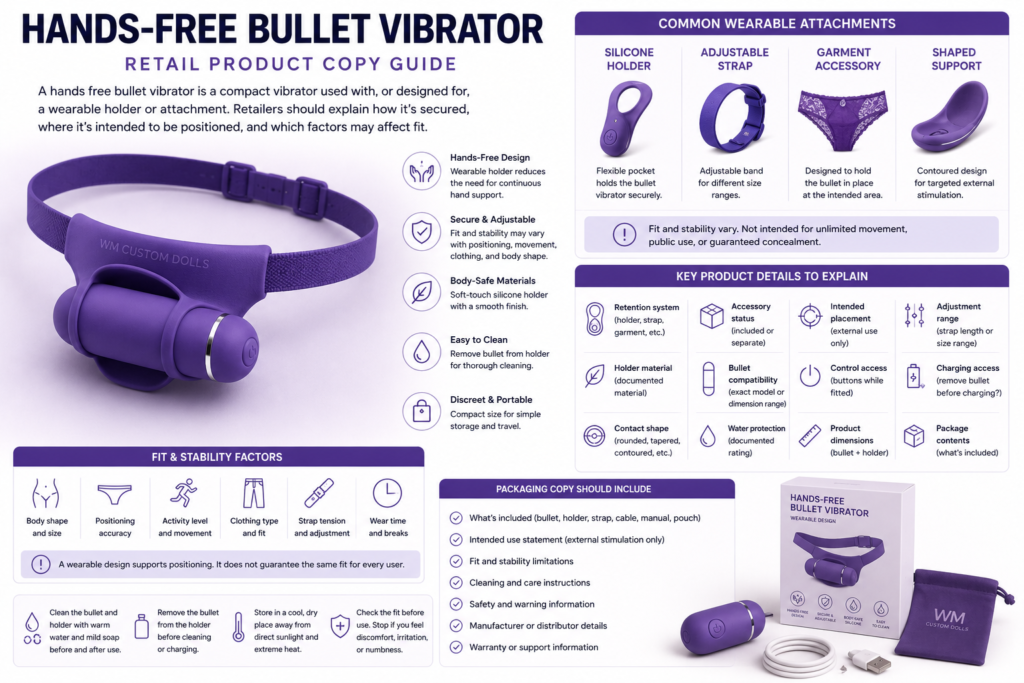
Retailers should treat “hands-free” as a design description, not an unlimited performance guarantee. The listing needs to identify the retention system and explain whether that component is included, optional, removable, or sold separately.
A clear product title might read:
[Brand and Model] Hands-Free Bullet Vibrator with Silicone Holder
If the accessory is not included, use more precise wording:
[Brand and Model] Bullet Vibrator Compatible with [Holder Name]
Avoid putting “wearable” or “hands-free” in the title when the product is simply a standard bullet that a customer could place inside an unrelated garment. The claim should come from an intentional product feature supported by the sample, packaging, and manual.
A useful opening description could say:
“This compact external vibrator fits into the included wearable holder, which is designed to reduce the need for continuous hand support. Fit and stability may vary with positioning, movement, clothing, and individual body shape.”
Product pages should define the following points near the top:
- What retains the product
- Whether the holder or accessory is included
- Whether the bullet can be removed from the holder
- The manufacturer’s documented intended placement
- Available strap or holder adjustments
- Compatible product dimensions
- Control access while the holder is fitted
- Factors that may affect fit or stability
Do not connect “hands-free” with public use, invisibility, or unnoticed operation. Those claims are unnecessary and may be misleading. If noise information is important, provide a verified test condition and measurement rather than calling the product silent.
WMCustomDolls lists bullet vibrators within its wider Toys range, allowing retailers to place suitable wearable models within an established product category rather than creating an unsupported category from appearance alone.Buyers can also review our bullet vibrator wholesale range when planning compact product selections.
How Should Listings Explain Wearable Attachments, Shape, and Fit Limitations?
A product image may show how a holder looks, but it cannot communicate adjustment range, pressure points, compatibility, or likely movement limitations.
A wearable bullet vibrator listing should identify the holder material, adjustment method, contact shape, compatible dimensions, and intended position. It should also state that fit and stability vary, so “stays perfectly in place” and “fits every body” are unsuitable claims.
The retention method is the central feature of a hands free vibrator. Retail copy should describe it before discussing colors, packaging, or promotional language.
Common designs may include a flexible silicone holder, an adjustable strap, a garment-style accessory, or a shaped external support. Retailers should only use these terms when they match the approved sample. A molded holder should not be described as adjustable unless it has a real adjustment mechanism.
Product teams can use a specification table to make the design easier to compare:
| Specification | What the listing should clarify |
|---|---|
| Retention system | Silicone holder, adjustable strap, garment, or another verified design |
| Accessory status | Included, optional, removable, or sold separately |
| Intended placement | Use the manufacturer-approved external placement wording |
| Adjustment range | Exact strap length or supported size range |
| Holder material | Documented material rather than “premium material” |
| Bullet compatibility | Exact model or dimension range |
| Contact shape | Rounded, tapered, flat, or contoured |
| Control access | Whether buttons remain accessible when fitted |
| Charging access | Whether the bullet must be removed before charging |
| Fit limitation | Stability may vary with movement, clothing, position, and body shape |
Retailers should distinguish between a wearable design and a wearable result. A holder can be designed to support positioning, but the seller should not guarantee that it will work identically for every customer.
The same rule applies to a mini bullet vibrator. Compact size may make it easier to fit inside a holder, but “mini” does not prove secure placement or broad compatibility. Exact measurements are more useful than a relative size label.
Product images should show the bullet separately, installed in the holder, and beside the included components. If possible, add a simple diagram showing how the bullet fits into the accessory without presenting an explicit usage scene. This gives customers practical information while keeping the page professional.
For replacement or interchangeable holders, list compatible model numbers. Do not suggest that an accessory accepts all small vibrators unless its tested dimensions support that statement.
What Safety and Comfort Wording Belongs on Adult Product Pages?
Overconfident comfort language can make a wearable accessory sound universally suitable even when pressure, fit, and material response vary among customers.
Retailers should advise customers to check fit before use, begin with limited wear time, avoid excessive pressure, and stop if discomfort or irritation occurs. Listings should also identify documented materials and direct customers to the specific manual for use, cleaning, charging, and care.
Safety wording should be concise and connected to the product’s actual construction. It should not make medical claims or imply that the product is risk-free.
A practical statement might read:
“Check that the holder feels secure without excessive pressure. Stop using the product if it causes discomfort, irritation, numbness, or visible surface damage. Follow the supplied manual for model-specific operation and care.”
Retailers should avoid saying:
- Completely safe for extended wear
- Comfortable for every body type
- Guaranteed not to move
- Hypoallergenic
- Medical-grade silicone
- Safe for all skin types
- Suitable for unlimited wear
- Waterproof
Some of these terms may be usable only when supported by specific documentation, testing, or an applicable rating. In most listings, it is better to identify the verified exterior material and explain the product’s limits.
For example, “silicone holder with an ABS-bodied bullet” is more informative than “premium body-safe construction.” If only the holder is silicone, do not describe the entire product as solid silicone.
Care notes can remain brief:
- Remove the bullet from its holder if the manual directs this before cleaning.
- Clean each component according to its documented material and instructions.
- Do not submerge controls or charging areas unless the product has suitable verified water protection.
- Dry all parts completely before reassembly, charging, or storage.
- Inspect the holder for stretching, tearing, or other damage.
- Follow the specific product manual, even if general website advice differs.
Retailers should also clarify whether compatible lubricants or cleaners are addressed in the manual. Avoid publishing one universal compatibility statement across an entire category because materials, coatings, and accessory construction can vary.
The customer should be able to find safety and care information on the product page, packaging, insert, and manual. Consistent wording is particularly important for private label products.
What Packaging Details Reduce Hands-Free Product Misunderstandings?
When packaging shows only the assembled product, buyers may not know whether the holder is included, removable, adjustable, or compatible with other models.
Hands-free vibrator packaging should show every included component and clearly state the holder type, intended external use, adjustment range, bullet dimensions, charging method, water protection, and fit limitations. The box, manual, and online listing should use matching terminology.
The front of the package can identify the verified product type and main retention feature. Detailed limitations belong on the back, side panel, insert, or manual, but they should not be hidden in unreadably small text.
A packaging content checklist may include:
- Bullet vibrator
- Wearable holder or attachment
- Adjustable straps, if supplied
- Charging cable or battery information
- Storage pouch, if included
- User manual
- Care and safety insert
- Replacement components, if included
Retailers should avoid creating a visual impression that optional accessories come in the box. If a photograph shows extra holders or colors, label them clearly as optional or sold separately.
Feature icons also require careful review. A hand icon crossed out may suggest hands-free support, but it does not explain how the product is retained. Pair the icon with text such as “included wearable holder.” Similarly, a water-drop icon should not replace the exact documented water-protection wording.
Useful package statements include:
- Includes removable silicone holder
- Designed for external use
- Adjustable strap range: [verified measurement]
- Bullet removes for separate cleaning
- Follow the manual before charging or cleaning
- Fit and stability may vary
- Package includes: [complete component list]
Avoid statements such as “invisible under any clothing,” “cannot be detected,” or “will never slip.” A discreet vibrator can be described through factual features such as compact dimensions, storage pouch, neutral packaging, or verified noise data. “Discreet” should not become a promise about concealment in every setting.
Privacy-focused packaging can help protect a brand’s presentation and support a professional customer experience. WMCustomDolls also supports compact product options for custom packaging programs, depending on the selected model and order details.Private label sellers can discuss OEM and private label support before approving box artwork or printed claims.
What Should Wholesale Buyers Test Before Scaling an Order?
A polished supplier image cannot show whether a holder stretches, blocks controls, traps moisture, or remains consistent across repeated assembly and cleaning.
Before scaling a wearable bullet vibrator order, buyers should test sample fit, holder retention, material finish, controls, charging, cleaning access, packaging accuracy, and batch consistency. Claims used online or on packaging should be based on the approved sample and supporting documentation.
In our experience, sample review should reflect normal handling rather than only a brief visual inspection. Product developers and wholesale buyers need to understand how the bullet and holder work as a complete system.
A practical sample review can cover:
Holder and fit
Install and remove the bullet several times according to the instructions. Check whether the holder stretches, twists, tears, or makes the controls difficult to reach. Confirm all adjustment measurements and identify where pressure may be concentrated.
Materials and finish
Inspect the surface for uneven texture, sharp edges, excessive seams, odor, discoloration, or poorly fitted components. Confirm that the material description matches the supplier documentation. WMCustomDolls features selected silicone toys with clean designs, modern colors, and wholesale-ready options for retail and private label buyers.
Controls and power
Check whether buttons remain accessible when the bullet is fitted. Review charging alignment, cable fit, indicator lights, and the instructions provided with the product. Any runtime or charging-time claim should use documented test conditions.
Cleaning and drying
Confirm whether the bullet must be removed from the holder. Look for narrow gaps that may be difficult to clean or dry. Check whether the manual gives separate care instructions for each component.
Product copy and packaging
Compare the physical sample with the online description, package images, feature icons, specifications, and manual. Confirm that the following details match:
- Included accessories
- Materials
- Dimensions
- Control layout
- Charging method
- Intended use
- Adjustment range
- Water-protection wording
- Care instructions
- Fit limitations
Order planning
Wholesale buyers should ask about current MOQ, color selection, packaging options, logo application, sample availability, production expectations, and mixed-order support. These details may vary by model and customization level.
WMCustomDolls supports wholesale product selection, packaging coordination, quality-control follow-up, and OEM/private label projects based on the selected model and order requirements.
For a new range, it may be more useful to compare several samples than to select one model based only on appearance. Buyers can evaluate different holder styles, dimensions, control layouts, and retail price points before deciding which products fit their market.
Contact our team with your preferred designs, quantities, target market, and packaging requirements. We can help review mixed wholesale order options, OEM/private label support, and product range planning based on current availability.
FAQ
Are all bullet vibrators hands-free?
No. Many bullet vibrators are handheld products without a wearable holder or retention feature. Retailers should only use “hands-free” when the product has a documented design that supports use without continuous hand support under stated conditions.
What should hands-free product listings clarify?
Listings should identify the holder or attachment, whether it is included, its material, adjustment range, compatible dimensions, intended placement, control access, and fit limitations. They should also explain that stability may vary and direct customers to the specific product manual.
How can retailers avoid misleading claims?
Retailers should verify every claim against the approved sample, specification sheet, packaging, and manual. Avoid universal fit, guaranteed placement, invisible use, silence, absolute safety, medical benefits, and guaranteed pleasure claims.
Does “wearable” mean the product will fit everyone?
No. Body shape, positioning, clothing, movement, holder dimensions, and adjustment range can affect fit. Use wording such as “designed for wearable support” and publish exact measurements instead of promising universal compatibility.
What should private label buyers confirm before packaging production?
Confirm the product name, intended use, holder type, included parts, materials, dimensions, adjustment range, controls, charging method, water protection, care instructions, and limitations. The box, insert, manual, and online listing should match.
Conclusion
Clear wearable limits support better buying decisions. Contact WMCustomDolls for wholesale sourcing, mixed orders, OEM/private label support, or hands-free product range planning.
Planning a Wholesale Order?
Share your product interests, estimated quantity and destination market with our team.
Request Wholesale Information