


Blog
Cock Ring Packaging and Instructions: What Buyers Need Before and After Purchase

A simple product can create complicated complaints when its package omits size, removal, power, cleaning, or accessory details.
On this page 8 sections
Effective cock ring instructions identify the exact product configuration, dimensions, fit limits, wear and removal warnings, power system, water protection, cleaning method, storage conditions, and package contents. Retailers should approve every statement against the final sample, supplier manual, and applicable market requirements.
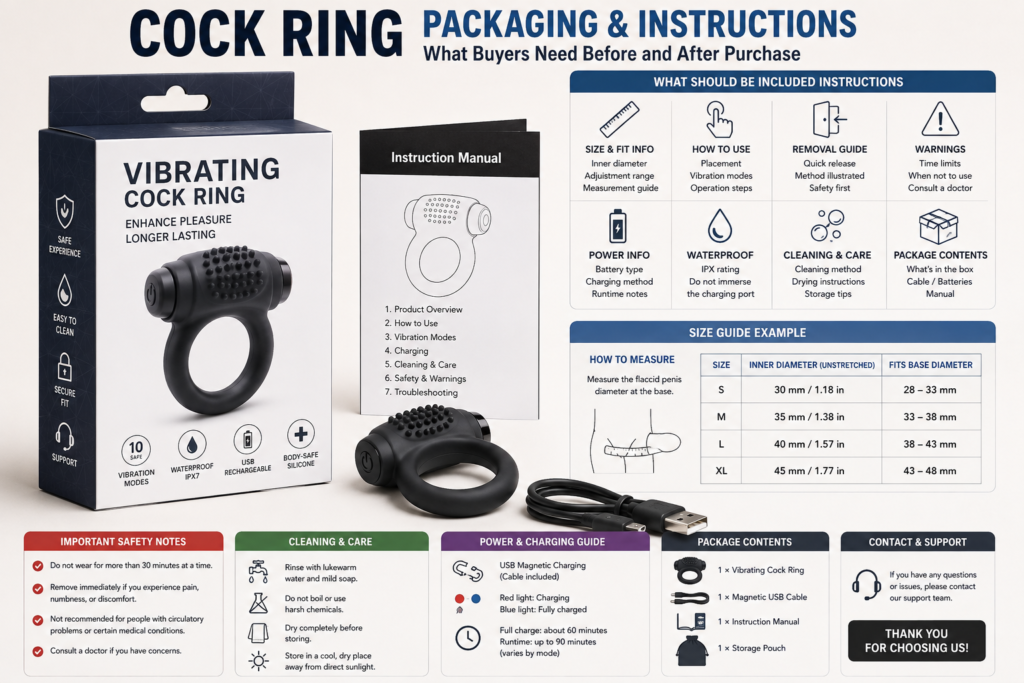
Packaging is not just a container. It is part of the product system because customers rely on it before purchase, during setup, and when something does not work as expected.
Why Is Packaging Part of Product Performance and Safety?
Minimal packaging may reduce printing space, but it can leave customers guessing about the product at the exact moment clear information matters.
Cock ring packaging should help buyers identify the model, choose the correct size, understand removal, verify included accessories, follow care instructions, and find support. Missing information can turn a usable product into a poor customer experience and create preventable complaints, returns, and artwork changes.
A package has several jobs. The front identifies the product and its main verified features. The side or back supports the buying decision. The instruction insert explains operation, care, removal, and troubleshooting. These parts should agree with one another.
For example, a box should not call a product rechargeable if the enclosed motor uses replaceable button batteries. A manual should not show a USB-C cable if the production model has a proprietary magnetic lead. A product page should not claim one size fits all when the supplier specification gives a defined internal diameter or adjustment range.
The FDA’s guidance for external penile rigidity devices recommends comprehensive instructions and adequate illustrations covering sizing, placement, operation, removal, and cleaning. It also recommends an overview of the system, its major parts, and its safety features. That guidance has a specific medical-device scope, so it should not be used to imply that every consumer cock ring is an FDA-regulated or FDA-approved device. However, its information principles offer a useful benchmark for packaging teams.
Strong packaging answers these questions quickly:
- What exact model is this?
- Is it fixed, flexible, adjustable, dual-loop, or vibrating?
- What are its relevant dimensions?
- How is it removed promptly?
- Does it require batteries or charging?
- What is included in the box?
- What cleaning and drying method applies?
- Can the motor or battery compartment be immersed?
- Where can the customer find help?
At WMCustomDolls, we support wholesale buyers with product selection, customization, production coordination, packaging, and shipment communication. We recommend treating the box, insert, product page, and supplier specification as one controlled information set rather than separate writing projects.
What Fit and Sizing Information Should Non-Vibrating Rings Include?
A generic diameter without a diagram can be misread as an outer measurement, inner measurement, circumference, or unstretched size.
Non-vibrating penis ring instructions should show the measured location, unit, resting inner diameter or circumference, adjustment range where applicable, and whether the dimensions are unstretched. A simple diagram is usually clearer than relying on a number or broad “small, medium, large” label alone.
A useful cock ring size chart must describe what has actually been measured. It should not copy dimensions from a similar-looking product.
For fixed or flexible models, consider recording:
- Resting inner diameter
- Inner circumference, if used by the target market
- Outer diameter
- Band width
- Band thickness
- Whether the figure is unstretched
- Supplier-documented stretch or fit limit, if available
- Unit in millimeters and inches where appropriate
- Exact measurement point
- Product variant or SKU
For adjustable products, the package may need minimum and maximum usable settings instead of one diameter. It should also identify the closure type and release point.
Illustrative Size-Information Layout
| Information field | Example format | Approval question |
|---|---|---|
| Inner diameter | XX mm / X.XX in | Was the inside opening measured? |
| Band width | XX mm / X.XX in | Is the measurement consistent around the ring? |
| Adjustment range | XX–XX mm | Does the final closure support this range? |
| Measurement condition | Unstretched | Does the supplier use the same condition? |
| Removal feature | Tab, snap, slider, or opening | Does the diagram match the sample? |
The values above are placeholders, not product specifications.
Avoid “universal fit” or “one size fits everyone” unless the claim is properly supported and suitable for the exact product. Anatomy and preferences vary, and adjustable products still have physical limits.
Instructions should also identify the removal method before discussing use. The FDA’s medical-device guidance says constriction rings within its scope should have a simple, quick manual release method and should not encourage extended continuous use. For consumer products, packaging teams should review whether the exact architecture has a tab, snap, slider, magnetic separation point, flexible edge, or another documented removal method.
Any wear-time statement should be prominent and approved for the exact product and market. SMSNA notes that most manufacturers of constriction rings used with vacuum devices recommend no more than 30 minutes to reduce injury risk. FDA guidance for external penile rigidity devices also recommends a prominently displayed limit of no longer than 30 minutes per use. These sources concern constriction devices in a medical context, so brands should obtain qualified regulatory review rather than copying isolated wording into unrelated novelty-product packaging.
What Extra Instructions Do Dual, Adjustable, and Vibrating Designs Need?
A generic insert cannot explain every ring because additional loops, closures, motors, and controls introduce model-specific setup and removal steps.
Dual-loop instructions should identify each opening, adjustable models should explain the closure and release mechanism, and vibrating models should cover controls, power, accessories, charging, and motor care. Every illustration must match the final production sample rather than a previous or visually similar SKU.
Dual designs need a clear diagram. Without one, the customer may not know which opening is intended for which placement or how the loops should be removed. Keep the wording clinical and concise. The illustration does not need explicit human imagery; a labeled product diagram can identify the primary ring, secondary loop, control button, motor, and release point.
Adjustable products need more than the phrase “adjust to fit.” Their instructions should explain:
- How the mechanism opens
- Which direction the slider or closure moves
- The documented adjustment range
- How to avoid trapping skin in the hardware
- How to release the product promptly
- Whether the closure can be detached for cleaning
- Whether force, tools, or permanent modification must be avoided
For rigid, multi-piece, or magnetic designs, the exact opening method is especially important. A package should not suggest cutting as the normal removal process. It should identify the designed release feature and state what customers should do if the product cannot be removed or if pain, numbness, unusual discoloration, or swelling occurs.
FDA guidance identifies bruising, pain, discomfort, numbness, loss of sensitivity, and tissue injury among possible concerns associated with medical constriction rings and vacuum devices. SMSNA also lists bruising, skin irritation, pain, discomfort, numbness, loss of sensitivity, and a cold sensation as possible issues with constriction bands. A consumer warning panel should be based on the exact product, reviewed sources, and applicable legal requirements, but it should clearly tell the customer to stop and remove the ring if concerning symptoms occur and to seek medical help when removal is not possible or symptoms continue.
Vibrating Model Details
Vibrating cock ring battery instructions should identify:
- Replaceable or rechargeable power
- Exact battery designation and quantity
- Whether batteries are included
- Whether batteries arrive installed
- Presence of an insulating pull tab
- Correct polarity
- Battery-compartment opening method
- Charging-connector type
- Whether a cable is included
- Charging-indicator behavior
- Supplier-verified charging time
- Supplier-verified runtime and test conditions
- Control-button sequence
- Automatic shutoff, if documented
- Motor-removal instructions, if applicable
Do not describe a proprietary magnetic lead as a standard or universal USB cable. The package contents should identify both ends of the supplied lead when that distinction matters.
How Should Material, Cleaning, Drying, Battery, and Storage Details Be Presented?
“Wash after use” sounds simple, but it does not tell customers whether the motor, charging contacts, battery cap, or internal joins can be exposed to water.
Care instructions should state the verified material, compatible cleaning method, restricted products, drying steps, water-exposure limits, battery or charging precautions, and storage conditions. Claims such as waterproof, submersible, dishwasher-safe, or boilable require SKU-specific support and should never be copied across a product family.
Material wording should match the supplier specification. “Silicone,” “TPE,” “TPR,” “metal,” and “mixed material” should not be used interchangeably. Packaging teams should also avoid adding “medical-grade,” “hypoallergenic,” or certification language without suitable documentation.
Cleaning instructions should answer:
- Should the product be cleaned before first use?
- Which surfaces need cleaning?
- Is the motor removable?
- Can the entire product be rinsed?
- Must the battery compartment remain dry?
- Can a charging-port cover be opened during cleaning?
- Which cleaners are compatible with the verified material?
- Should abrasive products or strong solvents be avoided?
- How should the product be dried?
- Must charging contacts be completely dry before connection?
- How should separate components be stored?
An unsupported waterproof claim is particularly risky. A sealed-looking motor does not prove a specific water-protection rating. Magnetic charging contacts do not automatically make a product submersible, and a rubber port cover does not guarantee that water cannot enter.
Use precise, limited language from the approved specification. For example, if only surface cleaning is supported, state that directly. If the removable silicone ring can be rinsed but the motor cannot, separate those instructions visually.
Battery and Storage Panel
For button-cell products, include the battery type, quantity, polarity, installation diagram, and removal method. State whether cells should be removed before extended storage when that direction is supported by the supplier documentation.
Rechargeable models should explain:
- Approved charging connection
- Charging-indicator status
- Whether charging must be supervised
- Need to keep charging contacts dry
- Storage charge guidance, if documented
- Replacement-cable route
- What to do if the product becomes unusually hot, damaged, or swollen
Battery symbols and disposal wording should be checked against the rules of each destination market. Packaging teams should not assume that one global label covers the USA, UK, EU, Australia, and every marketplace.
Storage information should address cleanliness, dryness, temperature conditions when documented, separation from incompatible materials, and protection from damage. Avoid inventing a fixed shelf life without evidence.
Retailers can use our adult toy product description guide to align care and specification information across packaging and online listings.
Why Do Generic Inserts and Copied Warnings Fail?
Reusing one insert can save time at the artwork stage, but it creates expensive inconsistencies when products have different dimensions, motors, closures, and cleaning limits.
Generic inserts fail when they omit model-specific fit, removal, battery, accessory, or water information. Copied warnings can also misstate a product’s intended use or regulatory position. Each manual should begin with an approved SKU specification and be checked against the final sample before printing.
Consider four products that look similar in catalog photos:
- A flexible single-loop ring
- An adjustable ring with a sliding closure
- A dual-loop model
- A rechargeable vibrating design
One shared insert cannot accurately show all four removal methods. It cannot give one valid size measurement, one power instruction, or one cleaning process. Even the package-contents list will differ.
Copied content creates several hidden costs:
Support Tickets
Customers ask which batteries fit, why no cable is present, how to open a closure, or whether a motor can be rinsed. These are not always product defects. They may be information defects.
Missing-Accessory Claims
If the online listing shows a charging cable but the printed contents panel does not, warehouse and support teams cannot quickly determine whether an accessory is missing. A controlled contents list reduces ambiguity.
Returns and Poor Reviews
A customer who expected an adjustable fit or rechargeable motor may see the product as misrepresented. Clear information before purchase can prevent that expectation gap.
Compliance and Claim Risk
An adult toy warning label should not imply medical approval, treatment of erectile dysfunction, or universal safety unless the product’s status and evidence support those statements. FDA medical-device guidance applies to a defined category of external penile rigidity devices and includes specific labeling expectations. Retail novelty products should not borrow medical positioning merely because they have a similar shape.
Artwork Rework
Private label artwork often begins before the final sample is approved. If the motor, cable, color, closure, dimensions, or package contents later change, previously approved panels may become inaccurate.
The safer order is specification approval, sample review, draft artwork, technical review, language review, and final print authorization.
What Should a Private Label Packaging Approval Checklist Cover?
Attractive artwork cannot compensate for an incorrect barcode, missing warning, wrong battery icon, or illustration taken from another product.
A private label approval should compare the final sample, specification sheet, manual, box, barcode data, package contents, carton markings, and marketplace listing. Sign-off should include product, packaging, compliance, language, and purchasing teams where appropriate.
Use the following checklist as a working framework. Exact requirements depend on the product and destination market.
Product Identity
- Brand and logo are correct
- Product name matches the approved taxonomy
- SKU, model, and color are correct
- Product image matches the final sample
- No unsupported medical or performance claims appear
- Intended use wording is properly scoped
Size and Material
- Inner dimensions are verified
- Measurement location is illustrated
- Adjustable range is documented
- Metric and imperial conversions are checked
- Material wording matches the specification
- No unsupported “medical-grade” or similar claim appears
Warnings and Instructions
- Instructions say to read before use
- Removal method is clear
- Wear limit is reviewed and prominent
- Stop-use warning signs are included
- Emergency removal guidance is appropriate
- Product-specific contraindications and precautions are reviewed
- Warnings are understandable to the target reader
- Required languages are complete
FDA guidance for external penile rigidity devices recommends layperson-readable instructions, clear warnings and consequences, comprehensive operating information, and troubleshooting content. Even when that exact regulatory framework does not apply, plain language and product-specific illustrations can improve usability.
Power and Water Information
- Battery designation and quantity are correct
- Battery-included status is stated
- Polarity diagram matches the compartment
- Cable type and inclusion status are accurate
- Charging indicator is explained
- Runtime and charging claims are verified
- Water-protection language is supported
- Dry-before-charging instructions are included
- Applicable battery and disposal symbols are reviewed
Package and Logistics
- Package contents match the physical sample
- Barcode scans to the correct SKU
- Country-of-origin wording is reviewed
- Manufacturer, importer, or responsible-party details meet market needs
- Lot or batch coding space is available where required
- Inner-pack and master-carton quantities agree with the purchase order
- Carton labels match the product and color
- Manual version and artwork version are recorded
Final Approval Process
Create one approval record containing:
- Final SKU specification
- Signed sample reference
- Box artwork
- Instruction manual
- Barcode file
- Translation approval
- Packaging contents list
- Carton markings
- Revision number
- Final authorization date
WMCustomDolls supports mixed wholesale orders, flexible product selection, and OEM or private label coordination for retailers, brands, and distributors. Our team can help coordinate product details, packaging, production follow-up, and shipment communication, depending on the product and order requirements.
Business buyers can review our wholesale and OEM guidance or contact us to discuss sample approval, custom packaging, mixed orders, and private label projects.
FAQ
What Instructions Should Come With a Cock Ring?
Instructions should identify the exact product, dimensions, fit limits, removal method, wear warnings, cleaning process, storage requirements, and support route. Powered models also need battery or charging directions, control information, water-exposure limits, and an accurate list of accessories.
Should Cock Ring Packaging Include a Size Chart?
Yes, when size affects selection or fit. The chart should state whether it shows inner diameter, circumference, adjustment range, or unstretched dimensions, and a diagram should identify the measurement location. Values must come from the exact production SKU.
What Extra Information Is Needed for Vibrating Models?
Vibrating models need the battery type or charging system, package contents, controls, charging indicator, verified charging and runtime information, and motor-specific cleaning restrictions. The instructions should also explain whether the motor is removable and whether charging contacts must remain dry.
Conclusion
Clear cock ring instructions reduce guesswork after purchase. Contact WMCustomDolls to coordinate product selection, samples, mixed orders, packaging, or OEM and private label details.
Planning a Wholesale Order?
Share your product interests, estimated quantity and destination market with our team.
Request Wholesale Information