


Blog
Automatic Masturbation Cups: Why Are Suction, Rotation, Licking, Thrusting, and Vibration Different?

Feature lists can make very different products sound identical. More modes on a box may mean more settings, not more mechanical functions.
An automatic masturbation cup should be compared by its physical mechanisms, not mode count alone. Suction, rotation, licking motion, thrusting, and vibration involve different movement paths, controls, cleaning considerations, and quality-control checks.
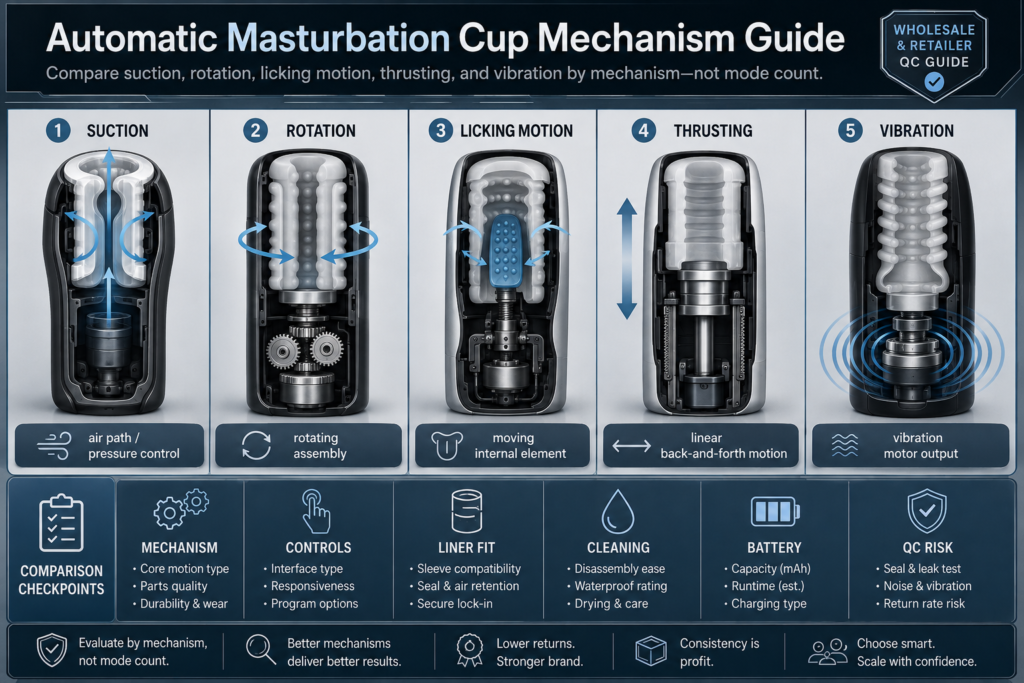
At WM Custom Dolls, we recommend separating a product’s claimed functions from the architecture that actually creates them. Product titles often combine terms such as “seven modes,” “suction,” “rotation,” and “vibration” without explaining whether the effect comes from an air system, moving liner, rotating assembly, linkage, vibration motor, or a combination of components.
That makes comparison difficult for adult buyers, retailers, distributors, and product managers. This guide explains what to check before selecting, listing, testing, or pricing an automatic model. The focus is on clear mechanism mapping and practical verification rather than unsupported performance claims.
Why Do Automatic Cup Feature Lists Become Misleading?
A long feature list can make one product appear more advanced than another. But feature words and numbers do not always describe the same kind of value.
Automatic cup feature lists become misleading when different mechanisms, intensity levels, programmed patterns, and control states are presented as though they are directly comparable. Retailers should identify what physically moves or changes behind every claimed function.
For example, “seven suction modes” may refer to seven programmed settings from one air-management system. It does not necessarily mean the product contains seven pumps or seven separate mechanical assemblies. Likewise, a model that lists rotation and vibration may use two distinct functions, or a more integrated drive system depending on the construction.
This is why “more modes” is not a reliable buying or sourcing shortcut. Mode or feature lists may include:
- Different intensity settings for one mechanism
- Repeating programmed patterns
- Separate motion directions
- Combined functions running together
- Control states such as pause, lock, or standby
- Display indicators that describe product status rather than a separate mechanism
For accurate product comparisons, turn every marketing claim into a clear question: What component or movement creates this effect? If the answer is not available, avoid describing the claim in technical detail until the current sample, manual, or supplier documentation is verified.
| Listing Term | What Should Be Confirmed |
|---|---|
| Suction | Whether an air path, valve, pump, or pressure-control structure is present |
| Rotation | What rotates: sleeve, internal component, external ring, or another part |
| Licking motion | What physically moves and where the motion is located |
| Thrusting | Whether the liner, housing, or internal mechanism moves back and forth |
| Vibration | Whether a vibration motor exists and how it is controlled |
| Multiple modes | Whether modes are separate mechanisms, patterns, or intensity levels |
For product managers, this approach also helps protect pricing strategy. A cup with a genuinely different movement system may justify a different position from a standard vibrating male stroker with multiple programmed settings. That distinction should come from verified construction, not promotional wording alone.
What Is the Mechanical Difference Between Suction, Rotation, Licking, Thrusting, and Vibration?
Similar labels can describe very different internal designs. Without a mechanism map, retailers may compare unrelated functions as though they were interchangeable.
Suction, rotation, licking motion, thrusting, and vibration are different types of movement or pressure control. Depending on the design, they may use separate or shared motors, pumps, linkages, liners, control systems, or drive components.
A suction masturbator may use an air-management system, pressure changes, an adjustable valve, a pump, or another enclosed structural feature. The exact construction varies by SKU. A seller should not claim a particular suction strength, pressure level, or pump design unless it is confirmed by the model documentation and current sample.
A rotating masturbation cup generally refers to a product where a documented component rotates. However, the word “rotation” is incomplete on its own. The rotating part could be an internal sleeve section, an outer ring, a motor-driven assembly, or another verified component. Product pages should state what rotates when that information is confirmed.
A product described with licking motion may use a moving internal element, repeated mechanical movement, or a liner-linked action. Because the term is used inconsistently across product listings, the physical movement should be verified through a production-intent sample, technical drawing, or demonstration video before it appears in retail copy.
A thrusting masturbation cup typically refers to a back-and-forth movement created by a liner, housing section, internal carriage, or linkage. This differs from rotation because the main travel path is linear rather than circular.
A vibrating male stroker generally uses a vibration motor to transmit vibration through the shell or liner assembly. It may be mechanically simpler than a multi-motion product, but simplicity is not automatically a disadvantage. A simpler architecture can also be easier to explain, operate, test, clean, and support.
At WM Custom Dolls, we encourage buyers to use the term “verified mechanism” in internal sourcing files. This keeps product marketing aligned with what the approved SKU actually does.
How Do Levels Differ From Separate Mechanisms?
A product can offer many control options without containing many different mechanical systems. Confusing levels with mechanisms can inflate expectations and complicate customer support.
Levels change the output or pattern of an existing mechanism, while separate mechanisms involve distinct types of physical movement or pressure control. Depending on the architecture, different functions may use separate or shared drive components.
Consider a product with three vibration levels and four programmed patterns. It may be marketed as having seven “modes,” but it could still use one vibration motor. Another model may combine vibration with a separate rotating or air-control system. Even if it has fewer total settings, its architecture may be more complex.
This distinction matters because additional mechanisms can affect more than product copy. They may change internal space requirements, total weight, battery demand, sound characteristics, charging behavior, cleaning access, maintenance needs, and possible failure points.
A useful comparison format is:
| Product Detail | Example of Clear Description |
|---|---|
| Mechanism count | “One verified vibration mechanism” |
| Control levels | “Multiple selectable vibration settings” |
| Motion patterns | “Programmed operating patterns, if confirmed” |
| Combined operation | “Documented controls allow selected functions to operate together” |
| Unverified feature term | “Confirm mechanism with final sample before publication” |
Do not convert a supplier’s “10 modes” statement into “10 functions.” Those are not the same claim. A mode may simply be a different sequence, output level, or pattern. Likewise, do not assume that a model with two mechanisms can operate both at the same time. Combined operation needs to be confirmed from the actual control sequence and product manual.
For B2B buyers, ask suppliers to provide a control sequence showing each button press, screen state where applicable, and resulting movement. If the product has an LCD, the display should match the function names used in the manual and product page. For a related interface review process, see our LCD display masturbation cup checklist.
Clear separation between mechanisms and settings makes product cards more accurate. It also helps buyers compare products based on the way they actually work, rather than relying on a mode count that may not explain the underlying design.
Which Moving Parts Create the Most QC Risk?
More moving components can create more points to inspect. A feature may work during a short demonstration but show problems after assembly, repeated cycling, liner removal, or reinstallation.
Moving liners, pumps, gears, linkages, valves, caps, and motor connections can all create additional QC points. Each claimed mechanism should be tested on the final assembled sample rather than judged only from an isolated component or supplier video.
The issue is not that one architecture is always more reliable than another. What matters is how well the mechanism integrates with the liner, housing, controls, seals, and power system.
Potential QC concerns may include:
- A liner that shifts or twists during a documented rotation function
- A moving internal section that catches against the shell
- A valve or air path that is difficult to inspect or clean
- A linkage that produces inconsistent travel or unusual mechanical noise
- A rear cap that does not align consistently after reassembly
- A control button that does not clearly activate the intended function
- A display state that does not match the selected setting
- A charging connection that needs special care after cleaning
These are inspection points, not assumptions about a product’s performance. Each current SKU needs its own sample review and quality-control record.
A practical QC plan should include startup, every documented control state, combined-function behavior if supported, shutdown, charging indication, liner installation, and post-cleaning reassembly. If the product contains a removable liner, test the mechanism again after the liner has been removed and reinstalled according to the instructions. Liner fit can affect how movement or force transfers through the assembly.
| QC Step | Why It Matters |
|---|---|
| Check assembly before power-on | Confirms caps, liners, and movable parts are seated correctly |
| Test each documented function | Verifies that the control map matches product behavior |
| Reinstall approved removable liner | Checks alignment after normal maintenance |
| Review seams and shell joints | Identifies obvious fit or construction concerns |
| Compare manual and product behavior | Prevents inaccurate customer instructions |
| Record sample version and date | Helps track changes between production revisions |
For wholesale projects, dated photos or short videos in the SKU approval folder can become a useful reference when the box, manual, product listing, or after-sales team needs to describe the approved version.
Why Do Liner Design and Mechanism Need to Be Tested Together?
A mechanism does not operate in isolation. The liner’s thickness, shape, attachment method, and fit within the shell can change how the finished product behaves.
Liner design and automatic mechanisms should be tested together because liner alignment, wall thickness, attachment points, and shell contact can affect movement transfer, cleaning access, and reassembly.
It is not enough to test an empty shell or an engineering assembly before the final liner is installed. The liner is part of the product architecture. If it sits differently from one sample to another, a rotating or thrusting movement may also feel or behave different mechanically. If the liner is too loose, too tight, or incorrectly aligned, the assembled product may no longer match the approved sample.
For sourcing teams, confirm these points during sample review:
- Is the liner fixed or removable?
- If removable, how does it align with the shell?
- Is there a front lip, rear cap, ring, or locking structure?
- Does the manual show the correct reassembly orientation?
- Does the function operate as documented after reassembly?
- Are there visible seams, gaps, or liner-to-shell interfaces that affect cleaning?
- Does the final retail package include all parts needed for normal assembly?
This is particularly important for automatic cups marketed with terms such as rotating, thrusting, or suction-based. A correct mechanism description should match the final liner configuration, not only an early product concept or supplier demonstration.
It also affects customer-service content. If a cup requires the liner to be seated in a particular orientation, the manual should show that clearly. Retailers should avoid creating their own installation instructions unless they are based on confirmed manufacturer guidance. Incorrect reassembly advice can lead to avoidable product issues, inaccurate return diagnoses, and poor buyer experiences.
For product comparisons, motion, liner fit, and control behavior should always be checked against the latest sample and documentation before they are added to a specification sheet.
How Do Noise, Battery, and Cleaning Change With More Mechanisms?
Extra mechanisms can add product complexity beyond the feature list. They may affect how the product is handled, maintained, charged, and described after purchase.
More mechanisms can change battery demand, sound characteristics, cleaning access, and support needs. These factors should be reviewed from the final sample rather than predicted from the number of modes or motors.
A multi-function product may use more than one motor, a motor plus a moving assembly, or a motor combined with an air-control structure. That does not automatically make it unsuitable or difficult to use. It simply means retailers should consider the full ownership routine before positioning it as an easy upgrade.
For example, a mechanism located near a closed shell section may make cleaning instructions more important. A removable liner may improve access but add reassembly steps. A display may improve status visibility while adding a screen window, button seams, and charging-area precautions. An air valve may offer useful pressure control in some designs but also require model-specific cleaning guidance.
Avoid unverified technical claims about noise, runtime, motor speed, charging time, waterproof protection, or suction power. These are SKU-specific variables. When documentation is unavailable, explain what buyers should verify instead of filling the gap with estimates.
| Consideration | What to Verify Before Listing |
|---|---|
| Battery behavior | Charging instructions, indicator states, and manual wording |
| Noise | Practical sample review under documented operating conditions |
| Cleaning | Removable parts, water limits, valve paths, and shell instructions |
| Storage | Whether the manual requires parts to be dry or stored separately |
| Controls | Button mapping, lock state, display response, and reset behavior |
| Support needs | Assembly instructions, care card, and troubleshooting information |
For consumer-facing content, simple wording is usually best: explain only the functions that are verified, link to the current care instructions, and avoid presenting one mechanism as universally better. The right design depends on the model’s documented features, buyer preferences, cleaning routine, and budget.
How Should Retailers Compare Two Multi-Function Cups?
Retailers often compare products by feature count, exterior appearance, or wholesale price. A more reliable approach compares the complete product system.
Retailers should compare multi-function cups using a mechanism map, control map, liner review, care route, sample QC record, and support requirements. This shows the practical value and workload behind each SKU.
Start with the product architecture. Write down every claimed function and identify the confirmed physical mechanism behind it. Then separate unique mechanisms from intensity levels and programmed patterns. This prevents a product with many settings from being positioned as mechanically equivalent to a product with genuinely different movement systems.
Next, compare the information buyers will actually receive. Does the product page explain the controls? Does the manual use the same terminology? If the model has a display, does it confirm mode changes or charging states clearly? Are cleaning instructions specific to the fixed or removable liner, shell, valve, and charging area?
A structured buyer comparison can use this checklist:
| Comparison Area | Product A | Product B |
|---|---|---|
| Verified mechanisms | List each confirmed mechanism | List each confirmed mechanism |
| Levels and patterns | Separate from mechanisms | Separate from mechanisms |
| Liner configuration | Fixed or removable, if confirmed | Fixed or removable, if confirmed |
| Control clarity | Sample and manual checked | Sample and manual checked |
| Cleaning route | Model-specific instructions available | Model-specific instructions available |
| QC evidence | Dated sample record available | Dated sample record available |
| Support burden | Care and troubleshooting needs reviewed | Care and troubleshooting needs reviewed |
For private-label teams, packaging and translation should be part of the final review. A box should not claim a mechanism that the product sample does not demonstrate. Likewise, icons, control labels, and product photos should match the final version being shipped.
At WM Custom Dolls, we can help wholesale buyers review automatic product options, compare available documentation, and discuss mixed orders, OEM coordination, or private-label packaging. Contact our team with your product list and the mechanism details you need to verify.
FAQ
Do seven suction modes mean seven different motors?
No. Seven modes may represent seven settings or programmed patterns from one mechanism. Confirm the product architecture, control sequence, and supplier documentation before describing the number of motors or separate functions.
Is rotation the same as thrusting?
No. Rotation refers to circular movement of a verified component, while thrusting refers to back-and-forth movement. The exact part that moves should be confirmed from the final SKU sample and manual.
Why can a feature work differently after the liner is installed?
The liner can affect alignment, friction, movement transfer, and the connection between the shell and internal mechanism. This is why final testing should be completed with the approved liner installed and correctly assembled.
Do more automatic functions always justify a higher price?
Not always. A higher price may be reasonable when verified mechanisms improve product differentiation or usability, but retailers should also consider control complexity, cleaning requirements, QC needs, packaging, and support workload.
Conclusion
Compare automatic cups by verified mechanisms, not mode totals. Map the controls, test the final assembled sample, confirm liner fit and care requirements, and keep product claims aligned with what the approved SKU actually does. Contact WM Custom Dolls for wholesale, OEM, or mixed-order sourcing support.
Planning a Wholesale Order?
Share your product interests, estimated quantity and destination market with our team.
Request Wholesale Information