


Blog
Egg Vibrator Battery Life: Why “Up to X Hours” Can Be Misleading

How long does an egg vibrator actually last on one charge?
On this page 11 sections
The answer is often less simple than the number printed on the product page. A listing may promise “up to 2 hours,” “up to 3 hours,” or another maximum runtime without explaining which vibration setting was used, whether a remote or app was connected, or what happened before the battery was considered empty.
That does not make the number useless. It means the number needs context.
Egg vibrator battery life should be treated as runtime measured under particular conditions, not as a fixed number that every user will reproduce. When comparing products, look at runtime together with charging time, power system, control method, battery indicators, and the conditions behind the published claim.
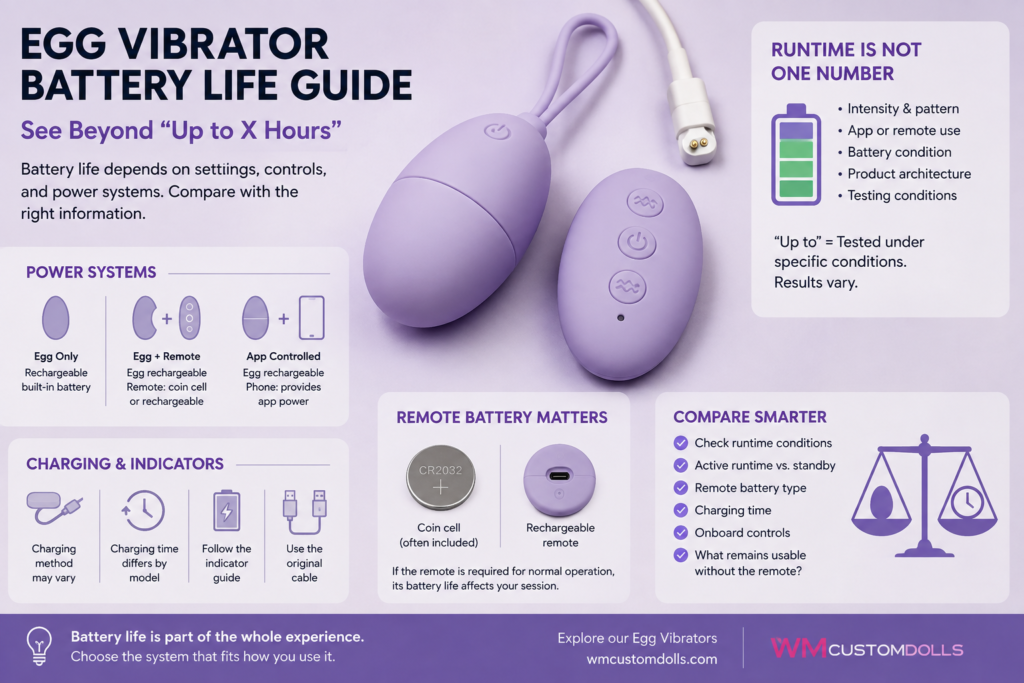
This matters even more with remote-control and app-controlled eggs because the vibrator may be only one part of the power system. A separate controller can have its own battery, while an app-controlled model also depends on a connected phone.
Buyers comparing current models can browse our Egg Vibrators and check the exact power and charging specifications for each SKU.
Why Is “Up to X Hours” Easy to Misread?
The phrase “up to” describes a maximum under some set of conditions. It does not automatically mean the product will deliver that same runtime in every session.
An egg vibrator may offer several vibration intensities, patterns, motors, control modes, or connected features. Depending on the design, changing those settings can change how quickly the battery is used.
The problem is that many short product descriptions publish the result without publishing the conditions.
A buyer sees:
“Battery life: up to 180 minutes.”
But useful follow-up questions remain:
Was that continuous operation?
Which setting was used?
Was a remote or app active?
Was the figure measured on a new, fully charged unit?
Does “battery life” mean active vibration time or include standby?
Does the device gradually reduce performance before shutting down?
Without that context, two products that both advertise “2 hours” may not have been measured in comparable ways.
This is why the word “up to” should not automatically be read as “typical runtime.”
For consumers, it is better used as an estimate. For retailers, the published figure should stay tied to the supplier’s current documentation rather than being rewritten as a guaranteed session length.
What Actually Changes Egg Vibrator Runtime?
Runtime can vary because the vibrator is an electronic system, not simply a battery attached to a motor.
The exact effect of each variable depends on the SKU, so retailers should avoid creating universal formulas such as “pattern A always uses more battery than pattern B.”
Still, several product details are worth checking.
Vibration setting
Different operating modes can place different demands on the motor and electronics. If a manufacturer provides runtime under a particular setting, keep that condition with the number.
Do not assume that the longest published runtime represents continuous use at the strongest setting.
Battery condition
Rechargeable batteries do not behave identically forever. Age, previous use, storage, and charging history can affect available capacity over time.
That means a brand-new review sample and a unit that has been sitting in inventory for a long period may not produce identical results.
Product architecture
Two egg vibrators with similar battery capacities can still have different runtimes because their motors, electronics, firmware, size, and control systems are different.
Battery capacity in mAh can be useful specification data, but it should not be treated as a direct “higher mAh = longer runtime” comparison across unrelated products.
Connected functions
If the product uses Bluetooth, an app, or another wireless system, the connection state should be included when runtime is discussed.
The exact effect varies by product. The important point is not to assume that a connected session and standalone operation represent identical test conditions.
For a broader explanation of remote and connected control systems, see our Remote Control Adult Toys guide.
Which Power System Does the Egg Vibrator Use?
Before comparing battery life, identify what is actually being powered.
Some egg vibrators use a built-in rechargeable battery. Others use replaceable batteries. Remote-control models may combine a rechargeable egg with a separate controller powered by a coin cell or another replaceable battery, while some products use rechargeable batteries in both components.
App-controlled models add another device: the user’s phone.
A useful product specification therefore separates the components instead of simply saying “rechargeable.”
| Battery detail | What buyers should check |
|---|---|
| Egg power | Rechargeable or replaceable battery |
| Charging method | Magnetic, pin, USB, or another documented system |
| Charging time | Supplier-stated time and conditions where available |
| Active runtime | Published or verified runtime and relevant conditions |
| Remote power | Rechargeable, coin cell, AAA, or another battery |
| Battery included | Whether replaceable remote batteries are supplied |
| Indicators | Charging, full, low-battery, or other documented signals |
| Standby | Listed separately from active runtime where provided |
This makes comparison much clearer.
A product can have good egg battery life while still creating inconvenience if the remote battery type is difficult to replace or poorly documented.
Likewise, a shorter active runtime may not be a problem for a buyer who values fast charging and simple local controls.
Battery life should therefore be judged as part of the complete product rather than as one isolated number.
What Changes When a Remote or App Is Involved?
Remote-control egg vibrators introduce an important question: what happens when the controller runs out of power before the egg does?
The answer depends on the product.
If the egg has an onboard button, basic functions may remain available even when the remote is unavailable. A remote-only design may depend much more heavily on the controller.
Neither architecture is automatically better, but the dependency should be clear.
For a remote-control model, check:
- How the egg itself is powered
- How the remote is powered
- Whether the remote battery is included
- Whether the egg has onboard controls
- Which functions remain available without the remote
- How low battery is indicated on each component
App-controlled eggs create a different situation.
The egg has its own battery, while the phone supplies the power for the app and phone-side connection. App connectivity, pairing, phone settings, and network-dependent features should therefore be treated separately from the egg’s active runtime.
A product page should not combine all of this into one vague sentence such as:
“Long-lasting battery with wireless app control.”
It is much more helpful to state what actually charges, how long charging takes, and which component the published runtime refers to.
How Should Charging Time Be Compared?
A long battery life sounds attractive, but charging time affects the real experience too.
A product that runs for several hours but takes a long time to recharge may suit one buyer perfectly and inconvenience another. A shorter-runtime product that charges relatively quickly may be more practical for a different routine.
The useful comparison is therefore:
runtime + charging time + control architecture
rather than runtime alone.
When reading a product page, check whether the charging time refers specifically to the egg or also to a rechargeable remote.
The charging cable matters too.
Egg vibrators may use magnetic connectors, pin-style charging, USB-based designs, or another proprietary connection. Confirm whether the correct cable is included and whether replacements are available if it is lost.
Do not assume that two magnetic cables that look similar are interchangeable.
Charging indicators are another useful but often overlooked detail.
The manual may explain whether an LED:
- Flashes while charging
- Changes color
- Becomes steady when full
- Indicates low battery
- Turns off when charging is complete
Those behaviors vary by model, so product copy should follow the actual instructions rather than using one generic LED description across an entire category.
For general information about charging systems and water-care claims, see our Waterproof and Rechargeable Adult Toys guide.
Why Are Standby Time and Active Runtime Different?
Some connected products publish both battery life and standby time.
These numbers describe different things.
Active runtime refers to the period in which the device is actually operating under the stated conditions. Standby refers to the time the electronics can remain idle or ready without performing the same level of active work.
A long standby figure therefore does not mean the vibrator can run continuously for that many hours.
This distinction becomes particularly important on app-enabled products, where a manufacturer may publish:
- Active battery life
- Standby time
- Charging time
as three separate specifications.
Retailers should keep them separate on the PDP.
Combining a large standby number with a smaller active-runtime number under one general “battery life” heading can easily create unrealistic expectations.
How Should Buyers Compare Two Egg Vibrators Fairly?
If two products list different battery-life figures, do not immediately assume the larger number means the better product.
First check whether the figures describe comparable situations.
Suppose one listing gives:
“Up to 3 hours.”
Another gives:
“Approximately 90 minutes.”
The second product may simply be giving a more conservative or differently measured figure. Without test conditions, the numbers alone cannot explain the difference.
A better comparison asks:
What setting or operating condition does the figure refer to?
Is the product standalone, remote-controlled, or app-controlled?
Is the published number active runtime or standby?
How long does it take to charge?
What power source does the remote use?
Are onboard controls available if the controller is unavailable?
Are replacement charging cables easy to obtain?
These questions move the comparison away from marketing maximums and toward actual usability.
For many consumers, the “best” battery life is not the largest possible number. It is enough runtime for their normal use combined with charging and controls that are easy to manage.
What Battery Information Should Retailers Publish?
Retailers do not need to run laboratory battery programs for every SKU.
They do need to avoid making the supplier’s claim stronger than the available evidence.
If the current manual or specification states “up to 120 minutes,” publish that wording unless you have another defined and reliable basis for changing it.
If the supplier provides test conditions, keep them.
If the conditions are not available, avoid rewriting:
“Up to 120 minutes”
as:
“Runs for 2 hours every charge.”
Those sentences do not mean the same thing.
A strong egg vibrator PDP can include:
- Power type
- Charging method
- Approximate or supplier-stated charging time
- Runtime using the supplier’s current wording
- Remote battery type where applicable
- Whether the remote battery is included
- Onboard controls
- Charging and low-battery indicators
- Cable included
- App or remote-control note where relevant
For private-label products, these details should agree across the PDP, box, instruction insert, and actual production unit.
This is especially important when a supplier updates a battery, remote, charging cable, or control system. Old runtime copy should not automatically remain on the product page if the underlying SKU has changed.
What About Rechargeable Eggs That Sit in Inventory?
Retailers should not assume that every rechargeable product will arrive months later with exactly the same charge state it had when packed.
For unsold stock, follow the battery or product supplier’s storage guidance rather than applying one universal charging interval across every egg vibrator.
Before shipping older inventory, a practical power-on and charging check can help confirm that the device and any included controller behave as expected.
There is no need to publish a fixed maintenance schedule unless the supplier actually provides one.
This keeps inventory guidance specific to the battery system instead of turning a general blog recommendation into an unsupported rule.
FAQ
How Long Does an Egg Vibrator Battery Usually Last?
There is no single standard runtime. Battery life varies by SKU, battery system, operating mode, control architecture, and the conditions behind the published figure. Use the manufacturer’s stated runtime as an estimate rather than assuming every egg will last the same number of hours.
Why Does My Egg Vibrator Die Faster Than the Advertised Runtime?
A published “up to” figure may represent conditions different from your own use. Operating settings, connected features, battery condition, and the exact product design can all affect runtime. Check whether the manufacturer explains how its runtime figure was measured.
Does App Control Reduce Egg Vibrator Battery Life?
The effect depends on the product architecture. If an app or wireless connection is active, that connection state should be considered part of the operating conditions, but the amount of additional power used varies by SKU.
Does a Remote-Control Egg Have Two Batteries?
Often, but not always. The egg may contain a rechargeable battery while the remote uses a coin cell or another battery. Some remotes are rechargeable. Check the exact product rather than assuming one architecture.
What Is a Good Battery Life for an Egg Vibrator?
There is no universal “good” number. A useful battery system provides enough runtime for the buyer’s intended use, reasonable charging time, clear battery indicators, and convenient control or charging options.
How Long Does an Egg Vibrator Take to Charge?
Charging time varies by model, battery, cable, and charging system. Follow the current product manual or supplier specification rather than using a category-wide estimate.
Is Standby Time the Same as Battery Life?
No. Standby time describes how long a device can remain idle or ready, while active runtime describes operating time under stated conditions. Keep the two figures separate when comparing products.
Conclusion
Egg vibrator battery life is more useful when it is treated as a documented runtime under specific conditions rather than a guaranteed number printed beside “up to.” Buyers should look at the complete power system: how the egg is powered, how long it takes to charge, whether a remote has its own battery, what remains usable without that remote, how charging and low-power indicators work, and whether the published figure describes active runtime or standby. For retailers, accurate wording is more valuable than turning the largest possible number into a headline claim. When two products are compared using the same questions, it becomes much easier to tell whether one genuinely offers a more practical battery system or simply advertises a bigger number. Browse our Egg Vibrators or contact WMCustomDolls for wholesale selection, mixed orders, packaging, and private-label coordination.
Planning a Wholesale Order?
Share your product interests, estimated quantity and destination market with our team.
Request Wholesale Information