


Blog
Temperature Play With Glass and Metal Dildos: Why Product-Specific Limits Matter

Shiny glass and metal products are often described as suitable for warm or cool sensations, but those descriptions can become misleading when the exact material, coating, joins, accessories, or product instructions are unknown.
On this page 10 sections
Temperature play dildos require product-specific handling. Confirm the material and construction, inspect the product for damage, follow the exact model’s instructions, avoid extreme or rapid temperature changes, and stop if the temperature feels uncomfortable.
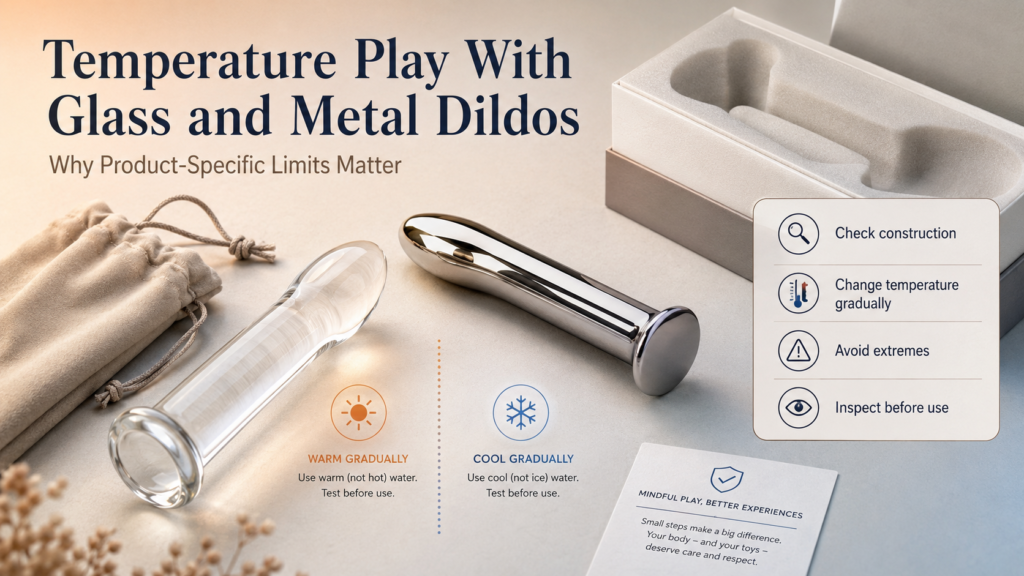
At WMCustomDolls, we recommend treating temperature play as a product-specific feature rather than a universal property of glass or metal. Wholesale buyers and retailers should confirm the exact SKU before adding temperature-related icons, instructions, or marketing claims.
Why Is Temperature Play a Product-Specific Claim?
Advice such as “warm it up” or “cool it down” sounds simple, but products that look similar may use different materials, coatings, joins, bases, attachments, or electronic components.
Temperature-play suitability depends on the exact product construction, current condition, and manufacturer instructions. A material name alone does not establish a universal temperature range or approved heating or cooling method.
The first step is to understand what is actually being handled.
A solid glass product is different from a coated metal product. A solid stainless steel body is different from a plated shell over another substrate. Mixed constructions may include suction bases, decorative inserts, bonded components, threaded joins, or removable accessories.
These differences matter because temperature changes can affect each component differently.
Before publishing a temperature-play claim, retailers should confirm:
- Main product material
- Surface coating or plating, if present
- Joined or bonded components
- Removable parts
- Suction bases or non-metal components
- Electronic modules or charging ports
- Supplier-approved care and temperature guidance
If these details are not available, it is better to omit the claim than to copy a generic instruction from another product.
How Do Glass, Solid Metal, Coatings, and Mixed Construction Differ?
Two products may look equally smooth and premium in a product photo while having very different construction and handling requirements.
Glass, solid metal, coated surfaces, and mixed constructions should not automatically share the same temperature guidance. Buyers should confirm the substrate, surface treatment, joins, accessories, and any electronics before approving instructions.
| Build type | What buyers should confirm | Main concern if unverified |
|---|---|---|
| Solid glass | Material description, visible condition, supplier guidance | Damage from abrupt changes or existing defects |
| Solid metal | Construction, finish, joins, care guidance | Rapid temperature transfer |
| Plated or coated | Substrate, coating type, care limits | Finish deterioration or discoloration |
| Mixed construction | Materials and joins for each component | Different component tolerances |
| With electronics | Water rating, removable parts, charging areas | Moisture or electronic damage |
Glass
Glass products should be inspected before temperature play. Chips, cracks, sharp edges, suspicious lines, or impact damage are reasons to stop using the product and request supplier or retailer guidance.
The term “glass” itself does not establish one universal temperature limit. Composition, geometry, thickness, decorative elements, and manufacturer instructions can differ between products.
Solid metal
Metal transfers temperature efficiently, which means relatively small temperature changes can become noticeable quickly.
That does not mean every metal dildo should follow the same routine. Alloy, construction, surface finish, joins, weight, and accessories still need to be considered.
Plated or coated products
A polished or colored surface may involve plating, coating, or another treatment over the underlying material.
The exterior layer may have different care requirements from the substrate, so buyers should not assume that a coated product can follow the same instructions as a solid untreated metal product.
Mixed-material products
When a product combines metal or glass with another base, attachment, adhesive, suction component, or removable part, the complete assembly should be considered.
The safest published instructions should follow the confirmed limits of the finished SKU rather than the broad material category.
Why Can Rapid Temperature Changes Be a Problem?
Temperature changes cause materials to expand or contract. The effect varies by material, construction, geometry, and starting condition.
Rapid temperature changes can place additional stress on glass, coatings, joins, adhesives, and mixed-material assemblies. The exact response depends on the product’s construction, which is why manufacturer-specific guidance should take priority over generic online advice.
Glass deserves particular caution when existing chips, cracks, scratches, or suspected damage are present. A product that has been dropped or damaged should not be used for temperature play simply because the defect looks small.
Metal presents a different issue: it can transfer heat or cold efficiently, so an external temperature change may feel stronger than expected.
Coatings, joins, accessories, and non-metal components can introduce additional limitations that are not obvious from photographs.
Electronic products require separate care. Do not immerse powered components or expose charging areas to water unless the exact model is specifically rated and instructed for that use.
The general rule is simple:
Avoid extremes, avoid sudden changes, and follow the instructions for the exact product.
Which Online Heating and Cooling Advice Should Be Avoided?
Many online shortcuts provide one temperature source or one amount of time for every glass or metal product.
That approach ignores differences in material, construction, mass, coatings, accessories, and starting conditions.
Avoid ovens, microwaves, stovetops, boiling, freezers, radiators, hair dryers, extreme heat or cold sources, and universal timed routines. Do not immerse electronic components unless the exact model allows it.
Examples of advice that should not be treated as universal instructions include:
- Microwaving a product
- Boiling or steaming it
- Placing it in an oven or on a stovetop
- Putting it in a freezer
- Applying direct ice or extreme cold sources
- Using a radiator, heat gun, or hair dryer
- Following fixed “30-second” or “five-minute” routines
- Submerging non-rated powered parts
- Assuming every glass or metal product has the same safe range
The problem is not simply whether one method has worked for another person.
Different products start at different temperatures, have different masses, and may contain components that are invisible from the exterior.
If the supplier does not provide model-specific guidance, retailers should avoid turning an internet shortcut into official product instructions.
What Should Manufacturer Instructions Actually Specify?
A useful instruction needs more information than a small “warm or cool” icon.
Model-specific guidance should define the relevant construction, approved handling method, exclusions, inspection requirements, gradual temperature changes, care after use, and clear stop conditions.
Useful instructions may cover:
Construction scope
Identify the main contact material, coatings, joins, removable components, and whether electronics are present.
Approved method
Explain what the exact SKU allows rather than simply saying “temperature play compatible.”
If water contact is allowed only for part of the product, that limitation should be clear.
Gradual handling
Temperature changes should be conservative and gradual.
Allow the product to reach a comfortable temperature gradually and follow the exact model’s instructions before use. Stop immediately if the temperature feels uncomfortable.
Explicit exclusions
Where applicable, instructions should clearly state restrictions such as:
- No microwave
- No oven or stovetop
- No boiling
- No freezer
- No direct high-heat source
- No immersion of powered or unsealed components
Product inspection
Before temperature play, inspect the product in good light.
For glass products, look for:
- Chips
- Cracks
- Sharp areas
- Suspicious lines
- Damage caused by impact
For metal or coated products, check for:
- Loose parts
- Peeling or damaged finish
- Sharp transitions
- Unusual surface changes
- Damaged joins
If anything appears questionable, do not continue temperature play.
Cleaning and storage
Follow the exact model’s approved cleaning, drying, and storage instructions.
For broader material and care information, see our adult toy materials guide.
Hard glass and metal products should also be stored separately from other hard items when the supplier recommends individual protection.
How Can Retailers Write Conservative Temperature Guidance?
Retailers do not need dramatic temperature claims to make a product description useful.
Good retailer copy explains only what has been verified for the SKU, avoids universal temperature ranges, and gives customers clear limits and stop conditions.
Suitable wording may include:
- “Follow the temperature guidance provided for this exact model.”
- “Avoid extreme or rapid temperature changes.”
- “Inspect the product before use and stop if damage is visible.”
- “Keep powered parts dry unless the model instructions specifically allow water exposure.”
- “Allow temperature changes gradually and stop if the product feels uncomfortable.”
Avoid broad claims such as:
- “All glass products are safe for hot water.”
- “Metal can always be placed in ice water.”
- “Safe from freezing to boiling.”
- “Microwave safe.”
- “Heat for 30 seconds.”
- “Works with any heating or cooling method.”
For B2B or private-label projects, temperature-play wording should be reviewed alongside:
- Supplier product specification
- Material and construction information
- Approved care instructions
- Packaging icons
- Product detail page
- Printed manual
- Customer-service guidance
These sources should not contradict each other.
Buyers can browse our wholesale dildo collection before requesting model-specific information.
When Should Temperature Play Not Be Promoted?
Sometimes the more accurate marketing decision is simply not to make the claim.
Do not promote temperature play when product construction is uncertain, supplier instructions are unavailable, electronics have unclear water or temperature limits, or the product shows damage or surface deterioration.
Temperature-play claims should be reconsidered when:
- Material or construction information is incomplete
- A coating or plating has unknown care limits
- Glass shows chips, cracks, or suspected damage
- Metal products have loose or damaged joins
- Adhesive or mixed-material components are not documented
- Electronics or charging areas have unclear water guidance
- Supplier instructions are outdated or inconsistent
- The current production unit does not match the approved sample
- Customer complaints suggest temperature-related finish or water-ingress problems
In these situations, remove temperature icons or claims until the product information is verified.
For private-label projects, this decision should happen before packaging is printed. Changing one sentence on a website is easy; correcting thousands of printed boxes is not.
What Should Wholesale Buyers Record?
Wholesale buyers should keep temperature-related claims inside the same controlled product file used for materials, construction, packaging, and care.
A useful record can include:
| Field | What to record |
|---|---|
| SKU | Exact model and revision |
| Material | Supplier-stated contact material |
| Construction | Solid, coated, mixed, or powered |
| Coating / plating | Confirmed surface treatment |
| Joins | Threaded, bonded, welded, or other construction |
| Electronics | Presence and applicable water guidance |
| Damage inspection | Approved check before sale or use |
| Temperature guidance | Current supplier instructions |
| Prohibited methods | Explicit exclusions |
| Packaging wording | Approved icons and copy |
| Manual revision | Current controlled version |
If a supplier changes the material, coating, join, accessory, electronic module, or product construction, the temperature-play claim should be reviewed again.
The same applies to repeat orders: an older instruction should not automatically be applied to a revised SKU.
FAQ
Can Every Glass Dildo Be Warmed in Hot Water?
No universal method should be applied to every glass dildo. Glass composition, geometry, decorative details, product condition, and manufacturer instructions can differ. Follow the guidance for the exact SKU and avoid using damaged glass products.
Should Metal Dildos Be Placed in a Freezer?
We do not recommend treating freezing as a universal method. Metal transfers temperature efficiently, and extreme cold can become uncomfortable quickly. Use only conservative, product-specific guidance supplied for the exact model.
How Should a Product Be Checked Before Temperature Play?
Inspect it under good light for chips, cracks, scratches, loose components, damaged coatings, or other visible changes. If anything appears questionable, do not continue temperature play and request retailer or supplier guidance.
Can Vibrating or Coated Products Follow the Same Routine?
Not automatically. Electronics, charging areas, coatings, joins, and mixed-material components may have different restrictions. Follow only the instructions for that exact product.
Conclusion
Temperature play with glass and metal dildos should be based on verified construction and model-specific instructions, not universal online recipes. Avoid extremes, change temperatures gradually, inspect the product before use, and do not publish claims that the supplier cannot support.
Planning a Wholesale Order?
Share your product interests, estimated quantity and destination market with our team.
Request Wholesale Information