


Blog
Inclusive Anal Toy Product Descriptions: How to Avoid Confusing Gendered Labels

Gendered labels can bury great options and frustrate shoppers.
Write anal toy product descriptions with function-first labels, clear dimensions, base/handle notes, and concise care wording. Use “Prostate Toys” as a functional category, not a gender tag, and keep language neutral and consistent across PDPs and packaging. We already organize Toys > Anal Toys for easier navigation.
At wmcustomdolls, we aim to make browsing and buying straightforward—first for shoppers, then for stores and private label partners who need consistent, inclusive product copy. Below is a practical framework to keep pages clear, accurate, and easy to compare across your Anal Toys assortment.
Why Gendered Labels Can Confuse Anal Toy Shoppers
“Men-only” and “women-only” tags often hide unisex designs.
Most anal toys are chosen by function, fit, size, base/handle, and vibration style—not by gender. Gendered labels can send shoppers to the wrong page and increase pre-sale questions.
A customer searching for a slim, tapered plug with a stable base may not find it if it’s buried under “for women,” even though the design is universal. Likewise, angled or contoured designs may be marketed “for men” despite being purchased for their function by a wide range of buyers. The result is friction: shoppers scan more pages, abandon carts, or message support to decode labels that don’t reflect how the products are actually used. A function-first approach avoids this by focusing on dimensions, control points, and features; customers can compare what matters, faster. On our site, grouping Toys > Anal Toys helps buyers and teams visualize the category and plan assortments without identity-based detours, a structure that supports both retail browsing and private label planning when needed.
When “For Men” or “For Women” Labels Are Too Broad
Category labels should reflect how people actually compare products.
Plugs, beads, vibrating models, and beginner-friendly options are better described by shape, size, base/handle, and features than by gender. Use neutral copy so shoppers can self-select quickly.
Shoppers scan for: maximum diameter, insertable length, the neck/base or handle shape, and whether there’s vibration or remote control. When a PDP relies on “for women” or “for men,” that information is missing or buried. This forces readers to guess whether the product fits their needs. A clearer path is to publish a short spec table (dimensions and control points) plus a few bullet features. Use consistent copy blocks across your assortment so comparisons feel predictable. Align this wording on your PDPs with packaging and icons for stronger clarity at every step—consistent phrasing on page, box, and manual reduces confusion and returns, especially for larger assortments or private label lines.
Use Function-First Labels Instead
Shoppers find products faster with clear, inclusive categories.
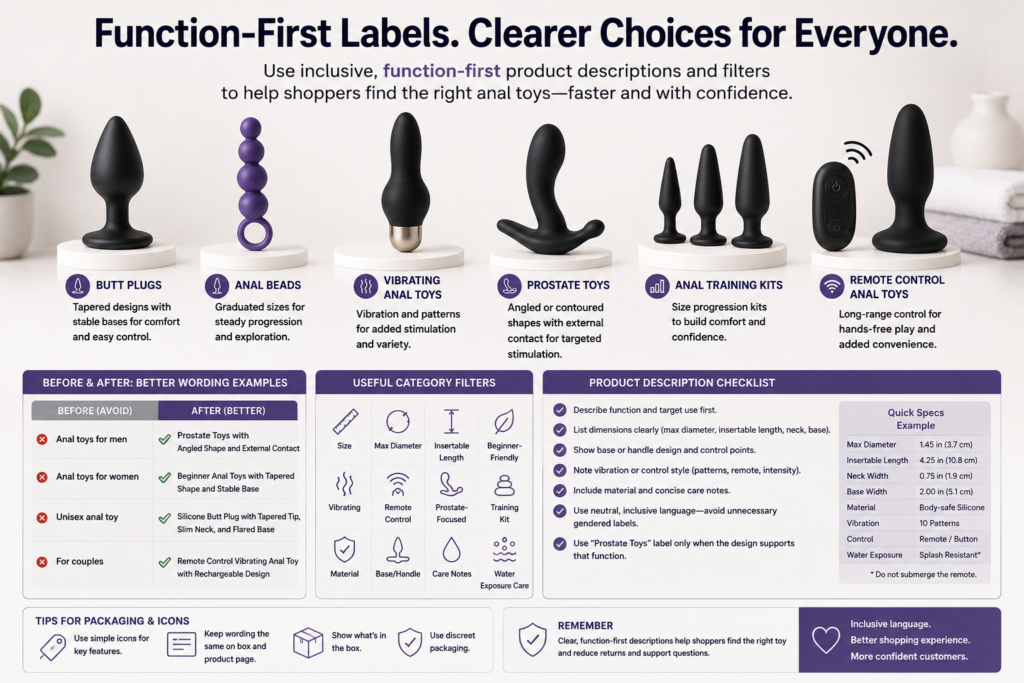
Recommended labels: Beginner Anal Toys, Butt Plugs, Anal Beads, Vibrating Anal Toys, Prostate Toys, Anal Training Kits, and Remote Control Anal Toys. Keep names short and relevant to how buyers compare.
These labels mirror real decision criteria. “Beginner Anal Toys” groups smaller, simpler designs with clear size specs. “Butt Plugs” and “Anal Beads” separate distinct formats shoppers evaluate differently—an approach we’ve used when planning category splits and filter sets for retail teams [3]. “Vibrating Anal Toys” and “Remote Control Anal Toys” help shoppers who prioritize controls and power. “Anal Training Kits” signals size progression across a set. “Prostate Toys” captures angled or contoured designs meant for targeted contact (details below). This naming strategy works for product cards, category pages, and PDP titles. It also aligns cleanly with packaging icons and spec tables when you’re building a consistent private label range, keeping online copy and on-box details in sync from the beginning.
When Prostate Toys Need a Separate Category
Make the label about function, not identity.
Use “Prostate Toys” when the design includes an angled/contoured shape and external contact features for targeted stimulation. Avoid treating all “anal toys for men” as prostate toys.
A separate Prostate Toys category makes sense when the silhouette and control points serve a specific function. This reduces clutter in general plug and bead pages and keeps comparisons clean. Keep descriptions neutral—explain the angle, neck/base, and any external contact point without implying the product is limited to one audience. For catalog consistency, mirror the same naming in your packaging and spec tables so the product’s purpose is clear in both digital and physical touchpoints. When brands maintain simple, neutral wording and repeat it across PDP, box, and manual, shoppers build trust faster and support tickets go down—an approach we emphasize in packaging and content alignment for retailers and private label teams.
Anal Toy Product Description Examples: Before and After
Small wording changes make product cards and PDPs clearer.
Replace broad gender tags with precise, function-first phrases that highlight dimensions, control points, and key features. Keep claims conservative and consistent with packaging.
- Before: “Anal toys for men”
After: “Prostate Toys with Angled Shape and External Contact” - Before: “Anal toys for women”
After: “Beginner Anal Toys with Tapered Shape and Stable Base” - Before: “Unisex anal toy”
After: “Silicone Butt Plug with Tapered Tip, Slim Neck, and Flared Base” - Before: “For couples”
After: “Remote Control Vibrating Anal Toy with Rechargeable Design” - Before: “All-purpose anal plug”
After: “Small Plug, 25 mm Max Diameter, 60 mm Insertable, Flared Base”
Use a consistent two-part structure on PDPs: a short feature line that names the format and key function (“Vibrating Plug with Remote”), followed by a compact spec block (insertable length, max diameter, neck/base or handle details, control method). Match these fields to your packaging icons and dimension table so shoppers see the same information online and in hand. This keeps communication tight and improves confidence during checkout—especially in a category where privacy and clarity matter.
Category Filters That Help Shoppers Decide
Filters should reflect how buyers actually compare items.
Useful filters: size, max diameter, insertable length, base/handle, beginner-friendly, vibrating, remote control, material, concise care notes, prostate-focused, and training kit. Keep filter names short and consistent across pages.
Size and geometry drive most comparisons. Make “max diameter” and “insertable length” easy to scan on both category cards and PDPs. Add “base/handle” as a filter with brief options like “flared base,” “anchor base,” or “handle/loop.” Use “beginner-friendly” for a curated group of smaller, simpler designs. “Vibrating,” “remote control,” and “charging type” help shoppers who care about controls and accessories. A “prostate-focused” filter isolates angled or contoured designs, while “training kit” collects size-progressive sets. Where possible, keep care notes short and conservative, aligning the wording across web copy and packaging. We find that aligning category labels and filters with your packaging icon set improves consistency across the buyer journey and reduces post-purchase questions—an approach we support through content and packaging coordination for retail and private label lines.
Inclusive Product Copy Checklist
Make every product page clear, neutral, and comparable.
Use function-first labels, list dimensions in a consistent format, show base/handle details, state vibration/control style clearly, keep care notes concise, avoid unnecessary gender labels, and apply a “Prostate Toys” label only when the design truly supports that function.
Quick checklist for your PDPs and packaging:
- Function-first name: “Butt Plug,” “Anal Beads,” “Vibrating Anal Toy,” “Prostate Toy,” etc.
- Dimensions: insertable length and max diameter, with a consistent table style.
- Control points: base/handle type, button or remote notes.
- Feature line: one sentence highlighting shape and key function.
- Care notes: short, conservative wording that matches packaging; avoid absolute claims unless validated.
- Filters/tags: beginner-friendly, vibrating, remote control, prostate-focused, training kit, material.
- Consistency: replicate the same wording and icons on PDP, box, and manual.
On our side, we maintain clear product menus—such as Toys > Anal Toys—to support straightforward browsing and assortment planning, and we help teams keep PDP wording aligned with packaging and manuals for reliable retail execution. For private label lines, we also support conservative claim matrices, privacy-focused packaging, and coordinated communication from inquiry to delivery so your content stays synchronized across assets.
FAQ
Are anal toys for men and women different?
Most format decisions are universal. Shoppers usually compare by size, shape, base/handle, and features rather than gender. Clear categories like Toys > Anal Toys and simple filters help people find what fits without identity-based detours.
What does “unisex anal toy” mean?
It means the design is not limited by gender—selection depends on dimensions, control points, and features. In practice, neutral wording and consistent specs on PDPs and packaging make comparisons easier for everyone.
When should a product be labeled as a prostate toy?
Use the label when the design includes an angled/contoured shape and external contact features for targeted function. Keep the language neutral and avoid implying that all “anal toys for men” are prostate toys.
How can adult toy stores avoid confusing gendered labels?
Adopt function-first categories—Butt Plugs, Anal Beads, Vibrating Anal Toys, Beginner Anal Toys, Prostate Toys, Anal Training Kits—and align filter names, PDP bullets, and packaging icons so shoppers compare by dimensions and features instead of gender.
What should an anal toy product description include?
A clear format name, compact dimensions (insertable length and max diameter), base/handle details, control style (button/remote), and concise care wording that matches packaging. Consistency across PDP, box, and manual improves trust and reduces questions.
Conclusion
Clear, inclusive anal toy product descriptions focus on function, fit, size, and features—not gender. Our team supports retailers and private label brands with category structure, conservative copy alignment, and packaging coordination from inquiry to delivery.
Planning a Wholesale Order?
Share your product interests, estimated quantity and destination market with our team.
Request Wholesale Information